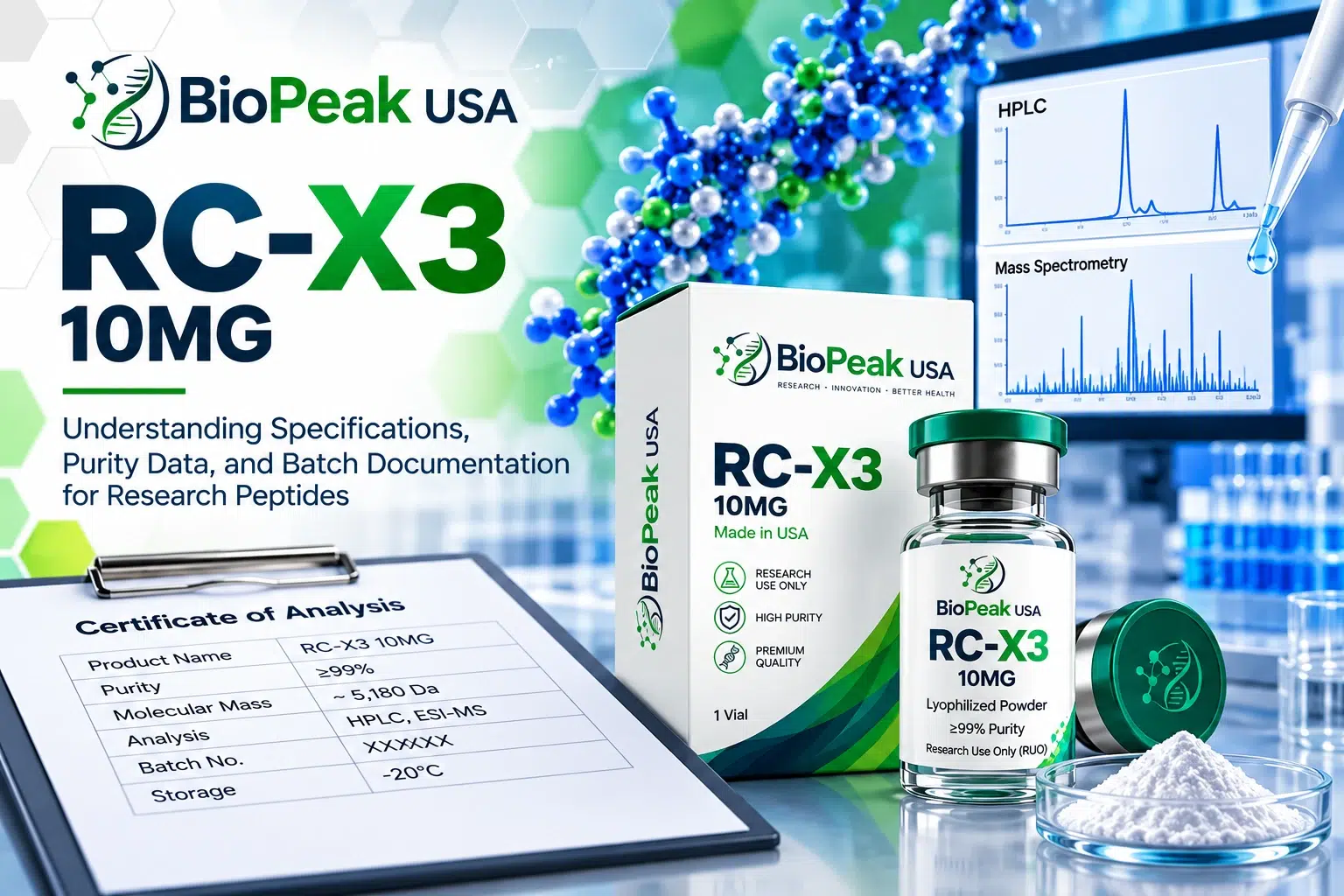
RC-X3 10MG explained through purity, molecular identity, HPLC and mass spectrometry verification, storage requirements, and batch-specific CoA documentation.
How to read a research peptide’s specifications, purity data, and batch documentation, using RC-X3 10MG as a worked example.
Two vials can carry the same name and differ in purity, identity, and paperwork. That is why the RC-X3 peptide is best evaluated through measurable details rather than a label: a listed molecular mass of approximately 5,180 Da, a stated purity of ≥99%, HPLC and mass spectrometry verification, and a batch-specific Certificate of Analysis (CoA). This guide explains what each detail means and how RC-X3 10MG, supplied by BioPeak USA as a lyophilized powder, fits into reference-standard and molecular research workflows.
Everything here concerns analytical characterization and documentation. Nothing in this article describes biological effects, and all materials discussed are intended for Research Use Only (RUO) in controlled laboratory settings.
Key takeaways
The RC-X3 peptide is listed by BioPeak USA as synthetic research material supplied as a lyophilized powder, with a stated purity of ≥99%.
Identity and purity answer different questions, so both HPLC and mass spectrometry data matter.
A batch-specific CoA ties the analytical results for the RC-X3 peptide to the exact vial, which supports traceability and reproducibility.
Non-natural amino acid substitutions change a peptide’s composition, so its identity is confirmed against that sequence’s own theoretical mass.
Unopened vials of the RC-X3 peptide are stored at -20°C according to product documentation.
Synthetic amino acid chain with non-natural substitutions, studied in multi-receptor research models
CAS number
2381089-83-2
Molecular formula
C267H404N72O80
Molecular mass
Approximately 5,180 Da
Stated purity
≥99%
Verification methods
HPLC, mass spectrometry, ESI-MS, Karl Fischer titration
Documentation
Batch-specific Certificate of Analysis
Storage
Unopened vials at -20°C
Category
Reference Standards
Research classification
Research Use Only (RUO)
The values above are taken from BioPeak USA’s product documentation. For current specifications and batch details, visit the RC-X3 10MG product page.
What is the RC-X3 Peptide?
The RC-X3 peptide, as described by BioPeak USA, is a synthetic amino acid chain with non-natural substitutions and is studied in multi-receptor laboratory research models. It is supplied as a freeze-dried powder for laboratory research only.
Two features shape how this material is described in documentation. First, it is synthetic, meaning it is assembled chemically in a defined sequence rather than isolated from a biological source, which is why its identity and purity can be verified analytically. Second, it contains non-natural substitutions, meaning residues outside the twenty standard amino acids, which makes its structural description more specific than that of a generic peptide.
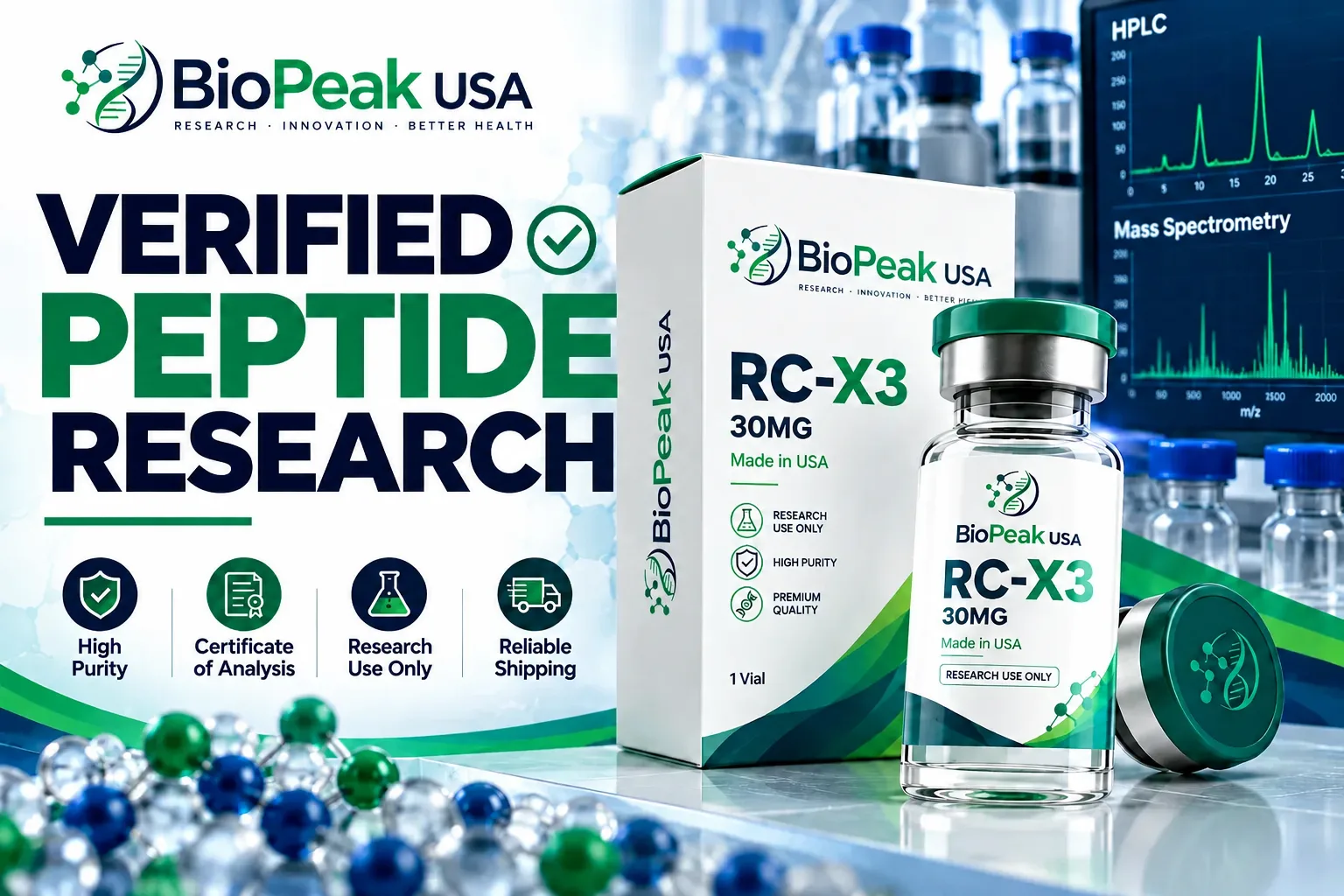
Explore RC-X3 peptide characterization through molecular structure, HPLC analysis, mass spectrometry, and batch-specific documentation for research use.
BioPeak USA lists the compound in its Reference Standards collection. The product information also connects it with molecular science research involving receptor structure and binding. Reference materials support identification, comparison, and analytical workflows, which is why documentation quality matters as much as the compound itself.
What Should Researchers Verify Before Choosing a Research Peptide?
Before selecting any research peptide, researchers typically verify five things: molecular identity, purity, physical form, analytical methods behind the reported numbers, and batch-specific documentation. The table below shows how each checkpoint maps to what BioPeak USA documents for RC-X3 peptide.
Checkpoint
Why It Matters
RC-X3 10MG Documentation
Molecular identity
Confirms the material corresponds to the expected compound
CAS number, molecular formula, and mass are listed; mass spectrometry verification
Purity
Shows the proportion of the target compound among detectable components
Stated purity of ≥99% by HPLC
Physical form
Affects storage, handling, and how the quantity is interpreted
Lyophilized powder with moisture testing by Karl Fischer titration
Analytical methods
Indicates how the reported results were generated
HPLC, mass spectrometry, ESI-MS, and Karl Fischer titration
Batch documentation
Links results to the exact vial used in an experiment
Batch-specific Certificate of Analysis
This checklist applies to any research material, not only this one. Its practical value is that a compound documenting every checkpoint gives a laboratory a clearer starting point than one described by name and quantity alone. It also has limits: documentation describes the material, but it does not replace laboratory verification steps or protocols.
RC-X3 10MG Specifications and Analytical Profile
BioPeak USA lists the RC-X3 peptide as a 10MG quantity of lyophilized powder with CAS number 2381089-83-2, molecular formula C267H404N72O80, and an approximate molecular mass of 5,180 Da. The stated purity is ≥99%, with HPLC and mass spectrometry used as verification methods. ESI-MS and Karl Fischer titration are testing methods.
How HPLC and Mass Spectrometry Complement Each Other
High-performance liquid chromatography (HPLC) separates components of a sample and produces a chromatographic profile, which is used to evaluate its purity. Mass spectrometry measures mass-charge information that supports molecular identification, and electrospray ionization mass spectrometry (ESI-MS) is a common approach for peptides. Because each method answers a different question, reporting both gives a fuller picture than either alone.
Neither method proves every property. A high HPLC purity value does not confirm identity, and a matching mass does not describe the full impurity profile. This is why peptide purity and identity are treated as separate considerations, and why complete characterization draws on more than one measurement.
Moisture Content and the Lyophilized Format
Lyophilized materials can retain small amounts of residual moisture. This affects how a stated quantity should be interpreted and how the material behaves in storage. Karl Fischer titration is a standard method for quantifying water content, and BioPeak USA lists it among the tested methods for RC-X3 10MG.
Reading a Peptide COA
A peptide COA is a batch-specific document that records analytical results for the exact material supplied. For RC-X3 peptide, BioPeak USA states that each batch is accompanied by a CoA containing identity and purity results. Researchers typically confirm that the batch number on the document matches the vial. They also confirm that both identity and purity results are present, and that analytical methods are disclosed.
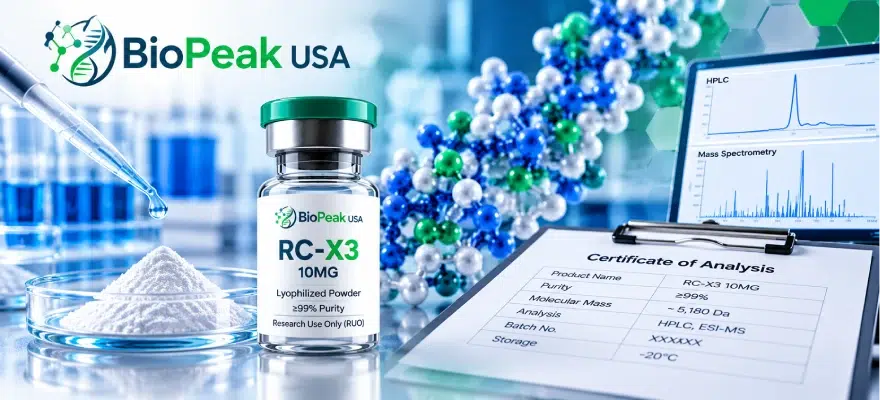
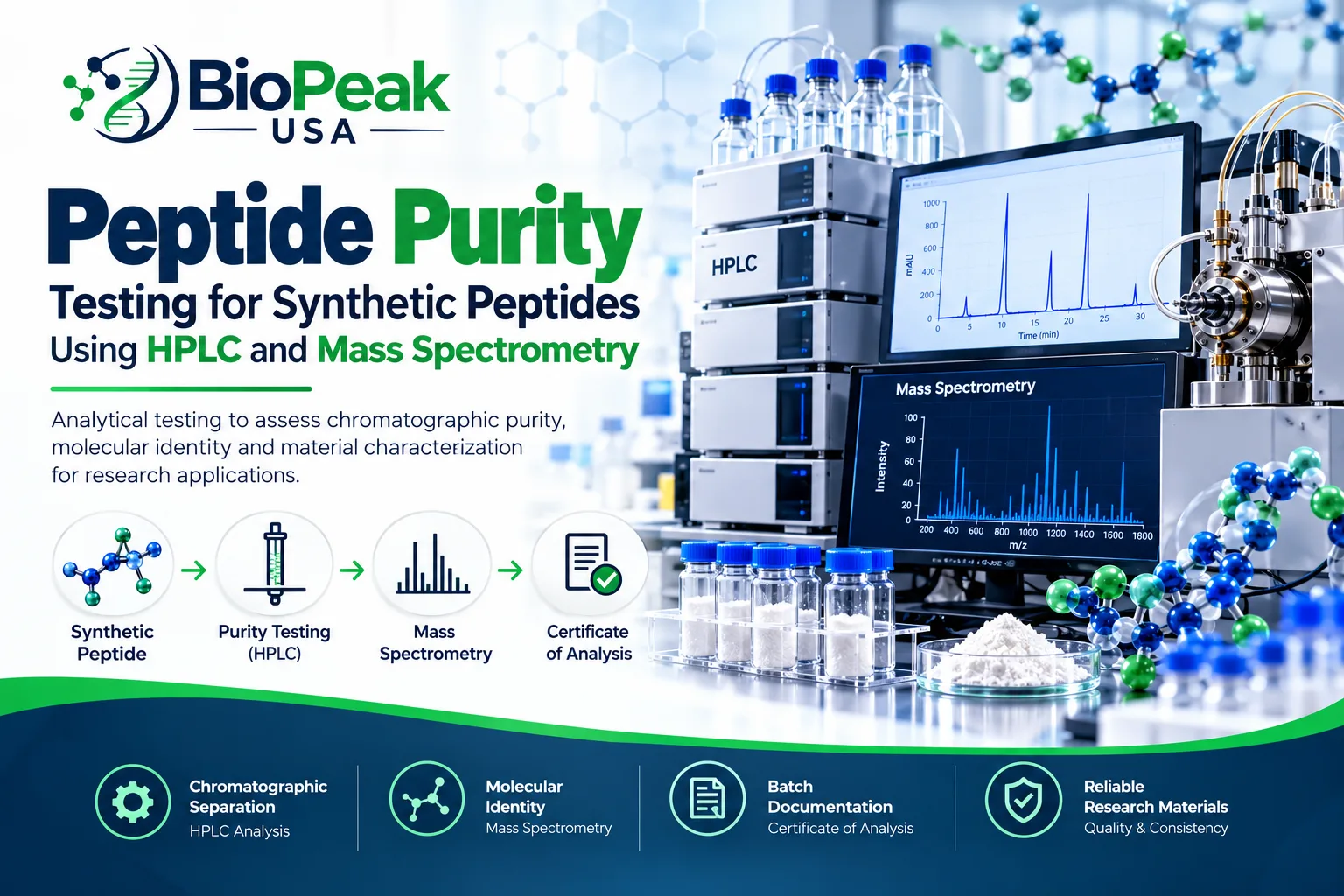
Understanding RC-X3 10MG peptide specifications, HPLC purity analysis, molecular identity, and batch-specific Certificate of Analysis documentation.
Why Non-Natural Substitutions Matter for Characterization
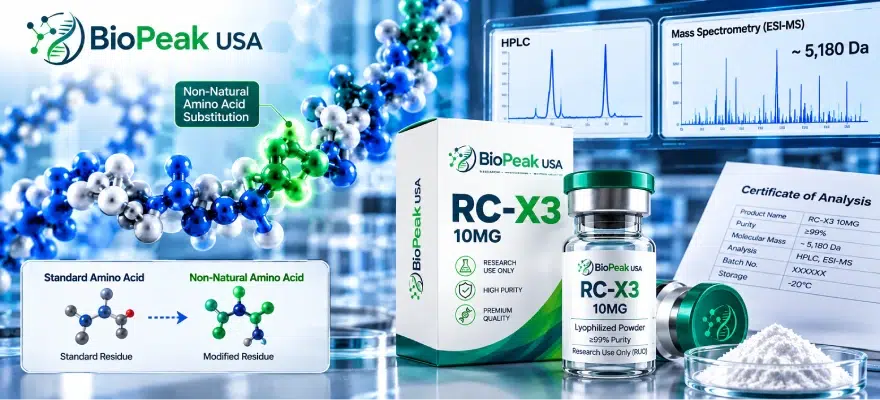
Synthetic peptide research can involve altered residues or non-natural amino acids. These changes alter the molecular composition and therefore the expected mass. Identity is confirmed against the theoretical values for that specific sequence rather than against a generic peptide.
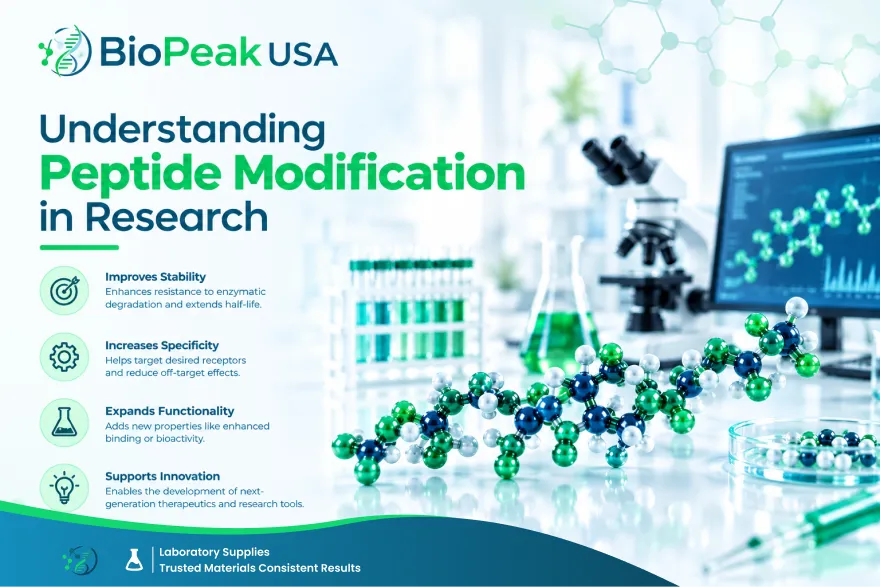
For RC-X3, structural description and mass data are especially relevant. Readers who want the underlying chemistry can explore BioPeak USA’s guide to peptide modification, which covers terminal changes, conjugation, and amino acid substitution.
Where RC-X3 Fits into the BioPeak USA Research Library
Peptide research covers several distinct areas, and treating them interchangeably creates confusion. Synthesis assembles amino acid residues in a defined order, purification removes byproducts, characterization confirms identity and purity, and documentation ties those results to a specific batch. The RC-X3 peptide sits at the characterization and documentation end of that chain.
For materials, the Molecular Science collection provides a broader category context, while the Reference Standards collection focuses on reference-oriented research materials.
Storage and laboratory handling
According to BioPeak USA’s product documentation, unopened vials of the RC-X3 peptide should be stored at -20°C for long-term stability. Laboratory users should follow their own safety procedures and the guidance provided in the product documentation. Institutional SOPs take precedence where requirements differ.
Storage conditions are also part of effective recordkeeping. Researchers can pair the batch CoA with internal laboratory records so that storage, handling, and material identification can be traced to a specific vial.
Next Step: Review the RC-X3 10MG Documentation
Researchers who have worked through the checklist above can compare it directly with the documentation for the RC-X3 peptide in the full RC-X3 10MG specifications, which list the analytical profile and the documentation supplied with each batch. The fastest way to evaluate any research peptide is to place its documentation next to a checklist and see which checkpoints are answered.
Questions about analytical documentation can be directed to BioPeak USA’s Certificate of Analysis resource. As with every product discussed here, RC-X3 10MG is intended for research use only.
Frequently Asked Questions
What is the RC X3 peptide?
BioPeak USA describes RC-X3 10MG as a synthetic research compound supplied as 10MG lyophilized powder. It is described as containing non-natural substitutions and studied in multi-receptor laboratory models.
What is RC-X3’s molecular mass?
The listed molecular mass is approximately 5,180 Da, and the listed molecular formula is C267H404N72O80. Researchers should confirm both values against the batch CoA.
How is the RC-X3 10MG analyzed?
Product information identifies HPLC and mass spectrometry as verification methods. ESI-MS and Karl Fischer titration are also listed among the testing methods.
Does the RC-X3 10MG come with a Certificate of Analysis?
Yes. BioPeak USA states that each batch is supplied with a batch-specific Certificate of Analysis containing identification and purity results.
What is the stated purity of RC-X3 10MG?
BioPeak USA lists a stated purity of ≥99%, with purity and identity checked using HPLC and mass spectrometry.
Is the RC-X3 10MG intended for human use?
No. It is sold strictly for laboratory and scientific research and not intended for human or animal use.
Conclusion
The RC-X3 peptide is best understood through documented, measurable characteristics: a synthetic structure with non-natural substitutions, a listed molecular mass, a stated purity of ≥99%, HPLC and mass spectrometry verification, and a batch-specific CoA. Reproducible laboratory work depends on knowing exactly what material is being studied, and this documentation makes that possible.
Researchers ready to compare these details firsthand can review the RC-X3 10MG listing alongside BioPeak USA’s Reference Standards and Molecular Science collections.
Table of references
Resource
Publisher
Use in This Article
Link
PubChem
NCBI / NIH
Chemical, structural, and identification information for amino acids and peptides.
All materials referenced in this article are discussed strictly in the context of laboratory and scientific research and are classified as Research Use Only (RUO). They are non-medicinal research materials and are not intended for human or veterinary use, clinical administration, or therapeutic application. Handling should be limited to qualified laboratory personnel working according to applicable institutional policies, laboratory procedures, and regulatory requirements.