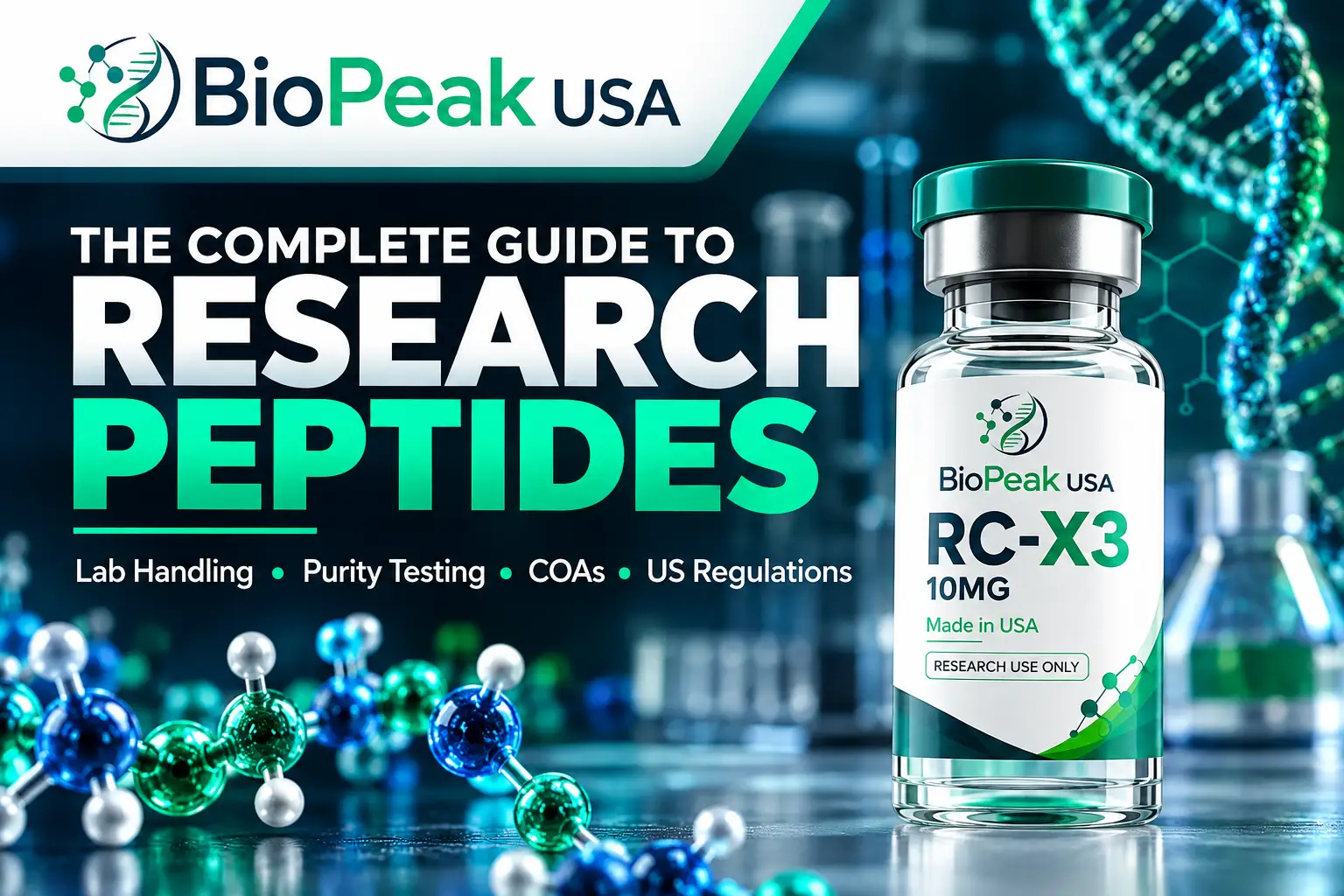
The Complete Guide to Research Peptides
Introduction to Research Peptides
Research peptides are short chains of amino acids that laboratories use as reference materials in in vitro studies. Since 2023, interest in these compounds has grown sharply. As a result, researchers now face a flood of confusing, low-quality information about handling, testing, and applicable rules.
This guide brings together answers to 30 common research questions. For example, you will learn about lyophilized peptide storage, Certificates of Analysis, and the meaning of “99% purity.” It also reviews published studies on widely discussed compounds and summarizes the US regulatory landscape in 2026.
Every product discussed here is sold for research use only. Nothing in this guide is medical advice or a guide to human or animal use.
What this guide covers
- Part 1: Lab handling, reconstitution and storage
- Part 2: Quality, purity and testing
- Part 3: The most-studied research compounds
- Part 4: Legal and regulatory questions
- Part 5: Peptide basics and 2026 trends
- Quick FAQ
Research Peptides: Lab Handling, Reconstitution and Storage
1. How do you reconstitute peptides with bacteriostatic water?
Reconstitution means dissolving a freeze-dried (lyophilized) peptide powder in a liquid for use in an assay. In many laboratory workflows, researchers choose bacteriostatic water because its preservative supports repeated vial access. However, the appropriate diluent always depends on the compound and the validated laboratory protocol.
A typical bench procedure looks like this:
- Let the sealed vial reach room temperature so moisture doesn’t condense inside it.
- Wipe the rubber stopper of both vials with an alcohol swab.
- Draw the planned volume of diluent with a sterile syringe.
- Add the liquid slowly down the inside wall of the vial, not directly onto the powder.
- Swirl gently or roll the vial until the powder dissolves. Avoid shaking, because vigorous movement may damage some peptides.
- Label the vial with the compound, concentration, date, and lot number.
Always follow your facility’s validated SOP. Some peptides dissolve poorly in water and need a different solvent, which is usually noted on the COA or product page.
2. How long do peptides last after mixing?
After reconstitution, some peptides may remain stable for a limited period at 2–8°C. However, the practical window varies with the sequence, diluent, and frequency of vial access. Compounds containing methionine, cysteine, or tryptophan may oxidize faster. For that reason, consult the lot-specific storage guidance on the COA instead of relying on a universal timeframe.
3. Do peptides need to be refrigerated?
The right conditions depend on the form.
| Form | Short term | Long term |
|---|---|---|
| Lyophilized powder (sealed) | Room temperature for days; 2–8°C for weeks | −20°C or colder, dry and dark |
| Reconstituted solution | 2–8°C | Split into aliquots and freeze at −20°C |
Light, heat, and moisture can accelerate degradation. Therefore, keep vials in their original packaging and away from direct light, while following the storage range specified for that compound.
4. Can you freeze reconstituted peptides?
Yes, where the validated protocol permits it; however, minimize freeze-thaw cycles. Repeated cycles may degrade a peptide or cause clumping. Instead, divide the solution into single-use aliquots and store them at a temperature supported by the compound-specific protocol. As a result, you can thaw only the amount required for each experiment.
5. What is the difference between bacteriostatic water and sterile water?
Both liquids are sterile; nevertheless, they serve different purposes and are not automatically interchangeable.
| Bacteriostatic water | Sterile water | |
|---|---|---|
| Preservative | 0.9% benzyl alcohol | None |
| Use | Multi-access vials | Single use, then discard |
| Shelf life once opened | Commonly up to 28 days | Use immediately |
| Best for | Peptides accessed repeatedly over days or weeks | Single preparations, or peptides sensitive to benzyl alcohol |
For workflows that require repeated vial access, bacteriostatic water may be a practical option when the protocol permits it. BioPeak USA stocks BAC water in 3 mL, 10 mL, and 30 mL sizes.
6. Why are peptides shipped as powder (lyophilized)?
Peptides often degrade faster in liquid form. Freeze-drying removes water and can help the powder remain stable for months or years under suitable cold, dry storage conditions. In addition, the process makes shipping lighter and less sensitive to brief temperature changes.
7. What happens if peptides get warm during shipping?
Lyophilized peptides may tolerate brief periods at room temperature during transit, but stability varies by compound and formulation. By contrast, prolonged high heat—such as a parcel left in a hot vehicle for days—can cause degradation. When a shipment arrives, follow the supplier’s validated storage instructions. If the powder looks sticky or discolored, contact the supplier and compare the lot documentation before use.
8. How do you calculate peptide concentration in mg/mL?
To calculate the concentration, use this simple formula:
Concentration (mg/mL) = peptide amount (mg) ÷ diluent volume (mL)
| Peptide in vial | Diluent added | Concentration |
|---|---|---|
| 10 mg | 1 mL | 10 mg/mL |
| 10 mg | 2 mL | 5 mg/mL |
| 30 mg | 3 mL | 10 mg/mL |
| 50 mg | 5 mL | 10 mg/mL |
To convert mg/mL to µg/mL, multiply by 1,000; for example, 5 mg/mL equals 5,000 µg/mL. For greater accuracy, laboratories may also account for the net peptide content listed on the COA. That adjustment matters because the powder can contain counter-ions and residual water (see Question 10).
Related topic:Explore the next cluster: quality, purity and COA testing.
Research Peptides: Quality, Purity and Testing
9. How can you tell if a peptide is real or fake?
Appearance alone cannot confirm authenticity. Instead, review the documentation and test results before drawing a conclusion. In particular, look for the following signs:
- A lot-specific COA.The lot number on the COA should match the lot number printed on your vial. A generic COA with no lot number is a red flag.
- Both HPLC and mass spectrometry results.HPLC shows purity. Mass spec confirms the molecule is actually the one on the label.
- Third-party testing.Results from an independent lab carry more weight than in-house testing alone.
- A realistic price.Prices far below the market average often mean underdosed or mislabeled product.
- A traceable company.Look for a real US address, clear policies, and responsive support.
If in doubt, independent labs can test a sample from your vial.
10. What does 99% purity actually mean for peptides?
In most COAs, “99% purity” means HPLC detected the target peptide as 99% of the measured material. However, the remaining 1% may include related impurities, such as shortened or incomplete sequences from synthesis.
Purity is not the same as net peptide content. For example, a vial labeled 10 mg can contain peptide with 99% chromatographic purity while the powder itself contains a lower percentage of peptide by weight. The remainder may include counter-ions (often acetate or TFA salts) and residual water. Therefore, both measurements matter for accurate analytical work.
11. How do you read a peptide Certificate of Analysis?
A good COA has these sections. Check each one.
| Section | What to check |
|---|---|
| Product name and sequence | Matches what you ordered, including the amino acid sequence |
| Lot or batch number | Matches the number on your vial |
| Test date and lab | Recent, with the testing lab named |
| HPLC purity | A percentage, usually with the chromatogram attached |
| Mass spectrometry | Observed molecular weight close to the theoretical weight |
| Appearance | Usually “white lyophilized powder” |
| Quantity or net content | The measured amount in the vial |
| Signature | Signed by an analyst or QC manager |
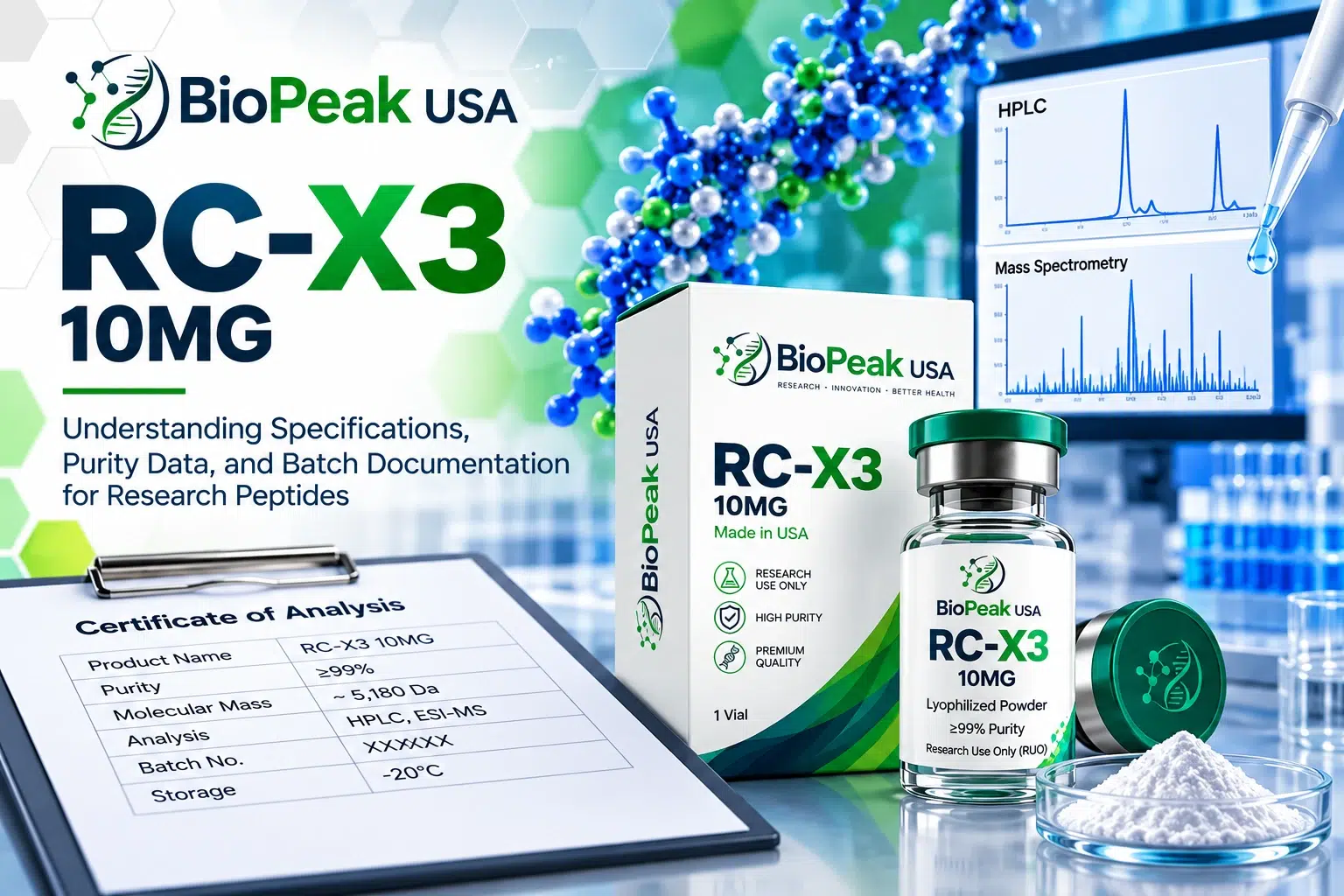
On the HPLC chromatogram, you want one tall main peak and only small peaks around it. On the mass spec report, the observed mass should match the expected mass within the lab’s stated tolerance. BioPeak USA publishes lot-level COAs on itsCOA testing page.
12. What is HPLC testing and why does it matter?
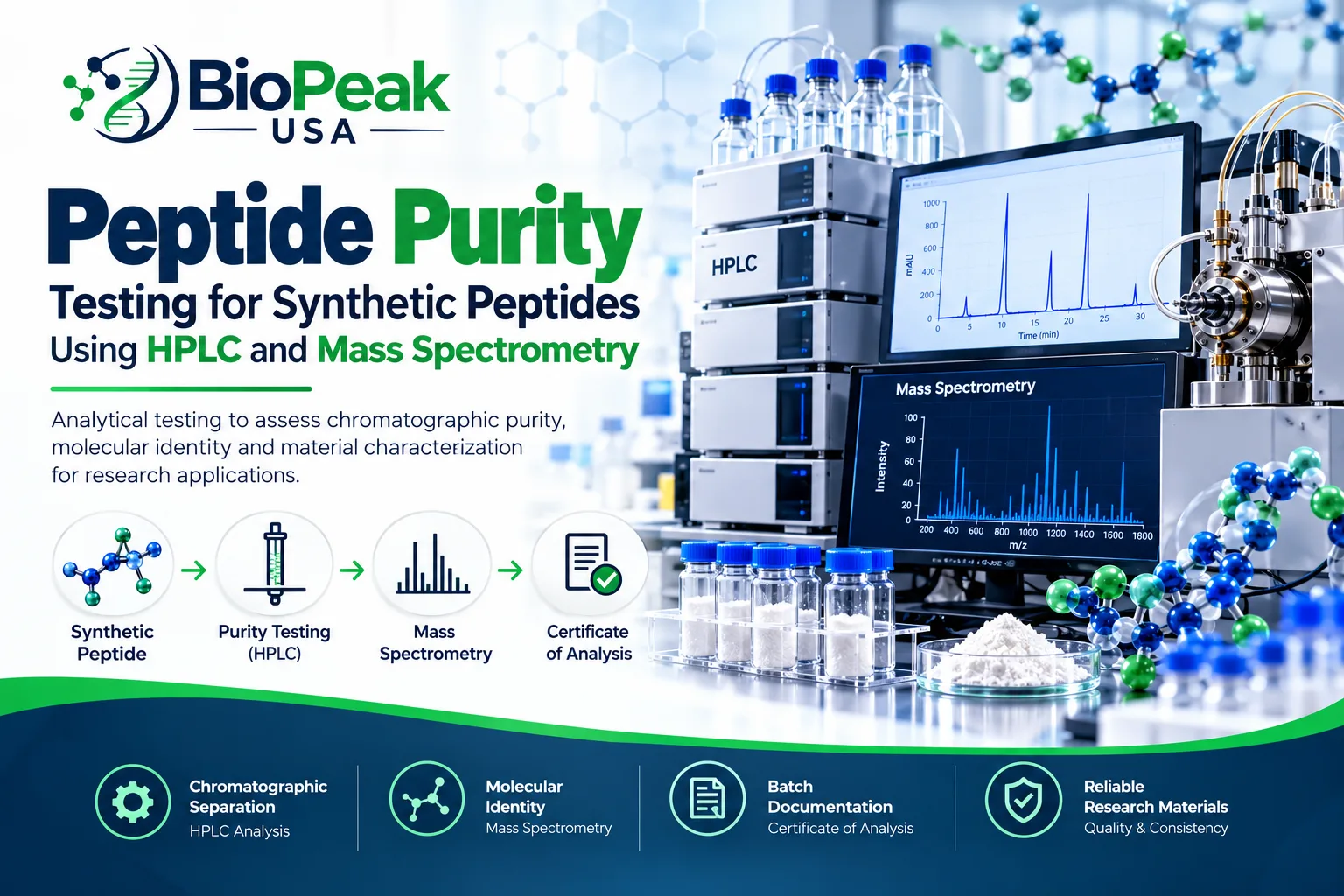
HPLC (high-performance liquid chromatography) moves a dissolved sample through a packed column under high pressure. Because molecules travel at different speeds, a detector records them as separate peaks. The lab then compares the main peak with the total peak area to calculate a purity percentage.
HPLC estimates a sample’s purity, but it cannot confirm molecular identity on its own. Consequently, laboratories often pair HPLC with mass spectrometry, which measures molecular weight and helps confirm the main peak’s identity. Used together, these methods provide complementary quality-control evidence.
13. What is the difference between research grade and pharmaceutical grade peptides?
| Research grade | Pharmaceutical grade | |
|---|---|---|
| Intended use | In vitro and laboratory research | Approved human medicines |
| Regulation | Sold as research-use-only reagents | Made under FDA drug cGMP rules with full approval |
| Testing | HPLC, mass spec, COA per lot | Full release testing, sterility, endotoxin, stability studies |
| Sold to | Labs and researchers | Pharmacies, by prescription |
Research-grade peptides may show high purity; however, that result does not make them approved drugs. In addition, suppliers do not necessarily manufacture or test these materials for human use.
14. What should you look for in a research peptide supplier?
- Lot-specific COAs with HPLC and mass spec data, available before you buy
- Independent third-party testing
- Clear research-use-only labeling and no health claims
- Proper cold, dry storage and fast, tracked shipping
- Transparent policies on returns, shipping, and privacy
- Responsive support that can answer technical questions
Health or weight-loss claims about research compounds should raise concerns about both product quality and legal compliance.
Related topic:Continue to the research compound profiles.
Research Peptides: The Most-Studied Research Compounds
The following summaries describe topics examined in laboratory and preclinical studies. Nevertheless, these findings do not establish effects in people or demonstrate clinical safety.
15. What is GHK-Cu and what does the research show?
GHK-Cu is a tripeptide made from glycine, histidine, and lysine that binds to a copper ion. Loren Pickart’s work identified GHK in human plasma in the 1970s. Since then, researchers have examined GHK-Cu in skin and wound-healing models.
Laboratory studies have examined GHK-Cu in models of collagen and elastin synthesis, fibroblast activity, and tissue remodeling. In addition, gene-expression studies have explored its relationship with broad sets of genes in cell models. Most of this work remains in vitro or in animal models.
16. What is MOTS-c?
The mitochondrial peptide explained
MOTS-c is a 16-amino-acid peptide encoded in mitochondrial DNA rather than in the cell nucleus. Researchers at the University of Southern California described it in 2015. Consequently, scientists classify it among the small group known as “mitochondrial-derived peptides.” For related product documentation, see theMOTS-c research materialpage.
Researchers have focused on MOTS-c’s role in metabolic signaling, including glucose handling and cellular responses to metabolic stress. Furthermore, studies have tracked changes in natural MOTS-c levels in relation to exercise and age. Even so, human clinical evidence remains very limited.
17. What is Epithalon and how is it studied in telomere research?
Epithalon (also spelled Epitalon) is a synthetic tetrapeptide with the sequence Ala-Glu-Asp-Gly. It was developed by Russian researcher Vladimir Khavinson, based on a natural extract from the pineal gland. TheEpithalon research materialpage provides related product information.
Researchers mainly examine Epithalon in cellular senescence studies. For example, several cell-culture experiments have explored its relationship to telomerase activity and telomere length. However, much of the published work comes from one research group, making independent replication an important research gap.
18. What is the difference between BPC-157 and TB-500?
| BPC-157 | TB-500 | |
|---|---|---|
| What it is | A 15-amino-acid synthetic peptide based on a sequence from a protein found in gastric juice | A synthetic fragment based on thymosin beta-4, a naturally occurring protein |
| Size | 15 amino acids | A short fragment of a 43-amino-acid protein |
| Main research focus | Tissue repair, gastrointestinal and blood-vessel models | Cell migration, actin regulation, wound models |
| Evidence base | Mostly animal and cell studies; very little human data | Mostly animal and cell studies; very little human data |
19. NAD+ vs NMN: what’s the difference?
NAD+ (nicotinamide adenine dinucleotide) is a coenzyme present in every living cell. It supports energy metabolism and DNA repair. Cells can convert NMN (nicotinamide mononucleotide) into NAD+. For a related example, see theBPC-157 research materialpage.
Researchers study NAD+ directly and examine NMN and NR (nicotinamide riboside) as compounds that may raise NAD+ levels. Importantly, NAD+ is not a peptide. Nevertheless, researchers often discuss it alongside peptides because both appear in longevity and cellular-energy research.
20. Why are BPC-157 and TB-500 often studied together?
These compounds involve different pathways that researchers associate with tissue repair. Studies examine BPC-157 in relation to blood-vessel formation and growth-factor signaling, while they examine TB-500 in relation to cell migration and actin. Therefore, researchers often compare them side by side in literature reviews and experimental blends.
21. What are bioregulator peptides?
Bioregulators are very short peptides, usually two to four amino acids long. Khavinson’s group proposed that they help regulate gene expression in specific tissues. Epithalon is the best-known example; the same group has also studied pinealon and thymalin. Still, this remains a specialized field, and a small number of institutions account for much of the published research.
22. What is a peptide blend and why do labs use them?
A peptide blend combines two or more peptides in one vial at fixed amounts. Laboratories may use blends to study several compounds in the same model and maintain consistent ratios across experiments.
A blend should include a COA that confirms the identity and amount of each component, not merely the total. BioPeak USA provides lot documentation for research formulations, including the Wolverine Blend and KLOW Blend. For exact composition details, review the relevant product page.
Related topic:Next, review the US legal and regulatory context.
Research Peptides: Legal and Regulatory Questions in the USA
This section provides general information rather than legal advice. Because regulations can change, consult the FDA’s current pages before relying on any detail here.
23. Are research peptides legal in the USA in 2026?
In the US, the legal status of a peptide product depends on its intended use, marketing, and applicable rules. For example, sellers cannot lawfully market unapproved products as FDA-approved drugs or make unauthorized treatment claims. Therefore, research-use-only labeling does not override other legal requirements.
In practice, marketing and intended use matter. A seller does not avoid scrutiny simply by labeling a product “for research use only” while advertising health benefits, dosing, or weight loss. The FDA and FTC have issued warning letters over such marketing. Reputable suppliers focus on research applications, avoid health claims, and clearly label products for research use only.
24. What does “research use only” mean on peptides?
Research use only (RUO) describes products intended for laboratory work, including in vitro experiments, analytical testing, and method development. However, the FDA has not approved these products as drugs or evaluated them for safety and effectiveness in people.
In practice, RUO products:
- Must not be used in humans or animals outside an approved research protocol
- Must not be marketed with health or treatment claims
- Are sold for use by qualified researchers and institutions
25. Why did the FDA move BPC-157 off the Category 2 list?
In 2023, the FDA placed BPC-157 and several other peptides inCategory 2of its interim list of bulk drug substances for compounding. Category 2 covers substances the FDA considers to raise significant safety risks, which meant compounding pharmacies could not use them.
The article’s cited timeline states that the FDA announced the removal of 12 peptides—including BPC-157, TB-500, MOTS-c, Epitalon, and injectable GHK-Cu—from Category 2 on April 15, 2026. It attributes the decision to withdrawn original nominations. According to that timeline, the change took effect on April 22, 2026; verify these dates against current FDA records before publication.
Removing a peptide from Category 2 does not, by itself, approve it or authorize compounding. Instead, the change may move the substance into a further review process:
| Date | What happened |
|---|---|
| 2023 | BPC-157 and other peptides placed in Category 2 |
| April 15, 2026 | FDA announces removal of 12 peptides from Category 2 |
| April 22, 2026 | Removal takes effect |
| July 23–24, 2026 | FDA advisory committee (PCAC) votes to recommend BPC-157, KPV, TB-500, MOTS-c, Epitalon and Semax for the 503A bulks list; DSIP is not recommended |
| Next | FDA must complete formal rulemaking before any of these can be compounded |
The reported committee votes were narrow: BPC-157, KPV, and TB-500 each passed 8–6 with one abstention. In contrast, FDA staff had recommended against adding any of the seven peptides. The article also reports that GHK-Cu was scheduled for review before the end of February 2027; confirm the current schedule before publishing.
These developments do not mean the FDA has approved the peptides as drugs. Research-use-only status also does not exempt a seller from other applicable laws.
26. What are FDA Category 1 and Category 2 peptides?
The FDA uses these categories in its interim policy for substances nominated for compounding under Section 503A. They address compounding policy; they do not, on their own, determine every legal requirement for research-use-only suppliers.
| Category | Meaning | Can pharmacies compound it? |
|---|---|---|
| Category 1 | Under FDA evaluation | Generally yes, while under review |
| Category 2 | Raises significant safety risks | No |
| Category 3 | Nominated without enough supporting information | No |
| 503A bulks list | Formally added through rulemaking | Yes |
A peptide’s category can change, as the article’s April 2026 timeline illustrates. Therefore, check the FDA’s current 503A categories page for the latest status.
Related topic:Continue to peptide fundamentals and research trends.
Research Peptides: Peptide Basics and 2026 Trends
27. What are peptides? A simple guide for beginners
Peptides are short chains built from amino acids, the same building blocks that form proteins. Specifically, chemical links called peptide bonds connect these amino acids. Although definitions vary by context, peptides often contain about 2 to 50 amino acids.
The body naturally produces thousands of peptides, including insulin, oxytocin, and many signaling molecules. Scientists also synthesize peptides in laboratories, often through solid-phase peptide synthesis. As a result, researchers can produce specific sequences for controlled experiments.
28. What are the most popular research peptides in 2026?
Based on search trends and research interest, these are the most-discussed compounds this year:
| Category | Compounds |
|---|---|
| Metabolic (GLP-1 family) | Semaglutide, tirzepatide, retatrutide |
| Tissue repair | BPC-157, TB-500 |
| Longevity and cellular | MOTS-c, Epithalon, NAD+ |
| Skin and cosmetic research | GHK-Cu |
| Inflammation research | KPV |
GLP-1 compounds lead search volume by a wide margin. Meanwhile, longevity and mitochondrial peptides are attracting growing interest, although trend claims should be supported with current data.
29. Peptides vs proteins: what’s the difference?
Primarily, the difference is size, although structure and production methods also vary.
| Peptides | Proteins | |
|---|---|---|
| Length | About 2–50 amino acids | Usually 50+ amino acids, often hundreds |
| Structure | Simple, often flexible | Folded into complex 3D shapes |
| Examples | Oxytocin, GHK-Cu, BPC-157 | Collagen, hemoglobin, enzymes |
| Lab production | Chemical synthesis | Usually made in living cells |
However, the cut-off is not exact. For instance, insulin contains 51 amino acids and is sometimes described as either a peptide or a small protein.
30. Why is peptide research growing so fast?
Several developments have converged to drive this growth:
- GLP-1 success.Approved peptide drugs for diabetes and weight management showed how powerful peptide signaling can be, which drew attention to the whole field.
- Cheaper synthesis.Automated synthesis and better purification have made high-purity peptides faster and cheaper to produce.
- Longevity research.Interest in aging biology has put compounds like MOTS-c, Epithalon and NAD+ in the spotlight.
- Regulatory attention.The 2026 FDA review of compounded peptides has made them a regular topic in news coverage.
Together, these changes have drawn more researchers into the field and increased demand for well-documented, high-purity reference materials.
Related topic:Review the quick FAQ for concise answers.
Research Peptides: Quick FAQ
How should lyophilized peptides be stored? For long-term storage, follow the compound-specific instructions and keep sealed vials dry and protected from light. Short periods at room temperature during shipping may be acceptable for some products; however, stability varies by formulation.
How long are reconstituted peptides stable? The usable period depends on the sequence, diluent, and handling conditions. Therefore, check the lot-specific COA and validated laboratory protocol rather than assuming a fixed number of weeks.
Is bacteriostatic water or sterile water better for peptides? The choice depends on the laboratory protocol and the compound. Bacteriostatic water contains a preservative, whereas sterile water does not; therefore, they are not interchangeable in every procedure.
What should a peptide COA include?A matching lot number, HPLC purity, mass spectrometry identity confirmation, test date, testing lab, and an analyst signature.
Does 99% purity mean the vial is 99% peptide?No. Purity measures how much of the detected material is the target peptide. The powder also contains salts and water, which is reported as net peptide content.
Are research peptides FDA approved? No. Research-use-only materials are not FDA-approved drugs. Instead, they are labeled for laboratory research, and their legal status depends on the product and its intended use.
Did the FDA approve BPC-157 in 2026?No. BPC-157 was removed from Category 2 in April 2026, and an advisory committee recommended it for the 503A bulks list in July 2026. Formal FDA rulemaking is still required, and it remains an unapproved drug.
Disclaimer: All products sold by BioPeak USA are strictly for in vitro laboratory and research use only. They are not for human or animal consumption, clinical use, or medical treatment, and have not been evaluated by the FDA. This article is for educational purposes and is not medical or legal advice.
Research Peptides: References and Scientific Resources
Regulatory sources:
-
- FDA: 503A bulk drug substance categories (updated April 22, 2026)
- Goodwin: FDA signals potentially evolving stance on peptide compounding
- McDermott Will & Schulte: PCAC backs majority of peptides in two-day meeting
- AJMC: FDA panel backs 6 peptides for compounding
- RAPS: FDA advisory committee backs two controversial peptides