How researchers design, build, and document a Peptide Library Synthesis instead of evaluating one sequence at a time.
Two laboratories can use the same phrase “peptide library” and mean different things: a small set of individually identified sequences, a spatially addressable array, or a large combinatorial mixture. That is why a peptide library is best evaluated through measurable details rather than a label: defined sequence variation, a stated synthesis strategy, HPLC and mass spectrometry verification, representation of members, and documentation that connects an experimental result to a defined sequence. This guide explains peptide library synthesis as a research methodology. It connects amino acid selection, peptide sequence design, synthetic methods, purification, analytical characterization, and experimental screening. Everything here concerns chemical synthesis, library architecture, and laboratory documentation. Nothing in this article describes biological effects. Materials discussed are intended for Research Use Only (RUO) in controlled laboratory settings.Key takeaways
- Peptide library synthesis is the controlled preparation of related peptide sequences so researchers can compare defined molecular variation inside one experimental framework.
- Identity and purity answer different questions. HPLC and mass spectrometry matter for library members the same way they matter for a single synthetic peptide.
- Library format—parallel synthesis, split-and-mix, peptide arrays, or one-bead-one-compound—determines whether each sequence is individually identifiable.
- Theoretical diversity is not the same as practical coverage. Synthesis capacity, representation, purification, and screening throughput limit what a library can answer.
- A useful library is documented: sequence design, synthesis record, analytical results, and—when discrete peptides are supplied—batch-specific Certificate of Analysis and testing information.
Table of contents
- Key takeaways
- Peptide library synthesis at a glance
- What is peptide library synthesis?
- What should researchers verify before building a library?
- How peptide library synthesis works
- Common library formats
- How library diversity affects research
- SPPS, purification, HPLC, and mass spectrometry
- Screening and data interpretation
- Factors that affect library quality
- Where this topic fits in the BioPeak USA research silo
- Limitations
- Next step
- Frequently asked questions
- Conclusion
- Table of references
Peptide library synthesis at a glance
| Element | Description |
|---|---|
| Topic | Peptide library synthesis for laboratory research |
| Purpose | Controlled collections of related peptide sequences |
| Typical chemical method | Solid-phase peptide synthesis (SPPS) |
| Common formats | Parallel synthesis, split-and-mix, peptide arrays, one-bead-one-compound |
| Sources of diversity | Amino acid identity, selected positions, length, termini, linear vs cyclic form, selected non-natural residues |
| Verification methods | HPLC, mass spectrometry, chromatographic profiling, sequence-appropriate identification |
| Documentation | Sequence list, synthesis record, analytical profiles; batch CoA when individual peptides are supplied |
| Research classification | Research Use Only (RUO) |
What is peptide library synthesis?
Peptide library synthesis is the controlled preparation of a collection of peptide sequences designed to provide systematic molecular variation for research. Each library can contain peptides that differ at one or more positions, allowing researchers to investigate how sequence changes relate to measurable laboratory observations. A peptide library may contain:- Multiple peptide sequences based on a common parent sequence
- Systematic substitutions at selected amino acid positions
- Different peptide lengths
- Natural or appropriately selected non-natural amino acid building blocks
- Linear or cyclic peptide structures
- Spatially separated peptides or mixtures, depending on format

What should researchers verify before building a library?
Before selecting a library strategy, researchers typically verify six checkpoints.| Checkpoint | Why it matters | What to look for |
|---|---|---|
| Research objective | Size and format must match the question | Sequence comparison, positional scan, array screening, or individual follow-up |
| Sequence design | Diversity without a design plan is noise | Fixed vs variable positions, allowed residues, length |
| Library format | Determines whether each member is identifiable | Parallel vials, mixtures, arrays, or bead-based members |
| Synthesis method | Controls bond formation and reagent removal | SPPS platform, protecting-group chemistry, split vs parallel workflow |
| Analytical verification | Confirms identity and purity are not assumed from the name | HPLC profiles, mass data, representation checks |
| Documentation | Ties results to the material used | Sequence list, batch identifiers, CoA for discrete peptides |
How peptide library synthesis works
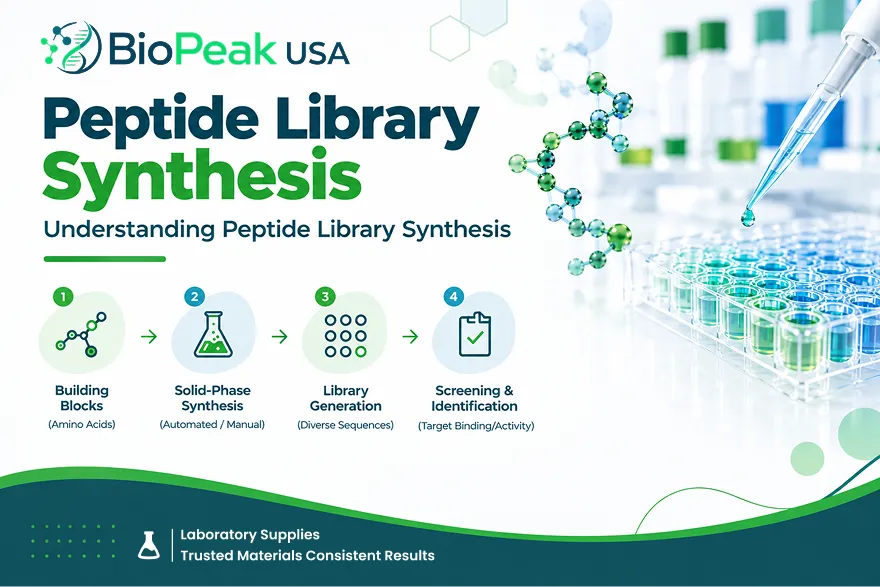
1. Define the research objective
Library construction starts with a defined question. Researchers decide what molecular variation needs to be investigated and what information the library should return: sequence comparison, positional substitution, molecular recognition assays, screening, or another laboratory question. A clear objective sets library size, peptide format, sequence design, and the analytical strategy.2. Design the peptide sequences
Sequence design determines which amino acids vary and which positions stay constant. A focused library may change only one or a few positions around a parent sequence. A broader combinatorial design can vary several positions and generate many more combinations. Library size grows quickly as positions and amino acid choices increase, so design has to balance sequence diversity against synthesis, characterization, screening, and interpretation.3. Select a synthesis strategy
Solid-phase peptide synthesis (SPPS) is an established chemical approach for constructing synthetic peptide libraries. In SPPS, a growing chain is assembled while attached to a solid support. Protected amino acid building blocks are added sequentially. Protecting-group chemistry allows controlled peptide-bond formation. For libraries, SPPS can be adapted to parallel synthesis, split-and-mix methods, and spatially addressable formats. The selected method depends on whether researchers need individually identifiable peptides, mixtures, bead-based libraries, arrays, or another configuration.4. Introduce sequence diversity
Sequence diversity is the defining feature of a peptide library. Researchers can vary:- Amino acid identity
- Selected sequence positions
- Peptide length
- Terminal modifications
- Selected structural features
- Natural or non-natural building blocks where scientifically appropriate
5. Cleavage and processing
After assembly, the synthesized material is processed to the intended peptide form. Depending on platform and format, that can include cleavage from the support, protecting-group removal, further chemical processing, and preparation for purification and analysis. Processing for a library is not identical to processing for a single research peptide. The workflow should match the experimental design.Common peptide library synthesis formats
Parallel peptide synthesis
Individual peptide sequences are prepared separately inside one overall workflow. Sequence identity for each member is clear, which simplifies comparison, purification, and characterization. This format is useful when researchers need a defined collection of individual peptides rather than a complex mixture.Split-and-mix synthesis
Supports are repeatedly divided and recombined so different building blocks can be introduced. The method can generate substantial diversity from a structured process. Mixture-based synthetic peptide combinatorial libraries were developed so large collections of free peptides could be screened in existing assay formats, with iterative resynthesis used to identify active sequences. Composition and representation still require care, because sequences may not occur at identical abundance.Peptide arrays
Peptides occupy defined locations on a surface or support. An experimental signal can be connected to a position and therefore to a sequence. Arrays are useful when many sequences need to be evaluated in a structured layout. Reviews of peptide-array methods describe SPPS-based preparation, in situ synthesis, immobilization chemistry, and detection as separate technical problems.One-bead-one-compound libraries
Individual beads can carry a particular peptide sequence. Split-and-mix on beads is often described as a one-bead-one-compound (OBOC) format: after enough mix-and-split cycles, a single bead theoretically carries one sequence. Analytical identification of selected members is part of the workflow, not an afterthought.How library diversity affects peptide research
If several amino acids can occupy each of several variable positions, the number of possible sequences increases rapidly. A theoretical library can become larger than the number of members that can realistically be synthesized, represented, screened, and analyzed. That creates a distinction between theoretical diversity and practical coverage. A library may describe a large sequence space while representing only part of that space in the laboratory. Researchers should weigh synthesis capacity, material availability, representation, screening throughput, and analytical identification before interpreting results. Library design is not a contest to make the largest possible set. The useful objective is diversity that matches the question and members that can be evaluated.Peptide library synthesis, SPPS, purification, and characterization
The chemical relationship can be written as: Amino acid building blocks → SPPS → sequence construction → library diversification → processing → purification → characterization → experimental evaluation SPPS is useful because assembly occurs on a solid support, so excess reagents and soluble byproducts can be separated during the workflow. Peptide synthesis is the broader process of constructing peptide molecules. Peptide library synthesis is the same chemistry applied to a controlled collection of related sequences. Researchers seeking broader background can review BioPeak USA’s synthetic peptide research resources for related concepts involving peptide synthesis, purification, and characterization. Synthesis alone does not establish the identity or quality of every member. Depending on format, relevant analytical approaches can include:- High-performance liquid chromatography (HPLC)
- Mass spectrometry (MS)
- Chromatographic profiling
- Molecular-mass analysis
- Sequence-specific methods appropriate to the material
How HPLC and mass spectrometry complement each other
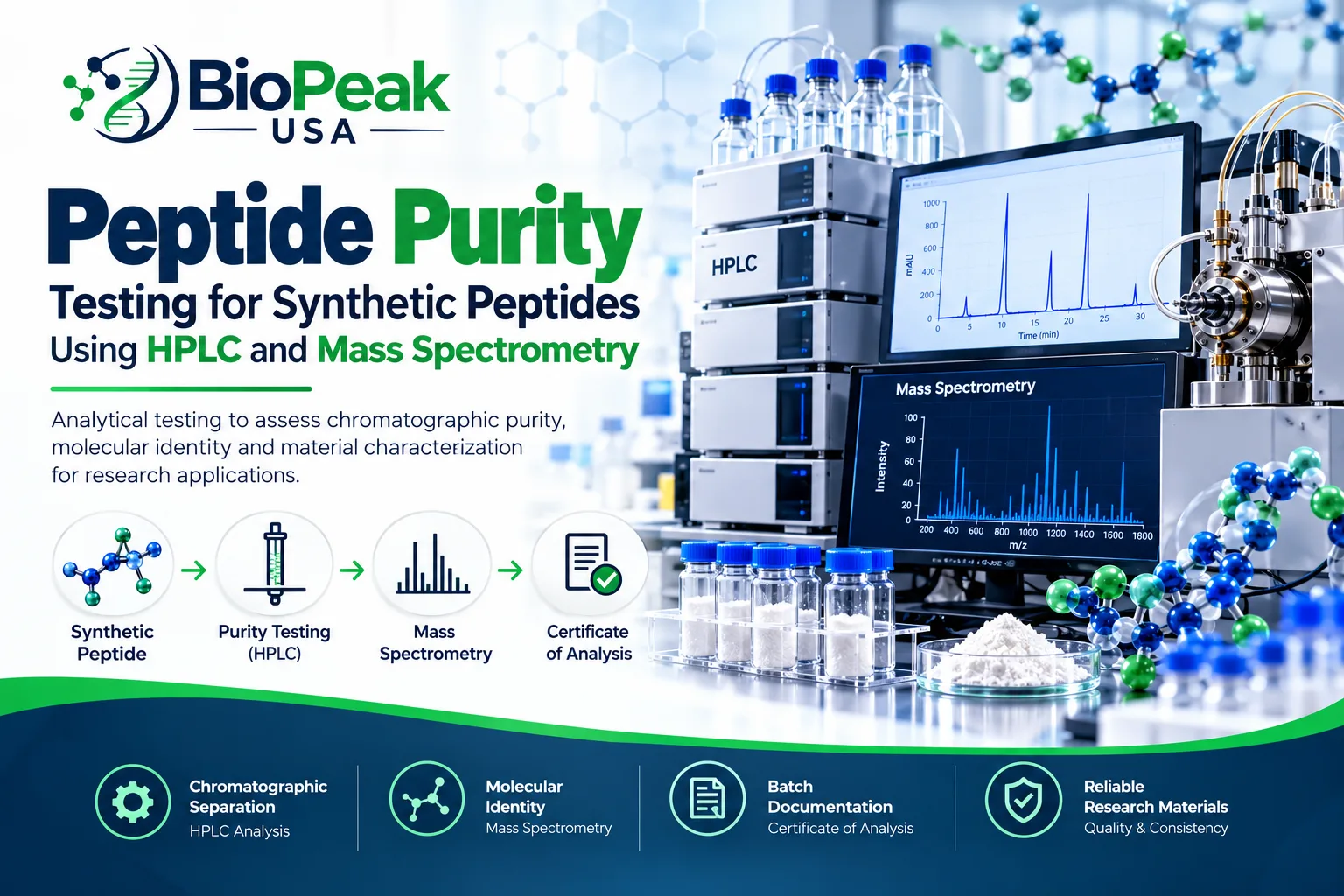
HPLC separates components and produces a chromatographic profile used to evaluate purity. Mass spectrometry measures mass-to-charge information that supports molecular identification. Each method answers a different question. Reporting both gives a fuller picture than either alone. A high HPLC purity value does not confirm identity. A matching mass does not describe the full impurity profile. Purity and identity are separate considerations. Complete characterization draws on more than one measurement.Reading documentation for discrete library members
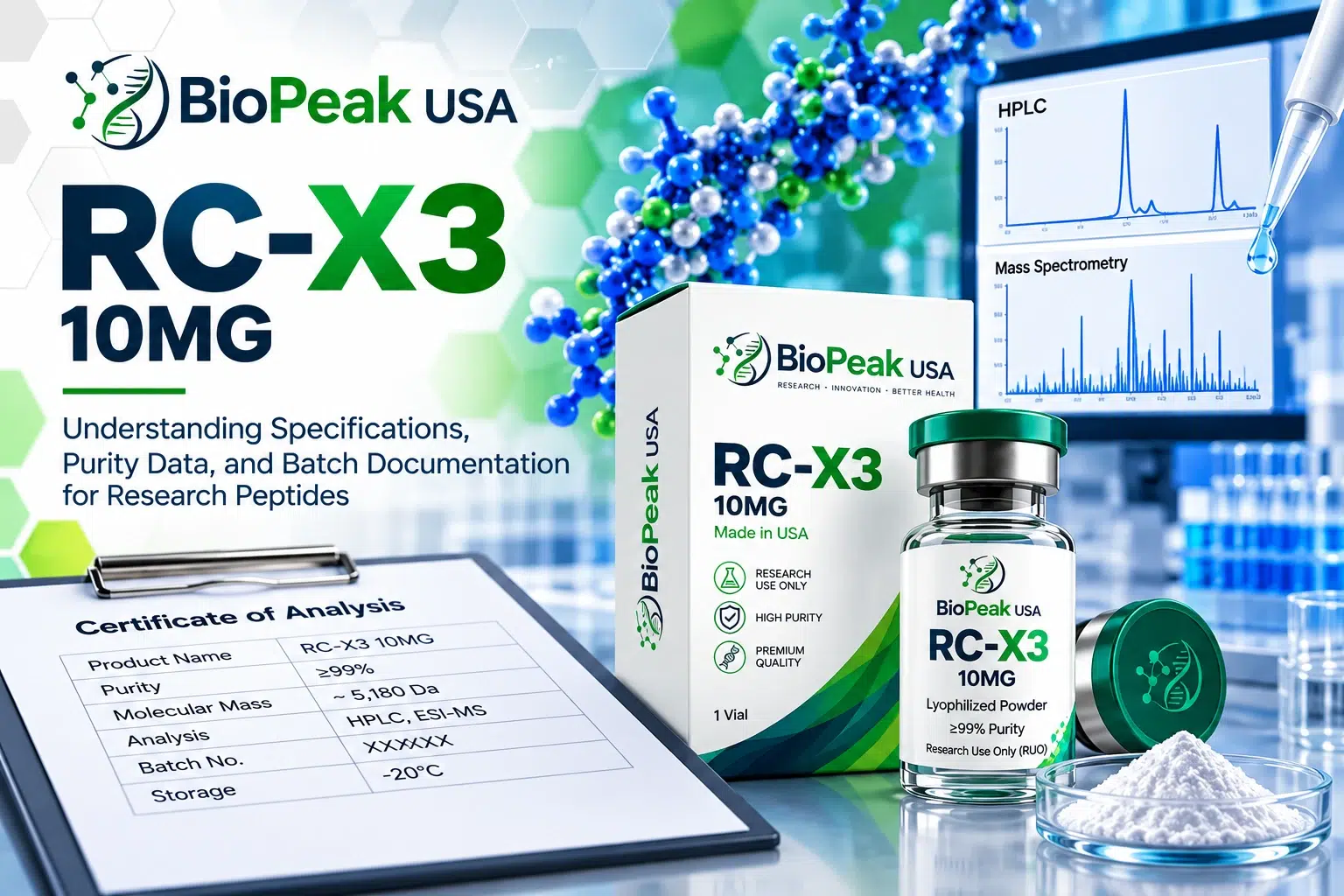
When individual peptides are supplied as discrete research materials, a batch-specific Certificate of Analysis records analytical results for the exact material. Researchers typically confirm that the batch number matches the vial, that identity and purity results are both present, and that methods are disclosed. For research workflows where batch documentation is important, review Certificate of Analysis and testing information. Non-natural substitutions change composition and therefore the expected mass. Identity is confirmed against the theoretical values for that specific sequence.What is the role of peptide library screening?
Peptide library screening is the experimental evaluation of library members to identify sequences that produce a measurable result under a defined research assay. Some approaches evaluate individual peptides. Others screen mixtures or spatially organized libraries. A useful workflow connects: Library design → synthesis → analytical verification → assay or screening → data analysis → sequence identification A signal associated with a library member is not, by itself, a complete molecular mechanism. Follow-up experiments may be required to confirm identity, reproducibility, specificity, or other characteristics relevant to the research question. Genetically encoded platforms such as phage display and mRNA display use a different logic: genotype–phenotype linkage and iterative selection rather than discrete chemical synthesis of each member. Those methods should be cited as complementary, not interchangeable with SPPS libraries.Factors that affect peptide library quality
Sequence representation. Not every theoretical sequence is represented equally. Coupling efficiency, chemical stability, and construction method can change abundance. Synthesis efficiency. Sequences with different chemical characteristics behave differently. Longer sequences and challenging residues may need additional optimization. Purification. Truncated sequences, deletion products, and related species affect interpretation. Purification and characterization should match the format. Analytical verification. Use methods appropriate to the material. A single measurement rarely provides complete characterization. Library identification. Screening studies need a reliable way to connect an observation with a sequence. Data interpretation. Large libraries produce complex datasets. Experimental design and statistics become more important as diversity and screening scale increase.Where peptide library synthesis fits in the BioPeak USA research silo
Peptide research covers several distinct steps. Treating them interchangeably creates confusion.- Synthesis assembles amino acid residues in a defined order.
- Purification removes byproducts.
- Characterization confirms identity and purity.
- Documentation ties those results to a specific batch or library member.
Limitations of peptide library synthesis
Large theoretical libraries may exceed realistic synthesis or screening capacity. Individual sequences can differ in synthesis efficiency and representation. Some peptide structures are difficult to synthesize, purify, or characterize with a given workflow. Screening adds further limits. Signals can be affected by assay conditions, library presentation, sample composition, detection methods, and data-analysis procedures. A library result should be interpreted as evidence inside a defined experimental system, not as a complete description of a peptide’s biological or molecular properties.Next step
Researchers who have worked through the checklist above can apply the same standard used for individual research peptides: compare the sequence list, synthesis record, HPLC and mass data, and—where discrete peptides are supplied—the batch documentation against the intended research question. Questions about analytical documentation can be directed to BioPeak USA’s Certificate of Analysis and testing information. Broader supporting materials sit in the molecular science collection. As with every material discussed here, research peptides and libraries described in this article are intended for research use only.Frequently asked questions
What is peptide library synthesis?
Peptide library synthesis is the preparation of multiple related peptide sequences for systematic laboratory research. The sequences can vary at selected positions, in length, or in other defined structural features.How is a peptide library different from a single synthetic peptide?
A single synthetic peptide represents one defined sequence. A peptide library contains multiple sequences designed to investigate controlled molecular variation.What method is commonly used for synthetic peptide libraries?
Solid-phase peptide synthesis is an established chemical approach for constructing peptide libraries. Different formats can use parallel, split-and-mix, array-based, or other synthesis strategies.Why is sequence diversity important?
Sequence diversity allows researchers to compare related peptide molecules and investigate how changes in amino acid sequence or structure correspond to experimental observations.How are peptide libraries characterized?
Characterization depends on the library format and research objective. Techniques can include HPLC, mass spectrometry, chromatographic analysis, molecular-mass measurements, and other appropriate analytical methods.Does a larger peptide library always provide better research results?
No. A larger theoretical library can increase sequence diversity, but practical coverage, synthesis quality, analytical verification, screening capacity, and data interpretation also determine usefulness.Are chemically synthesized libraries the same as phage display or mRNA display?
No. Those are genetically encoded systems. They are complementary discovery tools and should not be treated as the same methodology as SPPS-based chemical libraries.Are materials discussed here for human use?
No. Materials referenced in BioPeak USA research articles are intended for laboratory and scientific research only, not for human or animal use.Conclusion
Peptide library synthesis extends conventional peptide synthesis from individual sequences to structured collections of related peptides. By controlling amino acid variation, sequence design, library format, and analytical evaluation, researchers can investigate molecular diversity inside a defined experimental framework. The complete workflow connects peptide library design, synthesis, sequence diversity, purification, HPLC, mass spectrometry, characterization, screening, and data interpretation. Each stage contributes to whether the resulting research data can be trusted and interpreted. For modern synthetic peptide research, the most useful library is not necessarily the largest one. Its value depends on how well the library design matches the research question, how consistently its members are represented and characterized, and how clearly experimental results can be connected to defined peptide sequences.
Table of references
| Source | Why it is cited |
|---|---|
| Houghten et al., Nature (1991). Generation and use of synthetic peptide combinatorial libraries. | Primary background on chemically synthesized, mixture-based peptide combinatorial libraries and iterative screening. |
| Szymczak et al., Annu. Rev. Anal. Chem. / PMC review of peptide arrays (PMC6526727). | Review of peptide-array preparation, SPPS vs in situ synthesis, and remaining technical limits. |
| Sohrabi, Foster & Tavassoli, Nat. Rev. Chem. (2020). Genetically encoded cyclic peptide libraries. | Distinguishes phage display, mRNA display, and related encoded methods from chemical SPPS libraries. |
| Bozovičar & Bratkovič, Molecules (PMC6981544). Evolving a peptide: library platforms. | Overview that separates chemical SPPS / split-and-mix / OBOC libraries from recombinant display platforms. |