Buy Peptides Online: How to Evaluate Research Materials
Peptides are used across biochemical, molecular, analytical, and laboratory research. When researchers buy peptides online, however, evaluating a material involves more than comparing product names and prices. Molecular identity, analytical purity, testing methods, batch information, storage conditions, and supporting documentation can all influence whether a research material is appropriate for a particular laboratory workflow.
A peptide is a molecule composed of amino acid residues connected by peptide bonds. Peptides can differ substantially in sequence, length, terminal groups, chemical modifications, molecular mass, and analytical characteristics. Because these differences can affect how a material is identified and characterized, researchers should understand what is being offered and what analytical evidence is available before selecting a supplier.
Careful evaluation of a research peptide material involves considering its identity, analytical purity, characterization information, batch or lot traceability, documentation, storage requirements, and suitability for the intended laboratory workflow. These factors become particularly important when peptide materials are sourced online.
Research-focused principle: A peptide material should be evaluated using its molecular identity, analytical evidence, batch documentation, intended use, and laboratory requirements rather than price alone.
This guide explains why analytical information matters, how HPLC and mass spectrometry contribute to peptide characterization, what researchers can look for in a Certificate of Analysis, why batch traceability matters, and how research-focused materials differ from products intended for other purposes.
Table of Contents
- What Are Peptides?
- What Are Research Peptides?
- What to Check Before Buying Peptides Online
- Why Peptide Identity Is Important
- Why Peptide Purity Is Important
- HPLC Analysis of Peptides
- Information Provided by HPLC
- MS Analysis of Peptides
- What Is a Certificate of Analysis?
- Why Batch and Lot Traceability Is Important
- How to Evaluate Online Peptide Suppliers
- When to Buy Peptides in Bulk
- Research Peptides at BioPeak USA
- Frequently Asked Questions
- Conclusion
- References and Scientific Resources
What Are Peptides?
Peptides are amide compounds formed from amino-acid-derived units connected through peptide bonds. The International Union of Pure and Applied Chemistry (IUPAC) defines peptides as amides derived from two or more amino carboxylic acid molecules. The term is commonly used for chains formed from alpha-amino acids, while the broader chemical definition includes other amino carboxylic acid derivatives.
The characteristics of a peptide are strongly related to its sequence and chemical structure. Peptides may vary in length, sequence, terminal groups, amino acid modifications, molecular mass, purity profile, and other analytical properties.
In laboratory research, peptides may serve as defined molecular materials for biochemical experiments, analytical studies, screening workflows, assay development, and other controlled research applications.
For this reason, researchers should evaluate peptide materials at the molecular and analytical level and determine whether the available information is appropriate for the intended research workflow.
What Are Research Peptides?
Research peptides are peptide materials manufactured or supplied for laboratory research rather than human or veterinary administration. Their suitability depends on the intended research application, material specifications, analytical documentation, and requirements of the laboratory using them.
A research-use designation does not by itself establish purity, identity, biological activity, or suitability for a particular experiment. Appropriate product information and analytical evidence are required to evaluate those characteristics.
When evaluating research peptides online, researchers should examine the supporting documentation for the material rather than relying only on a product description or marketing statement.
Important distinction: Research-use-only materials are intended for laboratory research and should not be considered materials for clinical diagnosis, treatment, or human or veterinary administration.
Terminology and regulatory requirements can vary according to product type and intended use. FDA guidance, for example, addresses research-use-only and investigational-use-only products within the applicable in-vitro diagnostic context and distinguishes them from products intended for clinical diagnostic use.
What to Check Before Buying Peptides Online
Research-focused purchasing decisions should begin with the information available about the material. Researchers need to determine what is being supplied, what evidence supports the product description, and which batch or lot the available analytical information applies to.
Important considerations can include peptide identity, reported analytical purity, HPLC or other chromatographic information, mass spectrometry data where applicable, material format and quantity, batch or lot identification, Certificate of Analysis availability, storage conditions, and shipment information.
| Evaluation Factor | Why It Matters |
|---|---|
| Peptide identity | Helps determine whether the material corresponds to the expected molecular entity. |
| Analytical purity | Provides method-dependent information about detected components in the sample. |
| HPLC information | Provides chromatographic separation and profile information. |
| Mass spectrometry | Provides mass-to-charge information that can support molecular characterization. |
| Batch or lot number | Connects the supplied material with its associated documentation. |
| Certificate of Analysis | Can provide batch-specific analytical information where available. |
| Storage information | Helps researchers follow stated material-handling requirements. |
A research-use-only designation is also important because it establishes the stated intended-use context. The amount and type of supporting documentation required will depend on the research application and the laboratory’s analytical requirements.
Why Peptide Identity Is Important
Peptide identity describes whether the analyzed sample corresponds to the expected molecular entity. This is different from simply assigning a name to a sample or product.
For synthetic peptides, researchers may compare analytical results with expected molecular characteristics. Mass spectrometry can provide molecular-mass information that supports evaluation of the expected molecular entity.
Clear product identification also helps researchers maintain consistent laboratory records and distinguish between materials with related names, sequences, modifications, or molecular characteristics.
Researchers should remember that no single analytical result necessarily answers every question about a peptide. The appropriate characterization strategy depends on the scientific question and the properties that need to be evaluated.
Why Peptide Purity Is Important
Purity is a relative analytical term. For a peptide, it can describe the relative amount of the peptide of interest compared with other detectable components in a sample under a defined analytical method.
For chromatographic analysis, purity is commonly represented using the relative area of a detected peak. Reported percentages can depend on separation conditions, peak shape, detection parameters, integration, resolution, and other analytical factors.
Analytical context matters: A purity percentage without information about the method provides limited context. A reported result becomes more useful when interpreted together with the analytical method, conditions, sample identification, and batch documentation.
Different analytical approaches, including HPLC, UPLC, and mass spectrometry, can provide different types of information. Researchers should therefore avoid treating a single purity value as a complete description of every characteristic of a material.
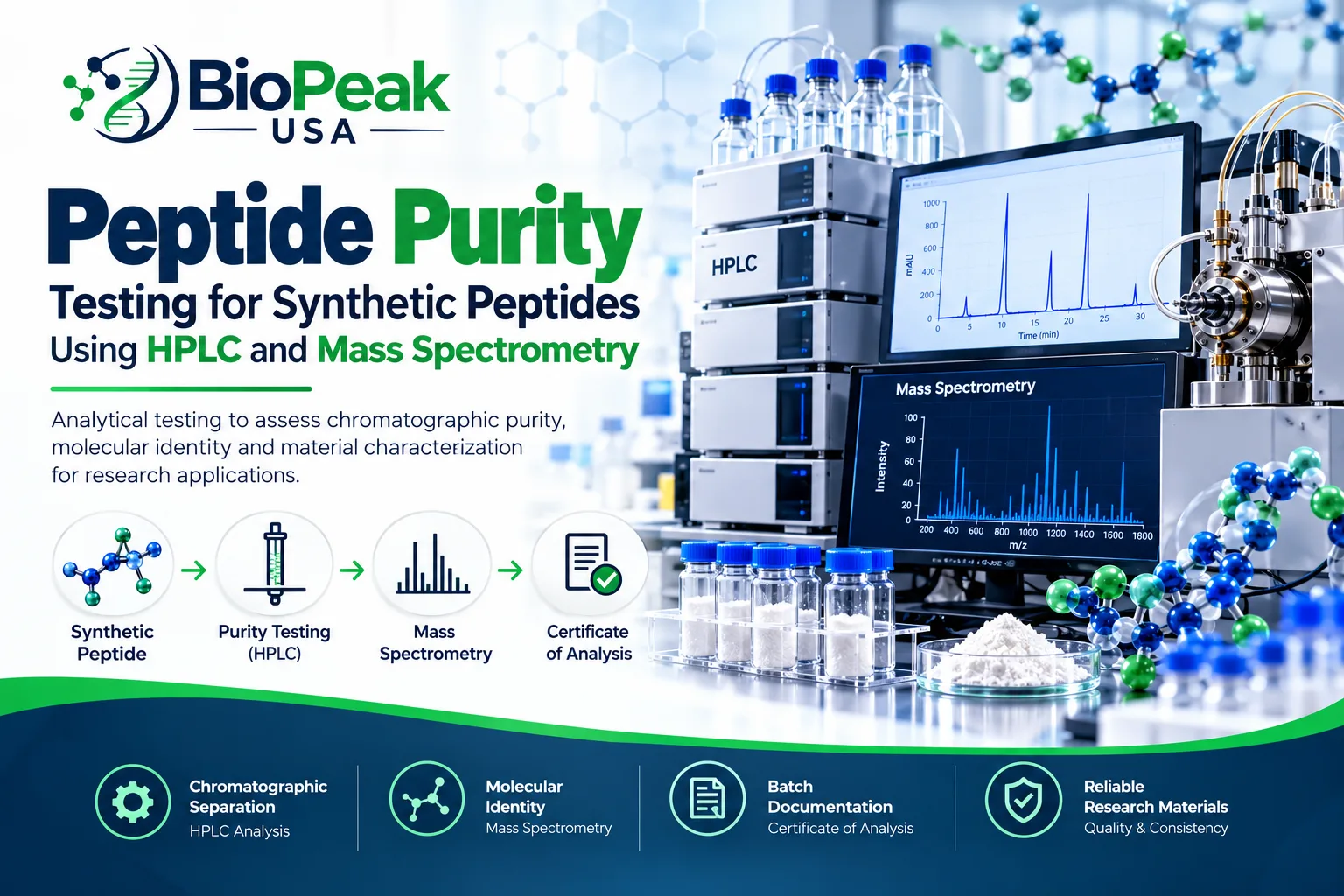
For a detailed discussion of peptide purity, chromatographic analysis, impurities, HPLC, and mass spectrometry, see
Peptide Purity Testing Using HPLC and Mass Spectrometry
.
HPLC Analysis of Peptides
High-performance liquid chromatography (HPLC) is an analytical separation technique widely used for peptides, proteins, and small molecules. It separates components according to their interactions with the stationary and mobile phases of the chromatographic system.
Reverse-phase HPLC is commonly applied to peptide analysis because differences in molecular properties can produce differences in chromatographic retention. Depending on the analytical conditions, factors such as polarity, charge, hydrophobicity, molecular size, and chemical structure can influence separation.
A resulting chromatogram can display the principal detected component along with other detectable signals. Additional signals may represent trace components, related products, degradation products, or other detectable species.
HPLC is a powerful analytical technique, but it does not answer every analytical question. A chromatographic peak does not by itself establish complete molecular identity, sequence, or structural characterization. Additional analytical methods may therefore be required depending on the research objective.
Information Provided by HPLC
The signals on the chromatogram will be shown over the time period that the chromatographic analysis has occurred. Some of the parameters used to evaluate the chromatogram and therefore the sample are: peak positions; relative peak area; and resolution.
In addition to the main signal(s) in a chromatogram, there may be other smaller signals that could potentially indicate trace components; related peptides; degradation products; or other related molecules. To help determine which of these possible interpretations are correct, it will be necessary to obtain additional characterization data and contextual information.
There are several factors that affect peptide chromatography; these include the type of chromatographic separation being used, the type of stationary phase being used, the mobile phase used for eluting the analyte, how the gradient is run, the temperature at which the analysis takes place and finally the chemical properties of the individual peptide.
Mass spectrometry is now a crucial analytical method used to determine the composition (identity) and physical form (structural integrity) of artificial peptides. The use of both HPLC and MS will yield complementary results to assess the identity of a sample. HPLC will produce chromatographic separation patterns that are dependent upon how the components interact with each other physically and chemically; whereas, MS will yield mass-to-charge ratios for each component that can be used to determine their respective molecular weights.
MS Analysis of Peptides
The use of Mass Spectrometry (MS) is most frequently used to identify peptides as well as assess their quality within research laboratory settings. MS will provide data regarding the molecular weight of a particular peptide and possibly give an indication of whether there has been any post-translational modification of the peptide or if it has been synthetically modified.
In addition to being a primary analytical method for determining both the chemical composition and structural stability of synthetic peptides, mass spectrometry has become a very important analytical technique.
When assessing a sample’s identity, both HPLC and MS can yield different types of data; therefore they are used as complements to each other. For instance, HPLC will create a separation profile through chromatograms that show how chemicals interact physically/chemically with the stationary phase. On the other hand, MS measures the ratio of mass to charge (m/z) which allows the determination of a sample’s molecular weight.
Complementary techniques: Mass spectrometry and liquid chromatography provide distinct analytical insights and should not be treated as interchangeable. HPLC reports separation data, whereas MS reports mass-to-charge information necessary for molecular mass characterization.
What Is a Certificate of Analysis?
Both HPLC (Liquid Chromatography) and MS (Mass Spectrometry) offer unique ways to analyze samples; therefore they are not interchangeable. HPLC produces separation data while MS provides the m/z (mass-to-charge ratio) data required to characterize the molecular mass of components.
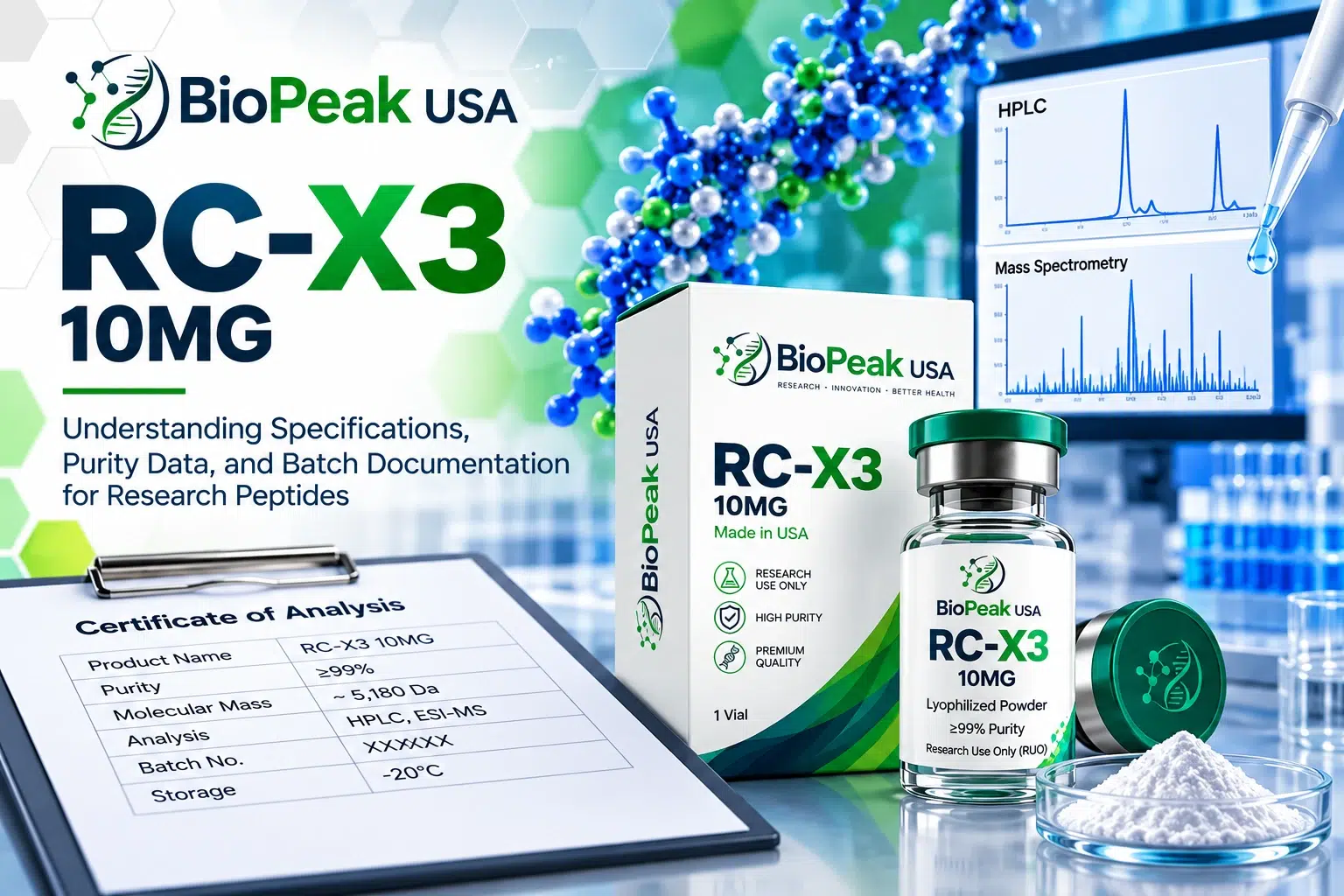
A Certificate of Analysis (CoA) connects analytical information to a particular batch or lot of material. As a formal document, the CoA identifies crucial parameters regarding the identification, quality, and properties of each lot.
When purchasing peptides online, batch-specific certificate of analysis (CoA) provides additional information about the materials properties which may not be present in typical product descriptions. The researcher needs to be aware of the technical information contained within a CoA so that he/she can assess if those parameters are compatible with the analytical needs of his/her lab workflow.
Key details to examine within a CoA include:
- Product and material identification
- Batch or lot number
- Reported analytical results
- Testing method or instrumentation utilized
- Acceptance criteria or specification thresholds
- Test and release dates
- Relevant analytical observations or notes
The contents of Certificates of Analysis differ from supplier to supplier and across different types of products, therefore, documents should be assessed by what they contain in terms of analytical data rather than simply the presence of the document.
Why Batch and Lot Traceability Is Important
Batch/Lot Identifier – Links physical sample(s) with corresponding analytical documentation. This links to the internal laboratory records, which provide a way to clearly attribute the exact material that was used during each individual experiment run.
In addition to the identification of products by lot number, documentation in a laboratory setting can also include other relevant information such as certification of the analytical results obtained from the tests performed on the product; the manner in which the product has been stored and/or handled prior to use; and when the product was used.
Traceability and analytical characterization are different functions, but when a firm has strict lot traceability, the firm connects its characterization data with its physical inventory so that the firm maintains both the ability to repeat the study and maintain the integrity of its data.
How to Evaluate Online Peptide Suppliers
When researching peptide suppliers’ web pages, it is important for scientists to evaluate the primary technical and product details offered by the supplier. Researchers also need to assess whether the supplier is making excessive marketing claims or providing products at significantly reduced costs.
Essential evaluation criteria include:
- Review Product Information: Product listings should clearly define the material, enabling researchers to distinguish synthetic peptides from unrelated dietary supplements, proprietary blends, or non-research formulations.
- Check Analytical Documentation: Ensure access to comprehensive analytical characterization data, including representative HPLC chromatograms and mass spectra where applicable to the research intent.
- Confirm Batch Information: Verify that distinct batch/lot identifiers are clearly labeled on both the material and accompanying documentation to maintain full traceability.
- Understand Intended Use: Ensure that materials intended strictly for laboratory research are explicitly designated as such and distinguished from products marketed for human consumption or unauthorized clinical uses.
When to Buy Peptides in Bulk
Bulk acquisition of peptide materials is generally suited for research facilities with consistent, sustained demand and established capacity to utilize materials within verified stability windows. Unit price discounts should not serve as the primary driver for high-volume purchasing.
Prior to placing bulk orders, research teams should evaluate peptide stability profiles, required storage infrastructure (e.g., ultralow temperature freezers), projected usage timelines, batch-to-batch consistency metrics, and total research value. A lower upfront cost does not necessarily yield improved scientific outcomes.
Research Peptides at BioPeak USA
BioPeak USA supplies research-grade peptide materials designed for qualified institutional and laboratory settings engaged in in-vitro experimental workflows. Product catalog details are structured around material specifications, analytical identity, and detailed characterization data.
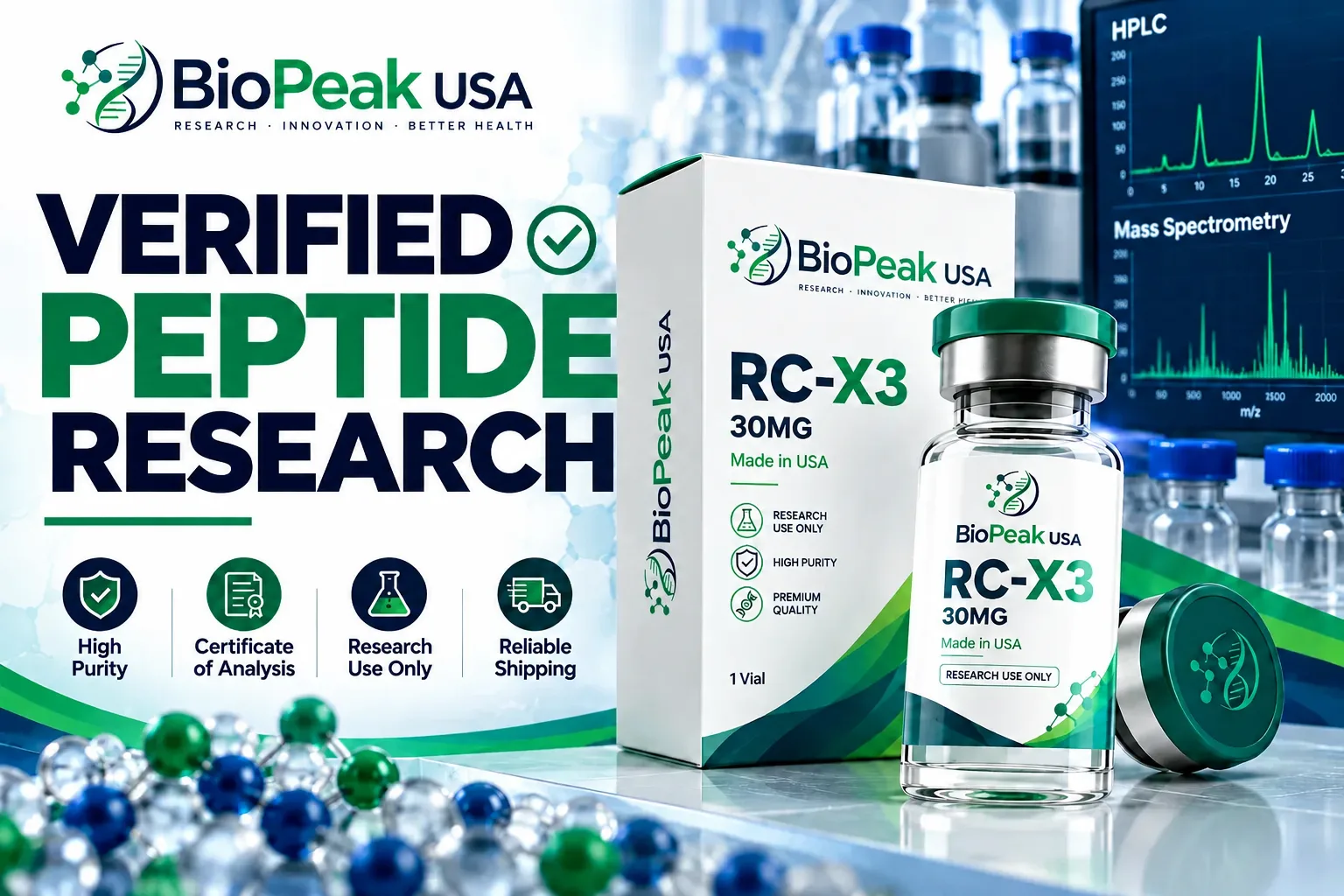
Researchers evaluating options to buy peptides online can access BioPeak USA products alongside product-specific analytical documentation and batch verification directly on the official portal.
For further reading on laboratory applications and analytical methodologies, refer to our comprehensive resource on
Scientific Research Materials
as well as our guide on
Peptide Purity Testing
, which details HPLC, LC-MS instrumentation, chromatography parameters, and batch documentation integrity.
Notice: BioPeak USA research materials are strictly intended for laboratory research and in-vitro experimental use by qualified professionals. They are explicitly not intended for human or veterinary use.
Frequently Asked Questions
Where can I buy peptides online for laboratory research?
Researchers should select vendors that transparently disclose material identity, provide complete analytical characterization (such as HPLC and MS data), issue batch-specific CoAs, and explicitly state research-use-only designations aligned with laboratory compliance standards.
What should I check before purchasing research peptides?
Key criteria include verifying batch-level traceability, inspecting identity and purity data, reviewing supporting documentation, confirming appropriate storage requirements, and validating that material formats match the experimental protocol.
Why are HPLC and mass spectrometry useful for peptide research?
HPLC acts as a physical separation tool to reveal purity profiles and detect related impurities, whereas mass spectrometry measures exact molecular weight and structural attributes. Used together, they offer complementary verification of sample quality.
Does a high purity percentage prove peptide identity?
No. Purity reflects the relative concentration of the primary peak within a sample under specific conditions, whereas identity confirms the precise molecular structure. Comprehensive characterization requires orthogonal testing such as mass spectrometry.
What is the meaning of a Peptide COA?
A Certificate of Analysis (COA) is a batch-specific document detailing the empirical test results of a sample lot, including identity confirmation, purity percentage, analytical methods used, and release criteria.
Are research peptides for human usage?
No. Research peptides are strictly manufactured and designated for in-vitro and laboratory experimental workflows and are prohibited from human, therapeutic, veterinary, or clinical diagnostic application.
Conclusion
When acquiring research materials, technical parameters—such as molecular identity, documented purity, HPLC and mass spectrometry data, batch traceability, storage conditions, and formal Certificates of Analysis—must take precedence over cost considerations. Utilizing orthogonal analytical techniques like chromatography and mass spectrometry provides a transparent framework for evaluating synthetic peptide quality.
Ultimately, the most suitable material for a qualified laboratory is one that aligns with the specific requirements of the scientific workflow and is fully identified, thoroughly documented, and verified across all technical parameters.
Explore
BioPeak USA Products
to review qualified research materials, or expand your understanding of peptide analytical testing through our scientific repository.
References and Scientific Resources
The following references offer further insight into peptide chemistry terminology, characterization protocols, and analytical guidelines for laboratory research materials:
| Reference | Type | Relevance |
|---|---|---|
IUPAC Gold Book – Peptides |
Scientific Organization | Outlines chemical nomenclature, definitions, and classification standards for amino acid derivatives and peptide chains. |
| Characterization of Synthetic Peptides by Mass Spectrometry | Analytical Guide | Provides technical details on evaluating mass, sequence integrity, and modifications in synthetic peptide synthesis. |
| Synthetic Peptide Characterization by Chromatography | Analytical Guide | Reviews liquid chromatographic separation mechanisms, stationary/mobile phase variables, and impurity profiling. |
FDA Regulatory Guidelines |
Regulatory Context | Offers regulatory contexts regarding research-use-only (RUO) and investigational materials within laboratory settings. |
PubMed |
Scientific Literature | National Library of Medicine repository for peer-reviewed biomedical literature and analytical method validation studies. |
Research-use information, in the context of the analyzed material and the applicable laboratory environment and workflow, should always be evaluated and interpreted according to documented analytical methods, batch-related information, intended research use, and the general requirements of the laboratory.