Explore synthetic peptide synthesis from amino acid sequencing and purification to HPLC and mass spectrometry characterization, libraries, and research documentation.
How Synthetic Peptide Synthesis Works
A synthetic peptide is produced through the laboratory synthesis of amino acids in a sequential order. Historical approaches to synthetic peptide research relied on the isolation of peptides from various biological sources, thus providing limited control and reproducibility in research. However, with the development of advancements in analytical and synthetic chemistry, researchers are now able to obtain significant control over the synthesis of peptides, and their subsequent characterization. The use of synthetic peptides has been well documented in the field of biomedical research. This document describes the in-depth methods of peptide synthesis, including the various techniques of peptide bond formation and chain elongation, the separation of synthesized peptides, and the various analytical methods of structure elucidation.
It should be emphasized that the references mentioned in this manual are to be utilized for Research Use Only (RUO) and controlled, in-vitro, research settings only.
A peptide is a polymer of amino acids found in proteins. A peptide can also be made artificially in the laboratory. These are called synthetic peptides. Synthetic peptides can be made with a very specific sequence and purified and analyzed prior to their use in research.
Synthetic peptides are very useful in biological and biomedical research as they allow scientists to control the peptides in their research. Synthetic peptides can also be used as standards to compare and evaluate other research.
Synthetic Peptide Synthesis
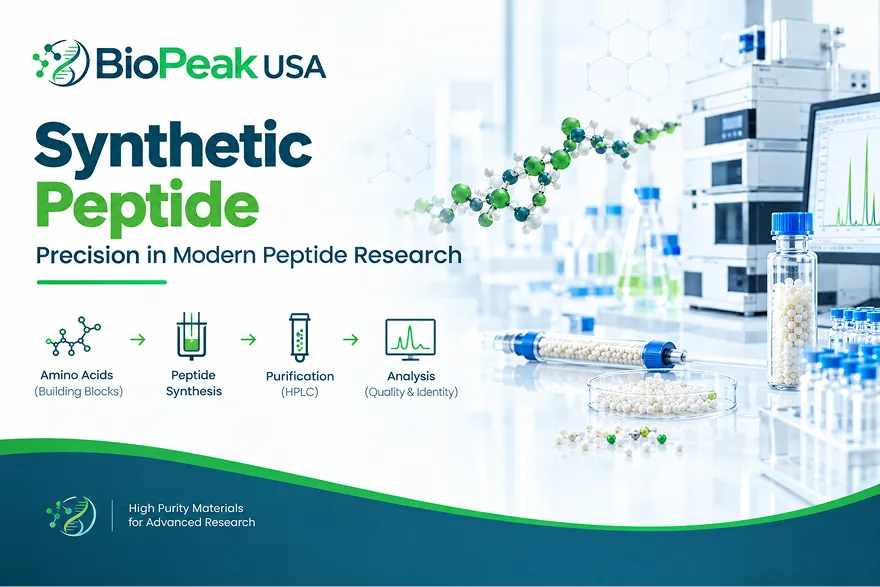
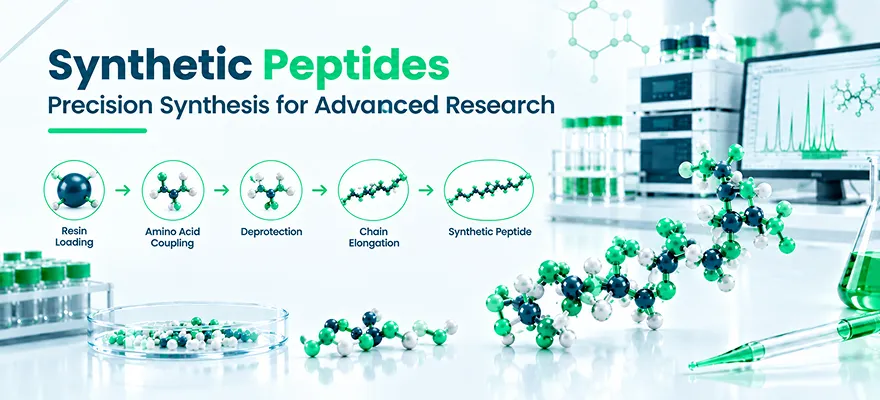
For peptide synthesis, the main step is creating a peptide bond. The main method of peptide synthesis is known as solid-phase synthesis. This method involves a growing peptide chain anchored to an insoluble support. Upon completion of the chain, the support is separated from the peptide chain.
It is difficult to control exact sequence as the length of a peptide chain increases. Because of this, most chemical syntheses of peptides are limited in chain length. Research-grade materials prefer short chains over full length proteins for this same reason. This branch will cover custom synthesis work and sequence control for those short syntheses.
Synthetic Peptide Purification
Full peptide synthesis results in a mixture of target peptides, as well as fragments and reagents. Purification is necessary to remove these impurities.
There are many purification methods. Reverse-phase chromatography is a technique in which components of a mixture are separated based on their hydrophobicity. This is the basis of both regular and preparative-scale HPLC. This research focuses on the chromatographic purification of synthetic peptides as well as the use of reversed-phase chromatography in synthetic peptide analysis.
Synthetic Peptide Characterization
After synthesis, analytical tests are performed to assess the molecular weight and purity of a peptide. Chromatography is used in both tests. When determining the purity of a peptide, it is necessary to first separate it from all other peptides and/or compounds. This is called chromatographic purity. Once other peptides have been separated from the target peptide, Mass Spectrometry can determine the molecular weight.
HPLC and mass spectrometry are used together to confirm both purity and molecular identity during synthetic peptide characterization.
Amino acid analysis can add further confirmation of composition for reference-standard materials, and together these methods generate the batch-specific analysis behind every Certificate of Analysis.
Synthetic Peptide Libraries
A peptide library is a product containing a set of sequence variants synthesized in a single construct. This is to enable testing of a large number of sequence variants in a given experiment. In a library of peptides, systematic variations in sequence allow identification of sequence variants that responded positively in an assay.
Peptide libraries are used in screening methods that are similar to phage display technologies. In these methods, peptides are displayed on the surface of a phage particle and are used for the selection and isolation of peptides that bind to a given target.
Why Documentation Matters in This Field
Reproducibility depends on more than a single successful experiment — it depends on knowing the material used in one study is identical, in every documented respect, to the material used in any attempt to replicate it. This is why batch-specific analysis and formal documentation are important when working with research-grade materials.
A Certificate of Analysis typically records the batch number, purity results, identity confirmation, and storage conditions. BioPeak USA supplies these research materials with batch-specific data included with each product.
Frequently Asked Questions
What is a synthetic peptide?
It is a peptide built through controlled chemical synthesis, joining amino acids together in a defined sequence rather than isolating the molecule from a biological source.
How is a synthetic peptide made?
Most are produced using solid-phase peptide synthesis, coupling residues one at a time to a growing chain, then cleaving and purifying the material once the sequence is complete.
Why is purification needed after synthesis?
The crude product contains the target sequence mixed with synthesis byproducts. Purification — typically by reverse phase chromatography — isolates the intended molecule before characterization.
How is purity confirmed?
Peptide purity is commonly assessed by HPLC, while mass spectrometry provides information used to evaluate molecular identity against the intended sequence.
What documentation should accompany this material?
A batch-specific Certificate of Analysis should accompany any research-grade material of this kind, documenting identity, purity, batch number, and storage conditions.
Conclusion
Synthetic peptide research follows a consistent path from design to documentation: residues are joined into a defined sequence through synthesis, the resulting polypeptide chain is purified to remove byproducts, and the finished material is characterized to confirm purity and identity before entering a laboratory workflow.
Researchers working with these materials can explore BioPeak USA’s Molecular Science category for research-grade products supplied with batch-specific analytical documentation.
Table of References
Resource
Publisher
Use in This Article
Link
PubChem
NCBI / NIH
Chemical, structural, and identification details for amino acids and peptides.
All synthetic peptides referenced in this article are discussed strictly in the context of laboratory and scientific research and are classified as Research Use Only (RUO). They are non-medicinal research materials and are not intended for human or veterinary use, clinical administration, or therapeutic application. Handling should be limited to qualified laboratory personnel working according to applicable institutional policies, laboratory procedures, and regulatory requirements.