Peptides and Proteins A Complete Guide to Polypeptide Chains
Explore how amino acids form polypeptide chains and how peptides differ from proteins, including their structure, research applications, and laboratory analysis.
How Peptides and Proteins Begin with a Polypeptide Chain
When many people first encounter the three types of substances: peptides, proteins, and polypeptide chains, the first pair they mix up are peptides and proteins. It is not entirely that novices have poor memory; the basic structures of these two types of molecules are inherently closely linked, and the core raw materials used to build them are exactly the same, which are all amino acids. Stringing these scattered amino acids together one by one, while supporting the shared core that underpins the entire underlying framework of both types of molecules, is the polypeptide chain. If you work in a Research Laboratory and want to sort out the Difference Between Collagen and Collagen Peptides, the first thing is you need to do is grasp this core logic; otherwise, you will not even find the entrance to research, and have no way to get started at all.
This material will follow a logical sequence to help you sort out all the key details clearly. It starts with the most basic amino acids, step by step unpacks How Are Amino Acids Linked to Each Other to finally form a complete polypeptide chain. It also explains the specific structure of the “connector” that firmly binds different amino acid units together—the peptide bond. Next, it sorts out the most core differences between peptides and proteins. It mentions the well-known difference in molecular size that most people have heard of, but also listing and explaining all the differences in their physical properties one by one. Finally, it organizes all current and active research directions related to these two types of molecules, such as the currently popular research on the Difference Between Collagen and Collagen Peptides, as well as the content related to the role of amino acids in biochemistry that must be mastered for MCAT preparation.
All examples related to peptides and proteins mentioned in this material are Research Use Only, abbreviated as RUO.
Peptides and proteins share similar chemical makeups because they are both made up of amino acids and peptide bonds. However, their length, shape, and structure differ, and so does the type of research they are each used for.
Element
Description
Both
The basic chemical structure of a peptide and protein is made of amino acids and peptide bonds.
Length
The average length of a peptide is 2 to 50 amino acids and usually does not fold. Proteins fold and average 100 to 1,000 amino acids.
Structure
Peptide backbone and links of amino acids fold to make a structure.
Purpose
Amino acids and proteins are studied to better understand biological processes. Peptides, however, are studied for laboratory research applications.
Research
Peptides are used for benchtop research.
What is a Peptide?
A peptide is a short chain of amino acids. Like a protein, a peptide is made when amino acids are bonded together. A peptide, however, has 50 amino acids. Since peptide bonds are limited, a peptide is less stable and complex than a protein. Proteins consist of 100 or more amino acids.
Peptides have a simple structure. Because of their small size, they can be manually created in a laboratory to have the exact amino acid sequence. A peptide’s simple structure allows scientists to identify its purity. Peptides are used in many scientific studies to understand enzymes and receptors.
What is a Protein?
Research laboratories can produce proteins in abundance using new biological and genetic engineering techniques.
Proteins, like peptides, are made up of amino acids. The biochemical properties of proteins are determined by the particular structure and architecture of the proteins. These activities are often preserved even when the proteins undergo changes in their amino acid sequence.
The Synthesis of Polypeptides
The linking of amino acids through a special type of bond, called a peptide bond, results in the formation of a polypeptide chain. Each amino acid contains an amine group and a carboxyl group. The amine group and the carboxyl group are involved in peptide bond formation with another amino acid. Bond formation results in water molecule release. The bond is covalent, and defines the polypeptide.
A polypeptide can be as short as two amino acids. A polypeptide is a functional unit called a peptide if it consists of between two and fifty amino acids. A polypeptide with more than fifty amino acids is a protein. Similar to a protein, a polypeptide can contain multiple amino acids in various combinations and sequences. It is the sequence of amino acids that determines the polypeptide’s function. For a polypeptide to bind to a particular molecular partner, it may need a specific sequence. A slight change in sequence may prevent the polypeptide from binding to its partner.
The Peptide Chain and Backbone
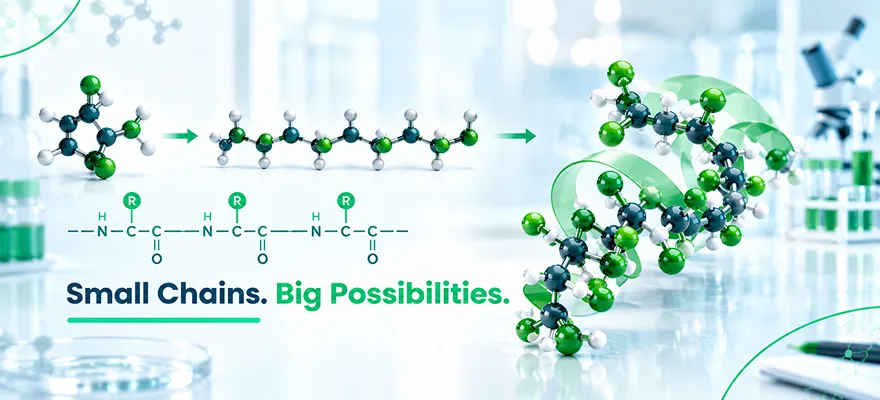
All proteins share a similar structure made up of a series of units called a peptide chain. Each unit is further made up of an amide bond, which connects an amino (N) group and a carboxyl (C) group. Side groups (also called R groups) are present in the amino group and vary from protein to protein. It is these side groups that impact the protein’s properties including charge, hydrophobicity, reactivity, and polarity.
Illustration of a peptide chain showing the repeating backbone structure and connections between amino acid residues.
Proteins have various secondary and tertiary structures. The peptide backbone plays a role in secondary structures by forming hydrogen bonds that help stabilize the structure. The peptide backbone also plays a role in the formation of the tertiary structure of a protein and helps fold the protein into its final 3-dimensional shape. Thus, to completely comprehend a protein’s tertiary structure, the geometry of its peptide backbone must be considered.
What Are Protein Building Blocks?
There are twenty standard amino acids that combine to create all proteins. These amino acids vary based on the side chain (R group) attached to the carbon (C). Based on the side chain, different amino acids have various chemical behaviors. Every amino acid contains a positively charged group, a negatively charged group and a group without charge.
During the study of biochemistry, the understanding of the formation of polymers from their monomers is of paramount importance. In the context of MCAT, the concept of polymers and amino acids is of paramount importance. In order to analyse the nature of peptides, it is imperative to know the characteristics of amino acids that make a peptide bond. This is, for example, whether an amino acid is basic, acidic, polar or non-polar. biochemical processes and molecular interactions happen due to amino acids and proteins. Knowledge of the characteristics of amino acids is essential for the study of biochemistry.
What is the Difference Between Polypeptides and Proteins?
Polypeptides are long-chain amino acids. Proteins are complexes of one or more polypeptides. A long and complex polypeptide, regardless of whether it is folded or biologically active, is termed a protein. If a polypeptide is small and does not have complex folding, it is often termed a peptide.
Feature
Polypeptides (general)
Proteins (functional)
Definition
Chains of amino acids linked by peptide bonds
Chains of amino acids that have been chemically linked together by the formation of peptide bonds and have a defined biochemical function.
Length
Varies
Thousands of amino acids
Folding
Not required
Necessary in order to fulfill a biochemical function.
Function
Not necessarily biologically active
Biologically active
How Long Do Peptide Chains Form?
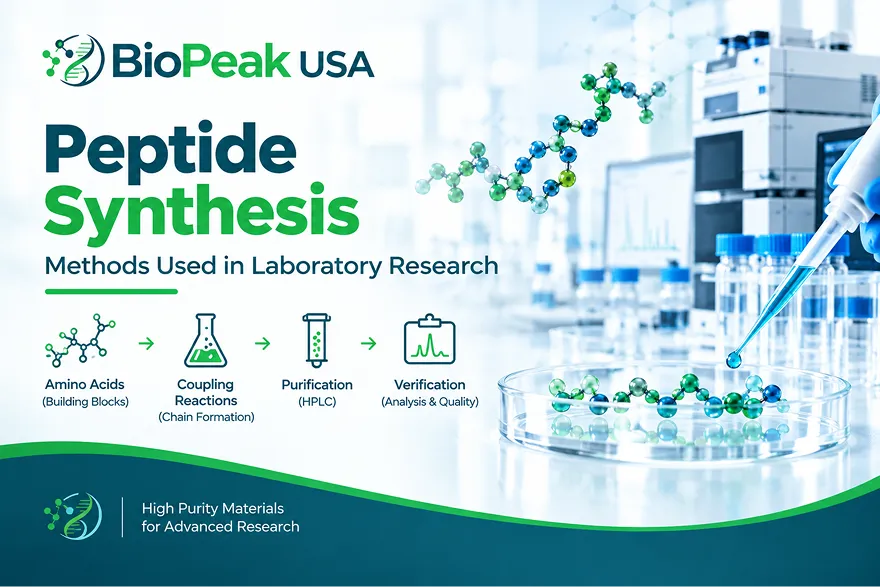
Peptide chains are synthesized by the step-wise condensation of amino acids in the order specified by their sequence in a laboratory.
Each amino acid is coupled to the growing peptide chain by removal of the protecting group and the addition of the amino acid to the end of the peptide. The protected group and unreacted amino acids are washed away and the process is repeated.
Precise control over the sequence becomes difficult as the peptide chain grows. This is one of the reasons peptides are limited in length for chemical synthesis.
What is the Difference Between Collagen and Collagen Peptides?
Collagen is a structural protein abundant in the body. It consists of three polypeptide chains that form a triple helix. Collagen peptides are produced from the breakdown of collagen and consist of short polypeptides.
There are significant differences between the two terms. Collagen consists of a single, long, and complex protein. On the other hand, collagen peptides consist of shorter protein segments. Due to their size, collagen peptides are more water-soluble, and their analysis by HPLC and mass spectrometry is easier, than larger proteins.
How the Research Field Studies Peptides and Proteins
In teaching and research, the study of peptides and proteins is introduced early in the education of a practicing scientist. It is reinforced at subsequent levels. Peptide and protein structure reviews are included in undergraduate and graduate level textbooks, especially in prepublished materials for advanced level courses such as MCAT. Structure and function are closely related. In combination with analytical data (i.e. HPLC and/or mass spectrometry), students generate inferences about the experiment outcome.
Researchers study peptides and proteins through molecular structure, biochemical interactions, cellular activity, and analytical characterization to better understand their roles in controlled laboratory research.
Many of the principles established during the analysis of laboratory peptides and proteins are applicable to the analysis of materials at large scales. Therefore, laboratory documentation and reporting practices associated with peptide and protein analysis reflect, and reinforce, practices used at large scales.
Why Peptides and Proteins Are Crucial in Laboratory Research
For peptide and protein research, it is critical to distinguish where a particular amino acid sequence resides on the peptide-to-protein spectrum. Short amino acid sequences are typically completely characterized by HPLC and MS, and are stable in a lyophilized state. In contrast, characterization of larger protein sequences may require SDS-PAGE, and assessment of biological activity may require additional characterization.
BioPeak USA has peptides and other related research materials available in their Molecular Science and Cellular Science categories, respectively. Batch-specific characterisation data is supplied with each product. Additional materials are available in the Reference Standards category.
Frequently Asked Questions About Peptides and Proteins
What is the difference between a protein and a peptide?
Peptides consist of 2-50 amino acids and are often unstructured, while proteins are larger, ≥50 amino acids, and may assume a defined structure.
What is a polypeptide?
A polypeptide is a chain of amino acids characteristic of all peptides and proteins.
What is a peptide backbone?
A peptide backbone is the multiple of N-Cα-C that repeats in a polypeptide and runs throughout the polypeptide. The variations in a peptide backbone are in the side groups attached to the backbone.
What are the building blocks of protein?
Proteins are made up of amino acids and thus, in a way, amino acids are the monomers of a protein.
Is a polypeptide a protein?
All proteins are composed of one or more polypeptide chains. A polypeptide can be considered a protein when its amino acid sequence and structural organization form a defined protein architecture.
What is the difference between collagen and collagen peptide?
Collagen is a protein made up of a series of polypeptides, and collagen peptides are shorter fragments of collagen polypeptides.
Why are proteins and peptides studied together?
The similarities between the structure and the nature of interactions of peptide bonds of amino acids give peptides and proteins similar properties that are studied together at this level of biochemistry.
Conclusion
This information has been reviewed by biochemists. Peptides and proteins are almost the same. Peptides and Proteins are made of amino acids and other building blocks, and one major difference is that longer amino acid chains make proteins. It is often easier for beginning students of biochemistry and peptide research to understand biochemistry if they understand the concepts of Proteins and Peptides. Students in biochemistry and related fields often utilize wet and dry laboratory work to gain a deeper understanding of the materials studied.
Laboratory and research personnel interested in research-grade peptides can locate them under the Molecular Science category of BioPeak USA’s website. Each product is comprised of research-grade peptides and accompanied by analytical data.
Table of References
Resource
Publisher
Use in This Article
Link
PubChem
NCBI / NIH
Provides openly accessible chemical, structural, and identification details for amino acids, peptides, and proteins.
Products and information pertaining to peptides in applied research have been included and discussed in science and technology. These products are for research use only (RUO) and should not be used for any medical or veterinary purpose. Handling should be restricted to trained personnel.