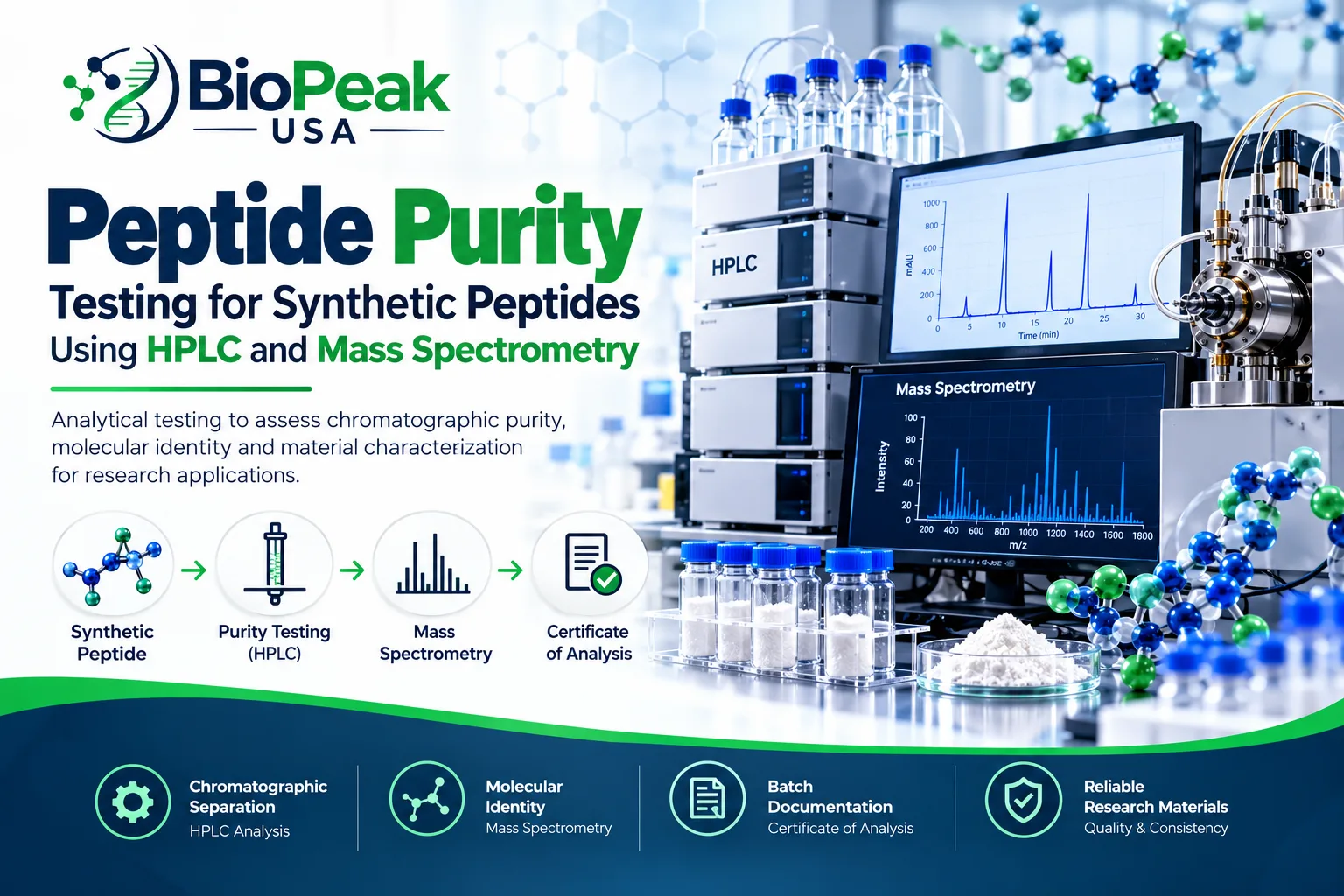
Research peptides work through receptor binding, enzyme interactions, and cell signaling, with purity, identity, stability, and batch documentation supporting reliable research.
How Do Research Peptides Work? Understanding Peptide Mechanisms
Research peptides are short-chain amino acid sequences that have become central to modern biochemical and cellular science investigations. Understanding how these mechanisms work is not just academic background for laboratory researchers, it directly informs experimental design, protocol selection, material documentation, and result interpretation. Among the most precisely characterizable class of molecular research materials available today, peptides derive their value not just from biological activity in experimental models, but from documented mechanistic traceability that makes results reproducible.
This article covers the mechanisms behind how research peptides work at every level: how their structure determines function, the pathways through which they interact with cellular systems in controlled in vitro models, and why understanding peptide mechanisms is inseparable from reproducible research. All materials referenced here are supplied for Research Use Only (RUO) and are intended exclusively for qualified research laboratories.
Here’s what this guide walks through:
- What a research peptide actually is
- How sequence shapes its mechanism
- The receptor-binding pathway
- Enzyme interaction mechanisms
- Cell signaling and migration mechanisms
- Why documenting mechanism matters for reproducibility
- Applying this understanding in the laboratory
- Frequently asked questions
Peptide Mechanisms at a Glance
| Element |
Description |
| Primary driver |
Amino acid sequence determines molecular conformation and binding behavior |
| Main mechanistic pathways |
Receptor binding, enzyme interaction, cell signaling |
| Identity verification |
Mass spectrometry — matches observed mass to theoretical sequence mass |
| Purity verification |
HPLC — confirms target peptide as percentage of total detected peak area |
| Key binding parameters |
Binding affinity (Kd), selectivity, agonism vs. antagonism |
| Documentation standard |
Batch-specific Certificate of Analysis (COA) |
| Applicable use |
Research Use Only (RUO), controlled in vitro laboratory research |
What Is a Research Peptide?
A research peptide, and the mechanism it exhibits, begins as a short-chain molecule composed of amino acids linked by chemical bonds. Unlike proteins — which are long, complex chains that fold into precise three-dimensional structures — research peptides are typically between 2 and 50 amino acid residues in length. Their smaller size makes the mechanism both synthetically accessible and analytically tractable: identity can be confirmed by mass spectrometry verified analysis, and purity assessed by HPLC-tested chromatography with high precision, giving researchers confidence in the underlying mechanism they’re studying.
What distinguishes a research peptide from other laboratory reference peptides or general research chemicals is the direct, verifiable relationship between its amino acid sequence and its functional behavior — the foundation of every mechanism observed in this class. The sequence determines which molecular targets it can interact with, how strongly it binds, and what downstream effects that interaction produces. Change one residue, and the molecule may behave entirely differently, which is why identity verification by analytical testing underpins any credible discussion of these mechanisms.
The Sequence-Structure-Function Relationship
The story of research peptide mechanisms begins with sequence. Each amino acid in the chain contributes specific chemical properties — charge, polarity, size, reactivity — that collectively shape how the molecule behaves in a given environment. In solution, a short chain adopts a local conformation influenced by these properties and by the pH, temperature, and ionic conditions of the medium.
This conformation determines the molecule’s surface features: which functional groups are accessible, which regions are hydrophobic or charged, and how it presents itself to potential binding partners. In a controlled in vitro research model, those surface features drive the mechanism that follows — which receptors or enzymes recognize it, how tightly they bind, and what signal is transmitted as a result.
The practical implication for laboratory researchers is that these mechanisms are tied directly to exact sequence. Mass spectrometry verified identity confirmation — matching observed molecular mass to theoretical mass — a check central to every mechanistic claim — is the only reliable way to confirm that a mechanism described in the scientific literature applies to the material actually in use. This is core to any rigorous discussion of how such mechanisms are verified.
For a deeper reference on research peptide mechanisms, the PubChem database provides structural and identity data for characterized peptides, and PubMed maintains peer-reviewed literature on mechanisms relevant to specific research models.
Receptor Binding: The Primary Mechanistic Pathway
The most widely investigated of all research peptide mechanisms in in vitro research remains receptor binding. In this pathway, the peptide interacts with a specific cell-surface or intracellular receptor, triggering a conformational change that initiates a downstream signaling cascade.
This receptor-binding mechanism is characterized by several parameters that laboratory researchers track and document:
- Binding affinity — how strongly it associates with its receptor, typically expressed as a dissociation constant (Kd). Higher affinity means it occupies the receptor at lower concentrations.
- Selectivity — whether it binds to one receptor subtype preferentially over others, which affects the specificity of the cellular response observed in the model.
- Agonism vs. antagonism — whether binding activates the receptor (agonist) or blocks it from being activated by other ligands (antagonist). This distinction shapes the directionality of the downstream peptide mechanism.
For any of these parameters to be meaningful, the material used in the experiment must be what its documentation says it is. An impurity that co-occupies the same receptor subtype will produce a mixed signal that muddies the underlying mechanism and is impossible to reproduce reliably. This is precisely why HPLC-tested peptides with independent batch verification are the appropriate standard for receptor-binding research.
Enzyme Interaction Mechanisms
Research peptides also function as biochemical reagents in enzyme interaction studies, revealing a second class of mechanisms distinct from receptor binding. In these models, the peptide may act as a substrate — a molecule the enzyme acts upon — or as an inhibitor or activator that modulates enzymatic activity without being consumed by the reaction.
These enzyme-based mechanisms are studied to investigate rate kinetics, inhibition constants, and the sensitivity of a given enzymatic pathway to molecular inputs. Molecules whose mechanism involves proteases, kinases, or peptidases are particularly relevant, as their susceptibility to enzymatic cleavage — or their ability to inhibit cleavage of other substrates — can be studied under controlled conditions.
Stability under assay conditions is an important practical consideration for interpreting this mechanism accurately. A research peptide that degrades during an enzymatic assay introduces a confound that HPLC testing of the original sample cannot detect — only testing under the actual assay conditions can reveal stability-related artifacts. Researchers should evaluate its stability as part of method validation.
Cell Signaling and Migration Mechanisms
In cellular science research, peptides are frequently used to probe signaling networks that regulate cell behavior: migration, proliferation, differentiation, and extracellular matrix interaction. These represent some of the more complex mechanisms in this class, in which the initial binding event cascades through intracellular messengers, transcription factors, and cytoskeletal regulators before producing a measurable cellular outcome.
Cell migration models, which reveal a distinct research peptide mechanism, involve researchers observing the movement of cells across a matrix in response to a molecular signal — are among the most common applications for studying these mechanisms. The peptide is introduced at a defined concentration, and migration rate or directionality is measured as the readout.
For these signaling mechanisms, batch-to-batch consistency of the research peptide is especially important. If purity or identity shifts between batches, the observed mechanism may shift with it — producing results that are difficult to compare across experimental runs. Batch-specific Certificates of Analysis (COA) from BioPeak USA give researchers the documentation needed to confirm that materials used across multiple experiments meet the same specification.
Why Mechanistic Documentation Matters for Reproducibility
Reproducibility of any research peptide mechanism depends on more than technique — it depends on knowing that materials used in one experiment are identical, in all documented respects, to those used in any attempt to replicate it. Documenting these mechanisms accurately is what separates research-grade materials from commoditized research chemicals that carry no analytical backing.
When a study describing a research peptide mechanism is submitted for peer review, reviewers need to know not just what material was used, but what batch, at what purity, verified by which analytical testing methods. Without that information, a failed replication cannot be interpreted: the discrepancy could lie in the method, the model, or the mechanism itself.
The Certificate of Analysis (COA) supplied with each batch of BioPeak USA research peptides provides the batch number, identity confirmation by mass spectrometry, purity data by HPLC, and moisture content where applicable. The FDA’s guidance on laboratory documentation and NIST measurement standards both underline the importance of retaining complete batch documentation as part of the experimental record.
Applying Mechanistic Understanding in the Laboratory
Understanding these mechanisms gives laboratory researchers a practical framework for experimental design. Before adding a research peptide to a protocol based on its presumed mechanism, it is worth asking:
- What receptor, enzyme, or signaling pathway does this mechanism engage with in the model system being used?
- Is the concentration range consistent with the binding affinities and mechanism reported in the relevant literature?
- Are there known off-target mechanisms that could confound the result at higher concentrations?
- Has the peptide’s identity been confirmed as a mass spectrometry verified peptide, and has its purity been assessed as an HPLC-tested peptide for this specific batch?
- Does the supplier provide GMP laboratory supplies-level documentation, including a batch-specific COA with disclosed analytical methods?
These questions don’t require specialized expertise beyond the experimental domain — they are the standard checkpoints of rigorous laboratory quality standards applied to selecting materials based on their underlying mechanism. BioPeak USA’s Molecular Science and Cellular Science categories supply research peptides that meet these documentation requirements by design.
Frequently Asked Questions
What determines a research peptide’s mechanism of action?
A research peptide’s mechanism is determined primarily by its amino acid sequence. The sequence dictates the molecule’s conformation, which surface features are exposed, and which receptors, enzymes, or signaling proteins it can interact with. Even a single amino acid substitution can change the underlying peptide mechanism entirely, which is why sequence verification is foundational to any mechanistic claim.
Is receptor binding the only mechanism research peptides use?
No. Receptor binding is the most widely studied research peptide mechanism, but these molecules also act through enzyme interaction — functioning as substrates, inhibitors, or activators — and through cell signaling cascades that regulate migration, proliferation, and differentiation. Which mechanism applies depends on the specific material and the model system it’s tested in.
How is a research peptide’s identity confirmed before it’s used in a mechanism study?
Identity is confirmed through mass spectrometry, which matches the observed molecular mass of the research peptide to the theoretical mass calculated from its stated sequence. This step is what makes a material a mass spectrometry verified peptide and is considered a prerequisite before drawing any conclusions about its mechanism.
Why does purity matter for interpreting a peptide mechanism?
An impure sample may contain byproducts or related fragments that interact with the same receptor or enzyme, producing a mixed signal that’s difficult to attribute to the target material alone. HPLC-tested peptides with documented purity give researchers confidence that the mechanism they’re observing reflects the material under study, not a contaminant.
Can two batches of the same research peptide show different mechanistic behavior?
Yes, if purity or identity shifts between batches. This is why batch-to-batch consistency and batch verification through a Certificate of Analysis (COA) are considered essential — without them, an apparent mechanistic difference between experiments could simply reflect a difference in the material rather than the biology.
What’s the difference between agonist and antagonist mechanisms in research peptides?
An agonist binds a receptor and activates it, triggering the downstream signaling cascade. An antagonist binds the same receptor but blocks it from being activated by other ligands, without triggering that cascade itself. This distinction shapes the directionality of the entire mechanism being studied.
Why is enzyme stability relevant to studying a research peptide’s mechanism?
If the research peptide degrades during an enzymatic assay, the degradation products can introduce confounds that standard HPLC testing of the original material won’t catch. Evaluating its stability under actual assay conditions — not just at the point of receipt — is part of validating any enzyme-interaction mechanism.
How do cell migration models reveal a research peptide’s mechanism?
Cell migration models introduce the research peptide at a defined concentration and measure how it affects the rate or directionality of cell movement across a matrix. Because this readout depends on signaling triggered by it, this offers a functional window into its downstream mechanism, not just its binding behavior in isolation.
What documentation should accompany a research peptide used in a mechanism study?
At minimum, a batch-specific Certificate of Analysis (COA) that includes identity confirmation by mass spectrometry, purity data by HPLC, the batch or lot number, and recommended storage conditions. This documentation is what allows a described mechanism to be independently verified or replicated.
Do all research peptides interact with only one receptor or pathway?
Not necessarily. Some peptides are highly selective for a single receptor subtype, while others exhibit off-target interactions at higher concentrations that can activate unrelated pathways. Reviewing selectivity data alongside concentration ranges used in the relevant literature helps rule out these off-target mechanisms before interpreting a result.
Conclusion
Research peptides work through a direct connection between molecular sequence, structural presentation, and biological interaction. Whether the mechanism is receptor binding, enzyme modulation, or cellular signaling, the underlying principle is consistent: sequence determines behavior, and that behavior is only as reliable as the identity and purity documentation behind it. Understanding these mechanisms in this way is the foundation of informed experimental design.
The combination of HPLC-tested purity, mass spectrometry verified identity, and batch-specific COA documentation is what separates a reliably understood mechanism from an uncharacterized guess.
Table of References
| Source |
Publisher |
Relevance to This Article |
Link |
| PubChem |
National Center for Biotechnology Information (NCBI/NIH) |
Structural and identity data for characterized research peptides referenced in the sequence-structure-function discussion |
pubchem.ncbi.nlm.nih.gov |
| PubMed Central |
National Library of Medicine (NLM/NIH) |
Peer-reviewed literature on receptor-binding and signaling mechanisms cited throughout the mechanism sections |
ncbi.nlm.nih.gov/pmc |
| FDA Laboratory Methods Guidance |
U.S. Food and Drug Administration |
Referenced in the discussion of batch documentation and experimental record-keeping standards |
fda.gov/science-research |
| NIST Measurement Standards |
National Institute of Standards and Technology |
Referenced for measurement traceability and batch verification standards |
nist.gov/topics/measurements |
Research Use Only. All research peptides referenced in this article are supplied strictly for laboratory and scientific research and are classified as Research Use Only (RUO). They are non-medicinal materials not evaluated by the FDA, and are not intended for human or veterinary use, clinical administration, or therapeutic application. Handling should be limited to qualified laboratory personnel working according to applicable institutional policies and regulatory requirements.
Views: 12