
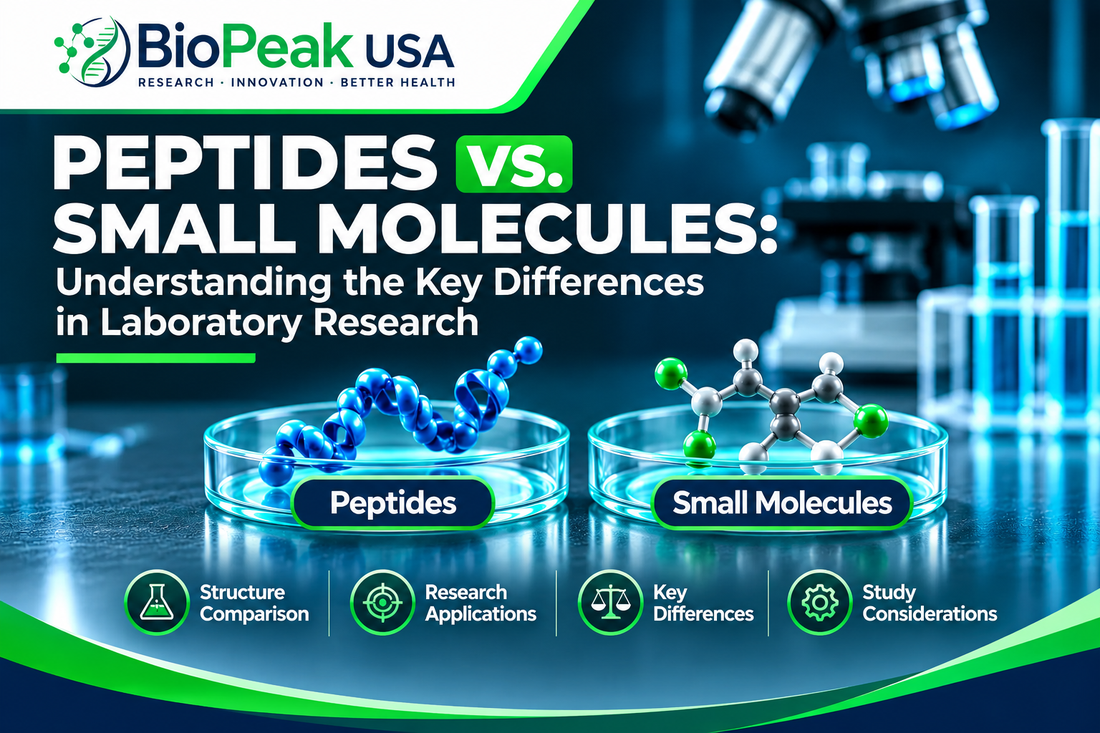
Peptides vs. Small Molecules in Laboratory Research
Choosing between peptides vs. small molecules is one of the first decisions an in vitro study requires. Researchers often make that choice before the target is fully defined. The two classes differ in size, structure, synthesis route, binding behavior and analytical verification. Therefore, treating them as interchangeable can lead to assay troubleshooting that careful planning would have prevented. This guide explains those differences in practical terms. It summarizes general patterns rather than the properties of any single compound. For the broader catalog, see our Research Peptides and Synthetic Reference Compounds guide.
Quick answer: what is the core difference between peptides and small molecules?
Peptides are chains of amino acids linked by peptide bonds, so they are usually larger and more structurally flexible. Small molecules are compact organic compounds with a fixed, well-defined structure and generally lower molecular weight. As a result, the two classes differ in how they are synthesized, verified and bound to a biological target.
Written by
BioPeak USA Team
Topic:
Structural, synthetic, analytical and binding differences in peptides vs. small molecules for laboratory research.
Updated:
November 3, 2026
Editorial note:
This educational guide compares general compound classes. Individual compounds vary, so check compound-specific literature and the documentation for each lot.
Structural Differences: Chains vs. Compact Molecules
The most direct way to understand peptides vs. small molecules is to examine their architecture. A peptide is a chain of amino acids joined by peptide bonds, the same linkage that forms proteins. Peptides are generally described as chains of roughly 50 or fewer residues, and longer chains are usually classed as proteins. Because the backbone can rotate and fold, a peptide can adopt several shapes in solution, including helical or extended segments.
A small molecule is built differently. It is a discrete organic compound, and the chemist joins its atoms in a fixed arrangement, which makes it typically more rigid. Its three-dimensional shape depends largely on its covalent structure and on any stereocenters it contains. For that reason, a small molecule usually has one well-defined structure, so characterization is more direct.
Molecular Weight and What It Signals
Molecular weight is one of the quickest ways to separate the two categories in practice. Small molecules are commonly described as compounds below roughly 900 daltons, although the exact boundary varies by convention. Peptides often exceed that range once a chain reaches several amino acids, and larger peptides can reach several thousand daltons. Therefore, comparing actual molecular masses gives a clearer answer than relying on a category label. When you compare peptides vs. small molecules on mass alone, check the calculated value against the lot's documented mass.
Molecular weight also has practical consequences. Analysts use it to interpret mass spectrometry data, and researchers use it to choose concentration ranges for an assay. It also determines how much material each experiment requires. For a peptide-specific walkthrough, see our guide to how peptide molecular weight is calculated.
Synthesis: Why Peptides and Small Molecules Are Made Differently
Manufacturing is another point of divergence. Most peptides are produced by solid-phase peptide synthesis, where chemists add amino acids one at a time to a chain anchored to an insoluble resin. The same stepwise cycle applies regardless of sequence. Longer sequences, however, accumulate more incomplete couplings, which lowers yield and affects purity.
Small molecules have no common synthesis route. Each compound requires a pathway suited to its structure, and those pathways can range from a few steps to many. Consequently, synthesis complexity for small molecules depends on the target structure, whereas peptide synthesis complexity depends mainly on sequence length and residue composition.
See How Peptide Synthesis Actually Works
Understand the step-by-step process behind the peptides in the catalog.
Our guide walks through resin anchoring, the deprotection and coupling cycle, cleavage and purification.
Receptor Binding and Target Interaction
Peptides and small molecules engage targets differently because of their size. A peptide can contact a receptor across a broader surface, which allows high specificity for receptors that naturally recognize peptide ligands. Small molecules usually bind into smaller, more defined pockets. This makes them easier to optimize for particular structural fits, and it can also limit their selectivity between closely related targets.
Neither class is inherently better. The right choice depends on the target's native ligand and the question the study is designed to answer. For a broader introduction, see our article on receptor ligands in bench-level studies.
Stability and Handling Differences
Stability behavior also differs. Peptides contain amide bonds and side chains that are sensitive to hydrolysis, oxidation and aggregation, especially in solution. For this reason, many peptides are supplied as lyophilized powder. To understand how freeze-drying protects these molecules, read our guide to what lyophilized research compounds are. Small molecules vary widely. Some remain stable in solid form, and others degrade readily. Therefore, handling conditions should come from each compound's documentation rather than from its class.
Solubility follows a similar pattern. Peptides often need specific buffers or pH ranges, and hydrophobic sequences may require organic co-solvents. Small molecules can dissolve in a wide range of solvents or in very few, depending entirely on their functional groups.
Analytical Verification: How Each Class Is Checked
Verification is where the two classes look most different on a Certificate of Analysis. For peptides, the usual combination is reversed-phase HPLC for purity and mass spectrometry for molecular mass. Together, these methods confirm that the main component matches the expected sequence mass. Small molecules are often verified with HPLC and mass spectrometry too. Analysts also apply nuclear magnetic resonance spectroscopy, which resolves structural detail that mass data alone cannot.
No single method settles identity and purity for either class. A purity percentage describes the sample under stated conditions, and a mass match does not prove purity. Therefore, read the method, the lot number and the test date together before relying on any figure.
Compare Documentation Before You Choose
Match the compound class to your protocol, then check the lot-specific records.
Review how BioPeak USA reports identity, purity and lot data on its Certificates of Analysis before you commit to a material.
Choosing Between Them for a Given Study
When deciding between peptides vs. small molecules for a specific study, a few questions narrow the choice quickly. Start with the target, then move to the protocol and the verification records.
- What does the target naturally bind? If the receptor's native ligand is a peptide, a peptide reference compound may reproduce the interaction more faithfully.
- What solubility and buffer conditions can the protocol tolerate? Peptides often need specific pH or co-solvent conditions, so check this before committing to a sequence.
- Does the assay need a rigid, single-structure ligand or a flexible, multi-contact one? The answer points toward one class or the other.
- Which verification data will you require? Confirm that the supplier can provide lot-specific purity and identity records for the chosen class.
Writing these answers down before ordering makes the choice easier to justify in a methods section later.
Where This Comparison Has Limits
The peptides vs. small molecules distinction is a useful framework, but it remains a generalization. Some short peptides fall near the small-molecule weight range. Certain small molecules are structurally complex enough to behave more like larger compounds. Cyclic peptides, peptidomimetics and modified residues also blur the boundaries. Evaluate each compound on its own documented properties. All materials discussed here are for laboratory research only and are not intended for human or veterinary use.
Frequently Asked Questions
1. What is the main difference between peptides vs. small molecules?
Peptides are amino acid chains with flexible structure, while small molecules are discrete organic compounds with a fixed structure and generally lower molecular weight.
2. Are peptides always larger than small molecules?
Usually, by molecular weight, but the boundary is not absolute. Some short peptides approach the small-molecule range, so compare actual molecular masses rather than assuming.
3. Why does synthesis differ between peptides vs. small molecules?
Peptides are commonly built by repeating one standard cycle of amino acid additions on a solid resin. Small molecules have no common route and need a pathway designed for each structure.
4. Do peptides and small molecules bind targets the same way?
Not usually. Peptides can contact a receptor across a broader surface, and small molecules tend to fit into smaller, defined pockets. Individual targets can behave differently.
5. Which is easier to store?
Neither class is easier by default. Many peptides are supplied as lyophilized powder for stability, and small-molecule stability varies widely by structure. Follow each product's documented storage conditions.
6. What analytical methods confirm identity for each class?
Mass spectrometry is common for both. Small molecules are often also characterized by nuclear magnetic resonance spectroscopy, and peptides rely on mass data and, where needed, sequence-level analysis.
7. Is molecular weight alone enough to classify a compound?
No. Molecular weight is a useful first screen, but structure, sequence and functional groups also determine how a compound behaves in the lab.
8. Is one class more specific than the other?
Specificity depends on the target and the molecule, not the class alone. Peptides can be highly selective for peptide-recognizing receptors, and small molecules can be optimized for selectivity within their own design constraints.
9. Can a peptide be replaced by a small molecule in an assay?
Sometimes, but the substitution changes the binding interface and may change results. Validate any replacement against the original ligand before comparing data.
10. How do I know which class my compound belongs to?
Check the chemical name, molecular formula and molecular mass on the product documentation. Names built from amino acid sequences indicate peptides, and systematic organic nomenclature usually indicates a small molecule.
Conclusion
Peptides vs. small molecules is a foundational distinction in laboratory research. Structure, molecular weight, synthesis route, binding behavior, stability and verification all differ between the two classes, and each difference affects assay design. Therefore, matching the compound class to the target and protocol, rather than choosing by habit, improves the reliability of the data. Finally, verify each compound's documented identity and purity, because category-level patterns describe tendencies, not guarantees.
Research use only. Not for human or veterinary use.
Ready to Choose Your Research Materials?
Start with the compound class your target requires, then confirm the lot.
Browse the BioPeak USA research-use-only catalog and review the stated intended use and documentation for each product before you order.
Next: How Solid-Phase Peptide Synthesis Works
See how peptides are built one amino acid at a time.
Continue the series to follow the resin, coupling and cleavage steps behind research peptides.