
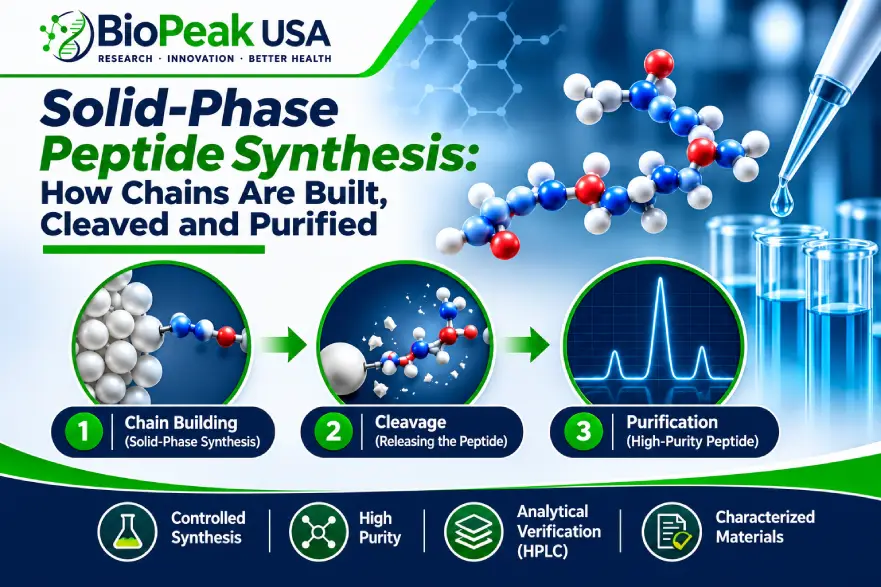
Peptide Synthesis Methods: How Solid-Phase Chains Are Built, Cleaved and Purified
Peptide synthesis methods determine how a research peptide is built, and solid-phase synthesis is the most widely used approach. Chemists anchor the first amino acid to an insoluble resin. Then they add each following residue in a repeating cycle. Because excess reagents wash away after every step, the growing chain stays in place while impurities leave. Therefore, this guide walks through each stage in plain terms, from resin loading to cleavage and purification. It describes general practice rather than the protocol for any single product. For the broader catalog, see our Research Peptides and Synthetic Reference Compounds guide.
Quick answer: how do peptide synthesis methods build a chain?
Solid-phase synthesis attaches the first amino acid to a resin. Then it repeats two steps for each residue: removing the temporary protecting group, and coupling the next protected amino acid. Finally, the completed peptide is cleaved from the resin and purified.
Written by
BioPeak USA Team
Topic:
Step-by-step mechanics of peptide synthesis methods, from resin anchoring to cleavage and purification.
Updated:
November 4, 2026
Editorial note:
This educational guide explains general synthesis practice. Specific protocols vary by sequence, scale and supplier.
Solid-Phase Synthesis: The Core Idea
Among peptide synthesis methods, solid-phase peptide synthesis (SPPS) is the most common approach for research-scale work. Instead of building a chain in solution, where each intermediate must be isolated, SPPS anchors the growing peptide to an insoluble resin bead. Excess reagents and byproducts can then be washed away after each step. As a result, the chain itself stays attached throughout.
The sequence is built from the C-terminus toward the N-terminus, one amino acid per cycle. Each cycle repeats the same pair of reactions on the same resin-bound chain. In addition, the process remains identical in structure no matter how long the target sequence is.
Step One: Anchoring to the Resin
The process begins when chemists attach the first amino acid, through its carboxyl end, to a solid resin support. A cleavable linker usually connects the two. Consequently, the resin acts as a physical anchor for the entire synthesis. That anchor is what separates SPPS from older solution-phase methods.
Step Two: The Deprotection and Coupling Cycle
Amino acids carry reactive side chains and amine groups. Chemists protect these groups temporarily, so they do not react in the wrong place during assembly. Most modern peptide synthesis methods use Fmoc (fluorenylmethyloxycarbonyl) protection on the amino terminus. Meanwhile, each side chain carries its own protection, which is removed later.
Each cycle follows the same two steps:
| Step | What happens | Why it is needed |
|---|---|---|
| Deprotection | The temporary group on the chain's free amine is removed. | It exposes the reactive site for the next residue. |
| Coupling | A protected amino acid, activated by a coupling reagent, bonds to the exposed site. | It extends the chain by exactly one residue. |
The cycle repeats once for every residue. Therefore, a 20-residue peptide needs about 20 complete cycles, and each cycle's efficiency compounds across the full run.
Step Three: Cleavage and Side-Chain Deprotection
When the full sequence is assembled, a strong acid treatment typically cleaves the peptide from its support. Moreover, that same treatment usually removes the remaining side-chain protecting groups. The result is a free peptide in solution. However, it remains in crude form, mixed with byproducts, deletion sequences and reagent residues.
Why Purification Follows Synthesis
The crude product is never the final material. Even efficient peptide synthesis methods produce truncated sequences, because some coupling steps do not complete. Consequently, preparative HPLC separates the intended sequence from these byproducts. Our guide to peptide purity levels explained covers how the resulting purity figure is measured and reported.
See How Purity Is Measured After Synthesis
Synthesis produces a crude mixture, and purification sets the final purity figure.
Read our breakdown of what 95%, 98% and 99%+ purity mean for research peptides.
How Sequence Length Affects Yield
Peptide synthesis methods repeat a cycle dozens of times, so a small inefficiency per cycle compounds across the whole chain. For example, if each coupling step is 99% efficient, a 10-residue peptide keeps roughly 90% of its theoretical correct-sequence yield. By contrast, a 30-residue peptide drops closer to 74%, before purification begins. Therefore, longer peptides usually cost more and reach somewhat lower maximum purity.
Certain sequences, including those that form secondary structure or contain long hydrophobic stretches, can also be harder to synthesize cleanly. This is true regardless of length. Thus, sequence design matters as much as residue count.
Frequently Asked Questions
1. What are peptide synthesis methods?
Peptide synthesis methods are the chemical procedures used to link amino acids into a defined sequence. Solid-phase synthesis is the most common approach for research peptides.
2. What is solid-phase peptide synthesis?
It is a method in which the growing chain stays anchored to an insoluble resin, so excess reagents can be washed away between steps.
3. Why is Fmoc chemistry widely used?
Fmoc protecting groups can be removed under mild basic conditions, which keeps sensitive amino acid side chains intact during each cycle.
4. Does synthesis produce a pure peptide directly?
No. Synthesis yields a crude mixture that contains the target sequence along with byproducts, so purification is a separate step.
5. Why are longer peptides harder to produce?
Each cycle has a small inefficiency that compounds across many residues. Therefore, the theoretical yield falls as sequence length grows.
6. What happens during cleavage?
Strong acid releases the assembled peptide from the resin and usually removes the remaining side-chain protecting groups.
7. Is solid-phase synthesis used for every peptide length?
It is the standard approach across most research peptide lengths. However, achievable purity and cost depend on sequence complexity.
8. What is a coupling reagent?
A coupling reagent activates the incoming amino acid so it can form a peptide bond with the free amine on the growing chain.
9. What is a truncated sequence?
A truncated sequence is a chain that stopped growing early because a coupling step did not complete. It is one of the main impurities removed during purification.
10. How can I check the synthesis result for a specific lot?
Review the lot-specific Certificate of Analysis, which reports the purity method and identity data for that batch rather than for the product in general.
Conclusion
Peptide synthesis methods build research peptides through a repeating cycle of deprotection, coupling, cleavage and purification. Solid-phase synthesis made this process practical because it keeps the growing chain anchored to a resin. Sequence length strongly influences yield and purity. Therefore, the documented results for each lot matter more than general assumptions about the method. Always check the lot-specific records before relying on a material.
Research use only. Not for human or veterinary use.
Next: Peptide Purity Levels Explained
Learn what 95%, 98% and 99%+ purity figures actually measure.
Continue the series to see how purity is calculated from the chromatogram and what each tier contains.