
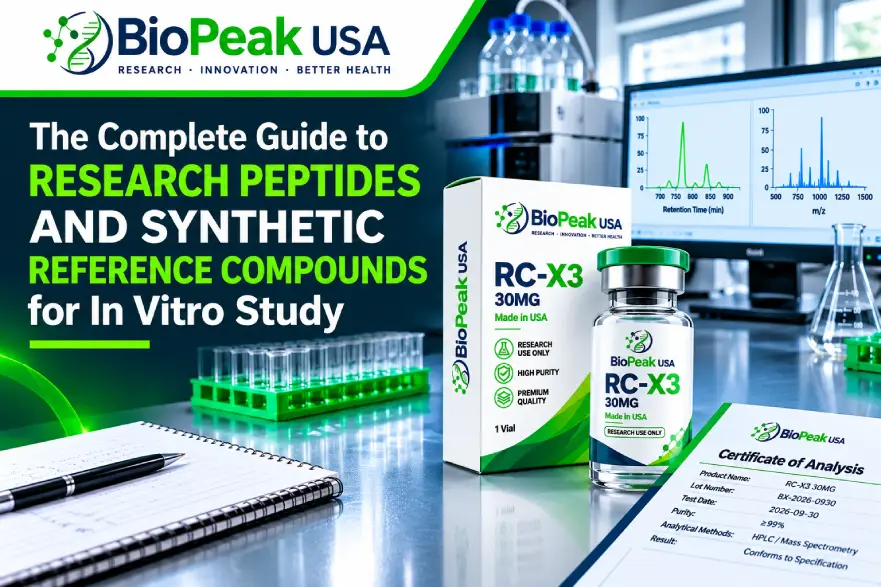
Verifying Research Peptides and Synthetic Reference Compounds
A vial labeled "99% pure" still leaves a researcher with questions. What does that figure cover, which method produced it, and does it describe the lot in front of you? For in vitro work, those answers matter more than the product name. Research peptides and synthetic reference compounds give dependable results only when their identity, purity and lot records have been verified. This guide focuses on that verification step: what to request from a supplier, how to read it, and what to check before a lot reaches your bench. For the broader catalog and production overview, start with our Research Peptides & Compounds guide.
Quick answer: what should you confirm before ordering?
Check the stated identity, the purity method and its result, a COA that matches your exact lot number, the storage instructions, and a clear research-use-only statement. No single measurement proves every quality attribute.
Written by
BioPeak USA Team
Topic:
Verifying research peptides and synthetic reference compounds, identity, purity, lot records and COAs.
Updated:
November 2, 2026
Editorial note:
This educational guide explains how to evaluate research-material documentation. Assess analytical claims against the method, batch-specific records and relevant scientific literature.
Why Verification Comes Before Every In Vitro Study
In vitro work takes place outside a living organism. Cell-free systems, such as binding assays built on purified protein, and cell-based systems, such as cultured cells, let investigators isolate variables and repeat measurements. That approach is powerful, but it depends on the reliability of every input.
Verification is the step that ties a result to a specific material. If a readout changes unexpectedly, a verified lot lets you rule out the reagent and focus on the biology or the method. Without that record, the same unexpected result could come from a different batch, a lower purity than assumed or a misidentified compound. This is why experienced labs treat verification as part of the experiment itself.
Research Use Only: What the Label Covers
Research Use Only (RUO) is a labeling category. It signals that a product is meant for laboratory investigation, not for administration to people or animals, and not for diagnosing, treating or preventing disease. The label describes intended use. It does not mean an independent reviewer has assessed the product for safety or effectiveness in humans.
Because RUO materials have no human safety assessment, misuse carries its own hazards, from contamination to dosing errors. Our peptide risks guide explains those concerns in more detail, so you can handle these materials with the right precautions.
Suppliers that describe their products through identity, purity and lot records are following the purpose of the RUO label. A product page that promises therapeutic benefit from a research material is a warning sign about the seller, and it tells you nothing reliable about the product.
Identity, Purity and Lot: Three Different Questions
Verification answers three separate questions, and a supplier can answer one well while leaving the others open.
Identity asks whether the material is the molecule the label names. For a peptide, that means the amino acid sequence and the molecular mass. Identity is the foundation, because a purity figure means nothing if the main component is not the intended compound.
Purity asks how much of the sample is that molecule under stated analytical conditions. The answer depends on the method, the column, the detection wavelength and the integration rules. Two purity figures are comparable only when those details match.
Lot asks whether the record describes the vial you received. A correct identity and a high purity from an earlier batch do not guarantee the same results for your current lot. The lot number is what connects the data to your material.
Testing Methods: HPLC and Mass Spectrometry
Two analytical techniques do most of the verification work, and each answers a different question.
High-performance liquid chromatography (HPLC) separates the components of a sample as they travel through a column and records each one as a peak. The result shows how much of the sample is the intended material under defined conditions. Our peptide purity guide explains how to read these traces.
Mass spectrometry (MS) sorts ions by their mass-to-charge ratio, which lets an analyst compare the observed mass of the main component with the expected value. In liquid chromatography-mass spectrometry (LC-MS), a separation step feeds directly into mass detection.
Neither technique settles the question alone. HPLC cannot confirm identity, and mass data cannot quantify purity. Sterility and endotoxin require separate testing, and a standard HPLC and MS run will not reveal them.
| Method | What it supports | What it cannot establish alone |
|---|---|---|
| HPLC | Purity under stated conditions, plus the number and relative size of components | Molecular identity or full sequence confirmation |
| Mass spectrometry | Whether the observed mass matches the expected molecular species | Purity, or every structural detail |
| Lot-specific COA | Documented results tied to one named batch | Any attribute the lab did not test |
| Combined methods | Complementary evidence for identity and purity together | Every possible property of the material |
What "HPLC Verified" and "Verified Purity" Should Mean
These phrases are only as strong as the data behind them. A purity figure should come with its chromatogram, the method and conditions, and the lot it describes. A claim of "mass spectrometry tested" should show an observed mass beside the expected one. When a supplier provides those records, the claim can be checked. When it offers only the phrase, treat it as marketing until the evidence appears.
Check the Data Behind the Claim
Compare the chromatogram and mass data with the exact lot you plan to order.
BioPeak USA publishes its analytical records, so you can review them before you commit to a batch.
How to Read a Certificate of Analysis
A Certificate of Analysis (COA) connects a laboratory result to a specific material. Read it in this order, and stop if any field does not match your order.
- Product name and identifiers, matching the item you ordered.
- Lot or batch number, matching the label on your vial or packing slip.
- Test date, showing when the analysis was run relative to your order.
- Method, including the HPLC conditions or mass spectrometry approach.
- Result and calculation, showing how the purity figure was derived.
- Observed versus expected mass, wherever mass spectrometry was reported.
A COA covers only what was tested, on the lot it names. A certificate for a different batch, or a single generic document reused across many products, says nothing reliable about the material you hold. Match the report to your lot before you order, and do not rely on a general page of results.
A Pre-Order Verification Checklist
Use this sequence before you place an order. It takes only a few minutes and prevents most documentation problems. If you are still comparing sources, our guide to buying peptides online covers the wider sourcing decision.
- Request the COA for the exact lot. Ask for it by lot number, not a general sheet for the product.
- Confirm the identity fields. The name, sequence or molecular formula should match across the product page and the COA.
- Read the purity method. Note the technique, the conditions and the reported result.
- Check the test date. Confirm that the analysis was performed on the lot you are buying.
- Ask for raw data if the summary is thin. A chromatogram and mass spectrum are stronger evidence than a single percentage.
- Confirm the RUO statement and storage instructions. Both should appear with the product.
- Record the lot number in your files. Link it to every experiment that uses the material.
If a report is incomplete or does not match your lot, contact the BioPeak USA team and ask for the lot-specific documentation before you order.
Match Documentation to Your Study
Choose materials whose records cover the exact lots you will use.
Browse the BioPeak USA research-use-only catalog and review the stated intended use and documentation for each product.
GMP, ISO and Other Quality Claims
Many suppliers list GMP, ISO or quality assurance credentials. These terms are legitimate, but each covers a different scope, and they are easy to overread.
GMP (Good Manufacturing Practice) is a manufacturing standard developed mainly for pharmaceutical products. A claim of GMP-compliant manufacturing should identify the standard, the facility or process it covers, and the date of the most recent assessment. Many research materials are not made under GMP, so verify the claim rather than assume it.
ISO certification also varies. ISO 9001 covers an organization's quality management system. An ISO-certified laboratory usually means accreditation under ISO/IEC 17025, which relates to technical competence for specific tests. Ask for the certificate, confirm that its scope includes the work you need, and check its issue date.
Quality assurance also depends on habit. Reliable suppliers keep records by lot, document their methods and share those records on request.
Storage Records That Protect Verification
Verification does not end when the lot arrives. Lyophilized research peptides and synthetic reference compounds are generally more stable than solutions, which is why most ship as freeze-dried powder. Storage needs still vary by sequence and compound, so the product-specific instructions always take priority.
As a general practice, keep lyophilized material cold, dry and shielded from light. Let the vial warm to room temperature before opening so that condensation does not form inside it. Avoid repeated freeze-thaw cycles after reconstitution. Record the solvent, date and lot number alongside each preparation, so that every result still links back to the verified material weeks or months later.
Where Verification Stops
No supplier record removes every limit. A verified identity does not predict how a compound will behave in a particular assay. Purity values depend on the method used, so two figures are comparable only when their methods match. Cell models simplify living systems, and results from cultured cells may not carry over to a whole organism. A COA from an earlier batch says nothing about a later one.
Research peptides and synthetic reference compounds are not approved for human or veterinary use, and researchers must follow the laws and institutional rules that govern their work. For compound-specific literature, search PubMed and check molecular records in PubChem before relying on a supplier's summary.
Frequently Asked Questions
1. What are research peptides and synthetic reference compounds used for?
They support laboratory work such as assay development, analytical method development, calibration and in vitro studies. They are for research use only.
2. Does an "HPLC verified" label prove that a peptide is pure?
Only when the supplier provides the chromatogram, the method and conditions, and a COA for the same lot. HPLC purity applies to the conditions used.
3. Is GMP manufacturing required for research materials?
Not generally. GMP mainly targets pharmaceutical products. If a supplier claims GMP compliance, ask which standard applies and what it covers.
4. Can research-use-only materials be used for human or veterinary purposes?
No. They are not intended for human or veterinary administration, diagnosis, treatment or disease prevention.
5. How should lyophilized research materials be stored?
Follow the product instructions. As a general practice, store them cold, dry and away from light, warm the vial before opening, and avoid repeated freeze-thaw cycles after reconstitution.
6. What is a Certificate of Analysis for a research material?
A COA reports the tested attributes of a specific lot. Check the product name, lot number, test date, method and results, and confirm that the report describes the material you received.
7. Does an HPLC purity result prove identity?
No. HPLC shows purity under stated conditions. Identity needs supporting evidence, usually a mass spectrometry result that matches the expected molecular mass.
8. Why does the lot number on a COA matter so much?
The lot number links analytical results to one production batch. Results for a different lot, or a report with no lot number, do not describe the material in your vial.
9. What should I do if the COA does not match my lot?
Do not use the material until the supplier provides documentation for your exact lot. Ask for the correct report in writing and keep both the vial label and the correspondence in your records.
10. Does a US-made label guarantee quality?
No. Origin can help with logistics and communication, but lot-matched analytical documentation is what shows quality. An imported material with complete records can be stronger evidence than a domestic one without them.
11. What is the difference between research-grade and pharmaceutical-grade materials?
Research-grade materials are made and labeled for laboratory use. Pharmaceutical products follow separate regulatory and manufacturing frameworks, and the two categories are not interchangeable.
12. How can I judge whether a supplier's documentation is trustworthy?
Look for lot-specific reports, named methods and conditions, visible raw data on request, a clear research-use-only statement, and a willingness to answer technical questions. Vague answers or reused certificates are warning signs.
Conclusion
Research peptides and synthetic reference compounds support reproducible in vitro work only when their identity, purity and lot documentation can be verified. HPLC, mass spectrometry, a COA that matches the lot in hand and clear RUO labeling each answer a different question, and none replaces the others. Treat GMP and ISO claims as facts to verify rather than assurances to accept. Researchers who read the records carefully, follow a consistent pre-order checklist and log every lot produce more dependable results.
Research use only. Not for human or veterinary use.
Confirm the Lot Before You Build Your Study
Verify identity, purity and lot records before the materials reach your bench.
Assemble a research-use-only kit for a planned series of experiments, with documentation matched to each lot.