Peptide Purity Testing Using HPLC and Mass Spectrometry
Most people glance at the purity number on a peptide CoA, see something in the high 90s, and move on. Fair enough. But that number has a backstory, and it’s worth knowing.
It came from a specific instrument running a specific method on one particular batch. Run the same material on a different column, or tweak the gradient a little, and the result can land a percent or two away. The peptide didn’t change. The way it was measured did.
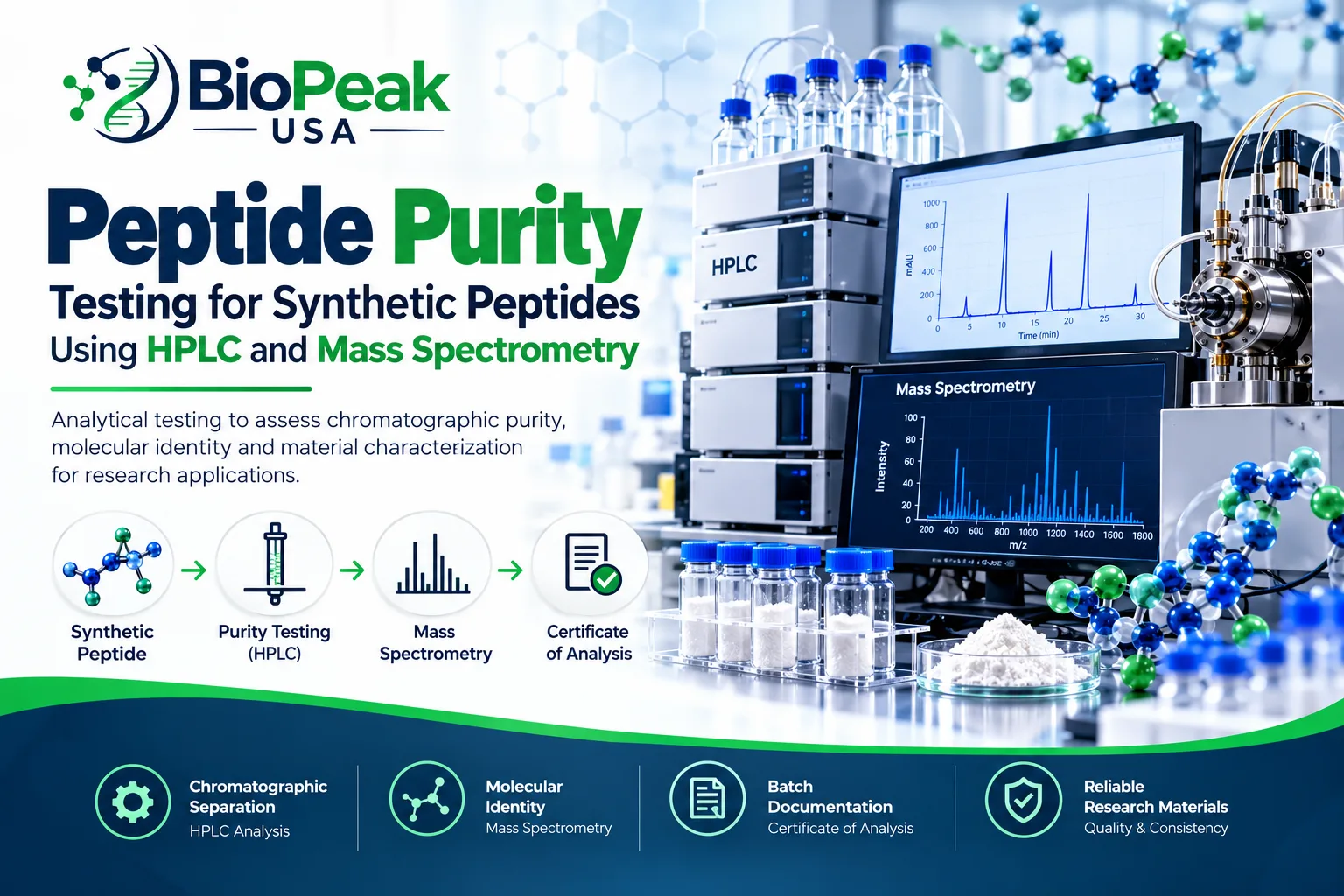
In peptide work, two techniques carry most of the load here. HPLC tells you how clean a sample looks. Mass spectrometry tells you whether you’re even looking at the right molecule. You really want both, and the rest of this page explains why.
Peptide purity evaluates the chromatographic composition of a material under a defined method. Molecular identity, analytical conditions, batch information, and supporting documentation provide additional context.
What Is Peptide Purity?
Think of it as a share of the pie. Run the sample through HPLC, and everything the detector picks up shows as a peak. Add up all the peak areas. Whatever slice belongs to your target peptide is the purity.
So far, so easy.
Where it gets messy is everything that feeds into that calculation. Which wavelength was the detector set to? What column? How steep was the gradient? Even the integration settings (basically, where the software decides one peak stops and the next one starts) can move the final figure. That’s why two good labs can test the same lot and come back with slightly different numbers. Neither one is wrong.
The takeaway: a purity value only means something alongside the conditions it was measured under.
How HPLC Evaluates Peptide Purity
The basic idea behind HPLC is old and pretty intuitive. You push a liquid sample through a column packed with tiny particles. Molecules that like the packing get held up. Molecules that don’t, pass through faster. They come out the other end at different times, and a detector notes each one as it goes by.
Peptides are almost always run in reverse-phase mode, usually on a C18 column. The packing is hydrophobic. You start with a mostly watery mobile phase (with a bit of TFA in it, typically) and slowly add more acetonitrile over the run. As the solvent gets more organic, peptides let go of the column one at a time. The greasier ones stick around longest.
Most labs watch the signal somewhere around 214–220 nm, where peptide bonds absorb light. Nearly every peptide-related species shows up in that range, which is convenient.
What you get out of all this is a solid measure of how clean the sample is. What you don’t get is any proof that the main peak is the sequence you wanted. Keep that in mind; we’ll come back to it.
Why reverse-phase, specifically?
Because it’s sensitive to small differences, and peptide impurities are usually small differences. Drop a single residue from a chain and its hydrophobicity shifts just enough to move its retention time. An oxidized methionine tends to show up as a little peak right before the main one. Reverse-phase catches a lot of these near-identical species that other methods would blur together.
What an HPLC Chromatogram Shows
If you’ve never stared at one: it’s a line that runs flat along the bottom and spikes up whenever something comes off the column. A good sample gives you one tall, skinny peak and not much else.
When we look at a chromatogram, the main peak’s shape gets checked first. Is it sharp and symmetrical? Good. A shoulder on one side, or a long smeared tail, usually means something else is hiding in there.
Then look at the small peaks nearby. They’re often the most closely related impurities, the hardest ones to get rid of. And if two peaks are squashed together instead of cleanly separated, the software may count them as one, which makes the sample look cleaner than it is.
One more thing people forget. HPLC only sees what the detector can see. A compound that doesn’t absorb at the chosen wavelength simply won’t appear. Neither will something that never makes it off the column. A quiet baseline is encouraging, but it isn’t proof of absence.
How Mass Spectrometry Supports Peptide Purity Analysis
Mass spec answers a much blunter question: how heavy is this thing?
The instrument turns molecules into ions (for peptides, electrospray ionization is the usual route) and measures their mass-to-charge ratio. From that you can work back to the molecular weight and check it against what the sequence says it should be.
A match is good news. A miss can be informative too. Sixteen daltons heavy than expected? Possibly oxidation. Short by the weight of one amino acid? Likely a deletion. It’s a bit like detective work.
This is exactly the gap HPLC can’t fill by itself. And in many labs, the two are hooked together as LC-MS, so each peak gets weighed right as it comes off the column. Hard to get a more direct link between a peak and what it actually is.
HPLC and mass spectrometry provide different types of analytical evidence. HPLC supports chromatographic purity assessment, while mass spectrometry can provide molecular-weight information relevant to peptide identity.
Common Impurities That Can Affect Peptide Purity
Making a peptide is a long chain of chemical steps. Each residue is added one at a time on a solid resin. Then the finished chain is cut free, purified, freeze-dried, packed and stored. Any of those stages can introduce something unwanted.
Incomplete or Deletion Sequences
Coupling steps aren’t perfect. If one of them only goes 99% of the way, a small fraction of chains skip that residue and keep growing without it. Over a long sequence, those small misses add up. The resulting peptides are almost identical to the target, which is exactly why they’re so annoying to purify out.
Modified Peptide Species
Certain amino acids are just more prone to trouble. Methionine oxidizes without much encouragement. Asparagine can deamidate. Sometimes a protecting group hangs on through cleavage when it should’ve come off. Any of these shows up as an extra peak and drags the purity down.
Process-Related Components
Salts (TFA counter-ions especially), residual solvent, moisture. HPLC with UV detection won’t catch most of this. It’s also why “purity” and “net peptide content” are different numbers, and shouldn’t be confused.
Peptide Purity vs Peptide Identity
These get used interchangeably all the time. They really shouldn’t be:
- Purity: how clean is it?
- Identity: is it the right peptide?
Picture a synthesis that went wrong early but cleanly, producing the wrong sequence at very high purity. HPLC would show you a gorgeous single peak. You’d have no idea anything was off. Unlikely? Sure. But that one scenario is the whole argument for checking mass whenever identity matters to your work.
Peptide purity does not replace molecular identity analysis. Chromatographic and mass-based measurements provide different forms of analytical evidence.
Peptide Purity in Peptide Library Research
Libraries make everything above harder, simply because of scale. Instead of one sequence you’ve got dozens, sometimes hundreds, and they won’t all come out of synthesis equally well. Some sequences are just difficult.
Logging purity and mass data per sequence feels tedious at the time. It pays off later, when you’re trying to work out whether a screening hit is real or just a byproduct of a messy prep.
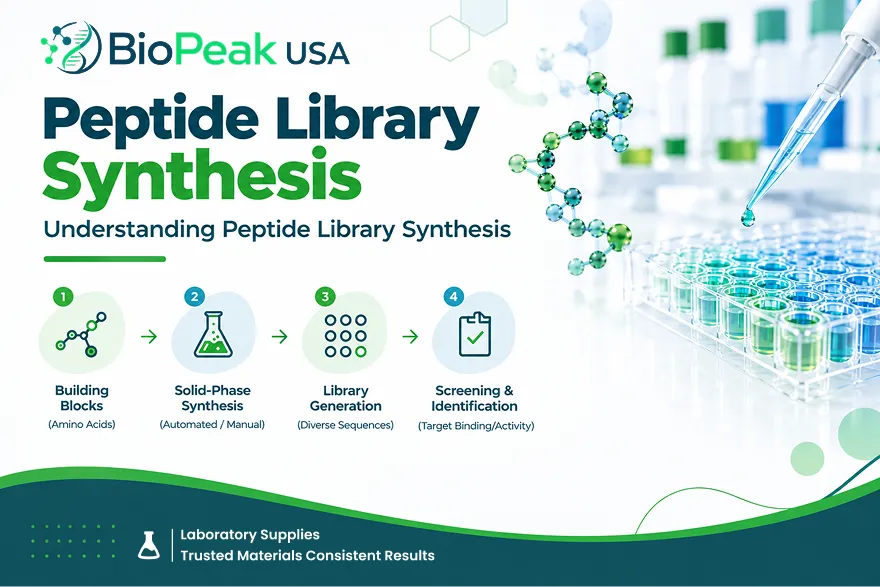
Library design, synthesis and screening get their own page: Peptide Library Synthesis. Here we’re sticking to purity and how it’s documented.
How to Interpret Peptide Purity Data
There’s no single rule, but a few questions help:
- Review the Analytical Method: Was it HPLC-UV? What wavelength, which column, what gradient? If the paperwork doesn’t say, the number is harder to put in context, and harder to compare with anything else.
- Review Molecular Identity Information: Is there mass data? Does the observed mass actually match the expected one?
- Check Batch or Lot Information: Check the lot number. Then check it again against the vial. A great result for a different batch tells you nothing about the one you’re holding.
- Consider the Analytical Context: Be careful comparing numbers across sources. A 97% from one lab and a 98% from another might reflect different methods, not different material.
Peptide Purity and Certificates of Analysis
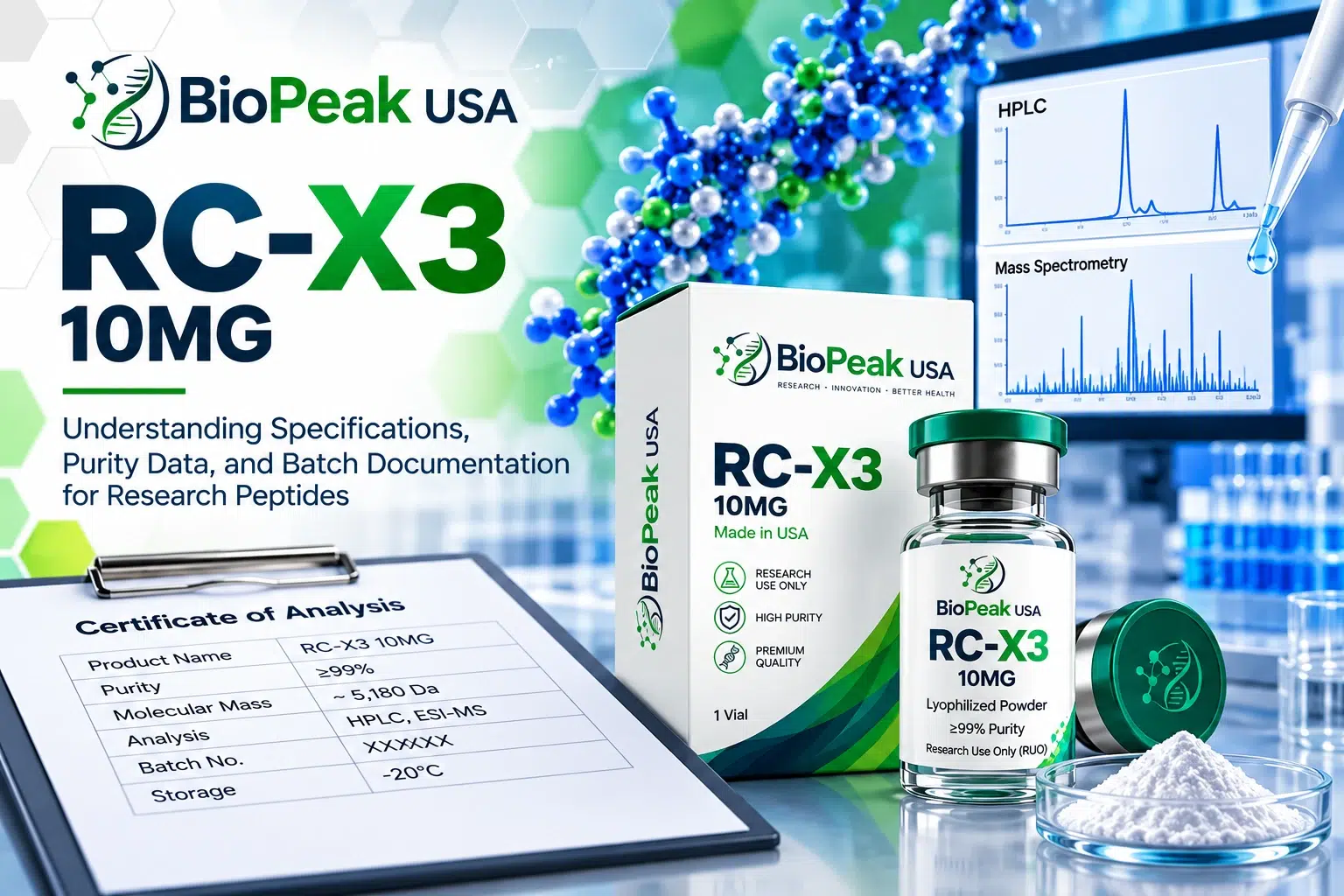
The CoA is the document that connects test results to a specific lot. What’s on it varies by product, but you’ll usually find purity, identity data, the method used, and the specs the material was tested against.
Honestly, the most useful habit here is a boring one. Match the lot number on the CoA to the label on your vial before you do anything else. It takes ten seconds, and it’s surprisingly easy to skip.
A batch-specific Certificate of Analysis can connect peptide purity information with the material and lot evaluated in a research workflow.
Peptide Purity and Research Reproducibility
When an experiment won’t repeat, the starting material is usually one of the first suspects. Clearing it is far easier if, back when the material arrived, someone wrote down the lot number, the purity and mass results, and how they were obtained.
It’s not glamorous record-keeping. But it can save days of troubleshooting.
You can read more about how we document our materials at BioPeak USA Scientific Research Materials.
Peptide Purity Testing at BioPeak USA
BioPeak USA supplies synthetic research materials to qualified laboratories for in-vitro research. Selected materials are characterized by HPLC and mass spectrometry. What gets reported depends on the product and its batch documentation.
Product-specific details and available documentation are on the BioPeak USA Research Products page.
All BioPeak USA materials are sold strictly for research use. They’re intended for controlled in-vitro laboratory work only and are not for human or veterinary use.
Frequently Asked Questions
So what does “peptide purity” really mean?
It’s the portion of detected signal that comes from the target peptide, measured under a particular method. Different method, possibly a slightly different number.
How are synthetic peptides usually tested?
Mostly reverse-phase HPLC with a UV detector. Mass spec is commonly added to check the molecular weight.
What does a chromatogram actually tell me?
How dominant the main peak is compared with everything else the detector picked up. It doesn’t tell you what that main peak is.
Can HPLC confirm I’ve got the right peptide?
No, not on its own. Identity is a job for mass spectrometry.
Then why bother with both?
They answer different questions. One shows how clean the sample is; the other confirms it’s the correct molecule. Skipping either one leaves a blind spot.
Why does the CoA matter so much?
It ties the test results to a specific lot. If the lot number doesn’t match your vial, the data isn’t really about your material.
Does 98% purity mean 98% of the powder is peptide?
Not quite. Purity doesn’t account for water, salts, or anything the detector can’t see. That’s a separate measurement (net peptide content).
Conclusion
Treat a purity number as a starting point, not a verdict. HPLC tells you how clean a sample looks under one set of conditions. Mass spec tells you whether the main peak is what it should be. Read the two together, make sure the CoA lot matches your vial, and keep a note of what you used. Do that, and a single percentage actually becomes useful.
Next up: Peptide Library Synthesis, or browse Scientific Research Materials.
References and Scientific Resources
The following resources provide additional scientific and research context for peptide chemistry, analytical characterization, and scientific measurement standards:
| Reference | Type | Relevance |
|---|---|---|
| Peptide Library Synthesis | BioPeak USA | Library design, synthesis and screening workflows. |
| Scientific Research Materials | BioPeak USA | How our research materials are documented. |
| PubChem | Scientific Database | Structures and molecular data. |
| PubMed | Scientific Literature | Published work on peptides and analytical methods. |
| NIST | Scientific Standards | Measurement science and reference standards. |
| IUPAC | Scientific Organization | Nomenclature and terminology. |
Research-use information should be interpreted according to the specific analytical method, material, batch documentation, and laboratory requirements.