Explore techniques for altering peptide structure, from terminal modification and PEG conjugation to non-canonical amino acid substitution, and how they're characterized in laboratory research.
What Is Peptide Modification and Why Does It Matter?
Peptide modification means changing a peptide’s structure beyond its basic amino acid sequence. Researchers make this change either during synthesis or afterward, through a targeted chemical reaction.
Why bother? Usually it comes down to a few goals: better stability, better solubility, easier detection, or simply understanding how one specific structural feature affects behavior in an experimental model.
This guide walks through the main modification categories used in lab research: terminal changes, conjugation techniques like PEG conjugation, and substitution with non-canonical or unnatural amino acids. We’ll also cover how researchers confirm a modification actually worked.
All materials discussed here are intended for Research Use Only (RUO) in controlled laboratory settings.
Key Takeaways
Peptide modification changes a peptide’s structure beyond its base sequence, applied during synthesis or afterward.
Terminal modification (N-terminus, C-terminus) improves stability by altering the chemically reactive ends of the chain.
Conjugation techniques like PEG conjugation and glycosylation attach additional molecules to change solubility, stability, or detectability.
Substituting non-standard residues at a specific position isolates the effect of a single structural feature on function.
Mass spectrometry confirms identity by mass shift, and HPLC confirms purity; both are standard for verifying any modification.
Peptide modification: a structural change to a peptide beyond its base amino acid sequence
When introduced
During synthesis or applied afterward through a targeted reaction
Common terminal techniques
N-terminal acetylation, C-terminal amidation
Common conjugation techniques
PEG conjugation, glycosylation, labeling
Common substitution approach
Non-canonical or unnatural amino acids
Analytical confirmation
Mass spectrometry, HPLC
Research classification
Research Use Only (RUO)
What Is Peptide Modification?
At its core, peptide modification is any deliberate structural change made to a peptide beyond its basic sequence. That change can happen in two ways.
The first is building it in during synthesis, where a modified residue gets incorporated at a specific spot in the sequence as the peptide is being built. The second is applying it afterward, through a chemical reaction performed once the peptide is already finished and off the synthesizer.
Tailored peptides, greater possibilities in structural peptide research.
A peptide’s behavior in an experimental model is closely tied to its structure. That’s why even a small, targeted change can shift how the molecule performs in measurable ways.
Think stability under storage, solubility in a given buffer, how it interacts with a target, or how easy it is to detect with a particular analytical method. Small tweak, real consequences.
Terminal Modification: N-Terminus and C-Terminus
Every peptide chain has two ends that are chemically different from each other: the N-terminus and the C-terminus. They exist because peptide bond formation links residues together in one direction during synthesis.
Terminal modification changes one of these ends. Because the termini sit at the edge of the molecule rather than buried inside it, changes there tend to affect stability and interactions with other molecules without disturbing the internal sequence.
C-terminal amidation is probably the most common terminal change. It swaps the terminal carboxylic acid group for an amide group, which neutralizes the negative charge normally carried at the C-terminus at physiological pH.
That swap also makes the structure a poorer substrate for carboxypeptidases, enzymes that specifically target a free terminal carboxyl group. This is part of why amidation shows up so often in research-grade peptide design. N-terminal changes, like acetylation, do something similar at the opposite end of the chain.
Conjugation and Derivatization
Conjugation is the second major category of peptide modification. It involves attaching an additional molecule to a peptide to change its physical or chemical properties in a targeted way.
PEGylation is one of the most widely used conjugation approaches. It attaches a polyethylene glycol (PEG) chain to a peptide, which generally improves solubility and extends how long the material stays stable in solution.
A PEGylated peptide’s altered size and surface chemistry can also change how it behaves in downstream analytical workflows. That’s worth keeping in mind when designing a characterization plan.
N-linked glycosylation is a different conjugation approach. It attaches carbohydrate structures to a peptide at specific asparagine residues in the sequence, a modification that occurs naturally in many biological proteins.
Researchers studying this kind of carbohydrate attachment often synthesize defined glycopeptides. The goal is usually to see how a specific sugar structure affects folding, stability, or recognition by other molecules.
Labeling is another common form of derivatization. It attaches a detectable tag to a peptide, which supports downstream imaging or tracking techniques in a laboratory model.
Amino Acid Substitution
Amino acid substitution takes a different approach than the modifications above. Instead of chemically altering an existing residue in place, it swaps a standard residue for a non-canonical or unnatural amino acid at a specific position in the sequence.
These are building blocks that fall outside the twenty standard residues typically found in natural proteins. Swapping one in lets researchers isolate the effect of a single structural feature, since it probes exactly how that one side chain contributes to structure or function.
Substituted building blocks also come in handy for two other purposes. They can introduce a chemical handle for later conjugation, or improve resistance to enzymatic breakdown by replacing a residue at what would otherwise be a common cleavage point.
Smarter modifications, greater possibilities in peptide research.
Confirming a Modification Analytically
Claiming a structural change happened isn’t enough. Any modification needs analytical confirmation before the resulting material enters an experimental workflow.
Mass spectrometry is the primary tool for this job. A successful modification produces a predictable shift in molecular mass compared to the unmodified peptide, so researchers compare the observed mass against the theoretical mass calculated for the intended sequence.
HPLC purity testing matters just as much, for modified peptides as much as for standard ones. An incomplete reaction can leave a mixture of modified and unmodified material sitting in the same sample.
This is where the reagents used for peptide synthesis, and the underlying solid-phase synthesis process, matter directly. Coupling efficiency and reaction completeness during synthesis determine how much cleanup purification actually has to do afterward.
Batch-specific analytical documentation can help researchers assess materials before putting them to work in a laboratory setting.
Frequently Asked Questions
What is peptide modification?
It’s a deliberate structural change made to a peptide beyond its base sequence. Researchers introduce it either during synthesis or afterward, through a targeted chemical reaction.
What is the difference between N-terminal and C-terminal modification?
These target the two chemically distinct ends of a peptide chain. C-terminal amidation, for example, replaces the terminal carboxylic acid with an amide group to improve stability.
What is PEGylation?
PEGylation is a conjugation technique that attaches a polyethylene glycol chain to a peptide. It generally improves solubility and extends stability in solution.
Why would a researcher use non-canonical amino acids?
They let researchers probe how a specific side chain affects structure or function. They’re also useful for improving resistance to enzymatic breakdown at a specific position.
How is a modification confirmed analytically?
Mass spectrometry confirms the expected mass shift tied to a successful change. HPLC purity testing then distinguishes fully modified material from any unmodified peptide left in the sample.
Why does N-terminal acetylation improve peptide stability?
It caps the free amine group at the start of the chain, removing a positive charge that would otherwise sit there at physiological pH. That makes the terminus a poorer target for aminopeptidases, the enzymes that chew through residues from a free N-terminus.
It’s a big part of why acetylation is such a common first move for extending a peptide’s usable stability window in research.
Does PEGylation change how a peptide shows up in mass spectrometry?
Yes, it does. Adding a PEG chain brings significant extra mass, and it can also broaden the observed peak compared to an unmodified peptide.
That’s because commercial PEG reagents are usually a distribution of chain lengths, not one single exact mass. So instead of checking against a single theoretical value, researchers compare the observed mass range against the expected range for that specific PEG reagent.
Can more than one modification be applied to the same peptide?
Yes, and it’s actually pretty common in research design. A peptide might carry a terminal modification like C-terminal amidation alongside a conjugated label or a substituted non-canonical residue somewhere internal.
Each modification targets a different part of the structure, and the effects are generally designed to work independently of one another.
How does glycosylation differ from PEGylation in practice?
Both fall under conjugation, but they’re not interchangeable. Glycosylation attaches a defined carbohydrate structure at a specific asparagine residue, closely mirroring something that happens naturally in many proteins.
PEGylation, on the other hand, attaches a synthetic polymer chain with no natural counterpart. Researchers typically study glycosylation for its role in folding and molecular recognition, while PEGylation gets used mainly for solubility and solution stability.
What determines where a labeling tag gets attached on a peptide?
It usually comes down to the research question. A label at the N-terminus or C-terminus tends to leave the internal sequence undisturbed, which is handy when the internal residues are what’s actually being studied.
A label introduced at an internal position, through a substituted residue, lets researchers track a specific site directly instead, as long as the substitution doesn’t interfere with the feature being studied.
Why might an incomplete reaction still pass a basic mass spectrometry check?
A mass spectrometry result can confirm a correctly modified species is present in the sample. What it can’t tell you is what proportion of the total material that species actually represents.
That’s exactly why HPLC purity testing runs alongside mass spectrometry. HPLC separates modified from unmodified peptide based on retention behavior, giving a quantitative purity figure that a mass spectrum alone just doesn’t provide.
What factors affect how long a modified peptide stays stable once prepared?
A few things matter here: the type of modification, storage temperature, buffer composition, and how many freeze-thaw cycles the sample goes through.
Terminal modifications and PEGylation are generally chosen specifically because they extend stability compared to an unmodified peptide. Still, documented storage conditions and batch-specific analytical data remain the most reliable way to judge a given material’s expected handling window.
Is peptide modification approached the same way across all research applications?
Not really. The right modification strategy depends on the specific research question, whether that’s extending solution stability, enabling detection through labeling, or isolating what one residue contributes to function.
There’s no single universal approach here. That’s exactly why researchers typically consult synthesis providers to match a modification strategy to their experimental design.
Who should handle peptide modification materials?
Handling should be limited to qualified laboratory personnel working within an institutional research setting, following applicable laboratory procedures and regulatory requirements.
All materials referenced in this guide are classified Research Use Only (RUO). They are not intended for human or veterinary use, clinical administration, or therapeutic application.
Conclusion
Peptide modification covers a lot of ground: terminal changes at the N-terminus and C-terminus, conjugation techniques like PEG conjugation and carbohydrate attachment, and substitution with non-canonical or unnatural amino acids.
Each approach offers a targeted way to adjust stability, solubility, or function. But whichever one is used, mass spectrometry and HPLC remain the standard tools for confirming a change actually took place before the material enters a lab workflow.
Table of References
Resource
Publisher
Use in This Article
Link
PubChem
NCBI / NIH
Chemical and structural information relevant to modified amino acids and peptides.
Explore the Molecular Science category for related laboratory research materials.
Research Only
All materials referenced in this article are discussed strictly in the context of laboratory and scientific research and are classified as Research Use Only (RUO). They are non-medicinal research materials and are not intended for human or veterinary use, clinical administration, or therapeutic application. Handling should be limited to qualified laboratory personnel working according to applicable institutional policies, laboratory procedures, and regulatory requirements.
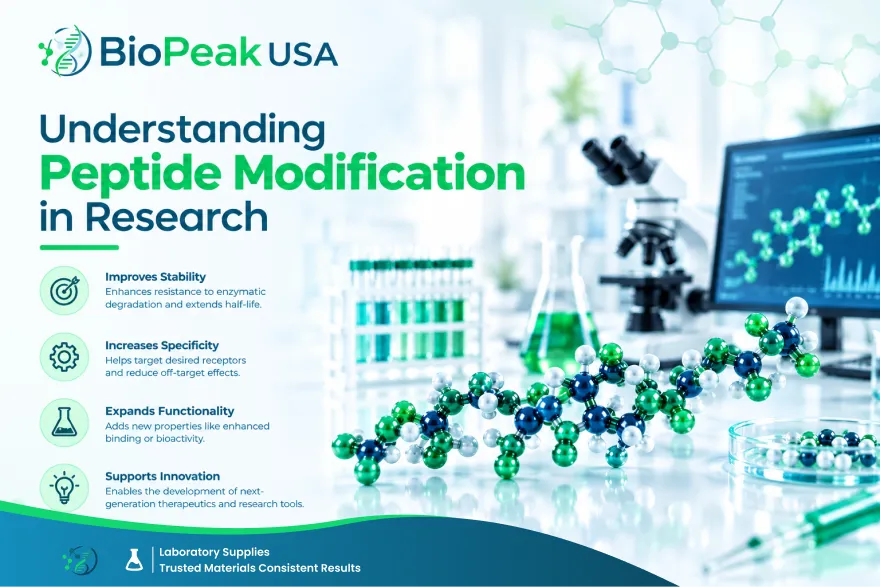
 Tailored peptides, greater possibilities in structural peptide research.
 Smarter modifications, greater possibilities in peptide research.