A Guide to Research Grade Peptides and Molecular Research
Explore how research-grade peptides are studied through sequence, structure, molecular interactions, cellular signaling, analytical testing, and batch traceability.
How Research Grade Peptides Work
Research-grade peptides consist of a short chain of amino acids that can be studied in the laboratory to gain information on various aspects including structure, interactions, and activities at the molecular level. Understanding the attributes of these peptides can assist researchers in multiple ways including designing and interpreting experiments correctly.
Of multiple factors that define the characteristics of peptides, the amino acid sequence and molecular weight are key elements. Peptides can interact with receptors, enzymes, and other molecular entities, and the nature of these interactions can differ based on the definition factors of the peptides. Therefore, understanding the factors defining a peptide can assist in predicting and interpreting outcomes of the interactions of the peptide with biological entities.
Other than defining factors and interactions of peptides, it is essential to characterize them for various attributes including purity and identity. Each batch of peptides is assigned and documented a COA for traceability.
This article provides basic information on various aspects of research-grade peptides. The aspects include definition and interactions of peptides at the molecular level, cellular signaling and receptor binding, as well as the role of documentation in defining and assisting molecular research. All the aspects described in this article are limited to a laboratory research context.
The mechanisms of research grade peptides are closely connected to molecular sequence, structural characteristics, and interactions within a defined experimental system. Researchers can use analytical data and scientific literature to establish a clearer relationship between material identity and observed laboratory results.
Receptor binding, enzyme interaction, molecular recognition, and cellular signaling.
Identity verification
Mass spectrometry can compare observed molecular mass with the expected molecular mass.
Purity verification
HPLC can provide chromatographic information about the analyzed material.
Key interaction parameters
Binding affinity, selectivity, agonism, antagonism, and assay-specific response measurements.
Documentation standard
Batch-specific documentation such as a Certificate of Analysis supports material traceability.
Research context
Research Use Only (RUO) and controlled laboratory research.
What Is a Research Grade Peptide?
A research grade peptide is a peptide that is studied to examine how it interacts with biological systems. Understanding the structure and function of peptides assists scientists to address several fundamental questions in science. Often, characterization of new peptides is complicated because of variations in peptide structure. Factors including sequence, size and shape, and molecular weight of peptides affect characterization.
The term research grade is used to describe the context of the science and the analysis provided to support a evaluation of the material for a research use. Information to be included in the description may include, but is not limited to, physical and chemical analysis of the material. Researchers should evaluate the supporting information for the material to be used in their research.
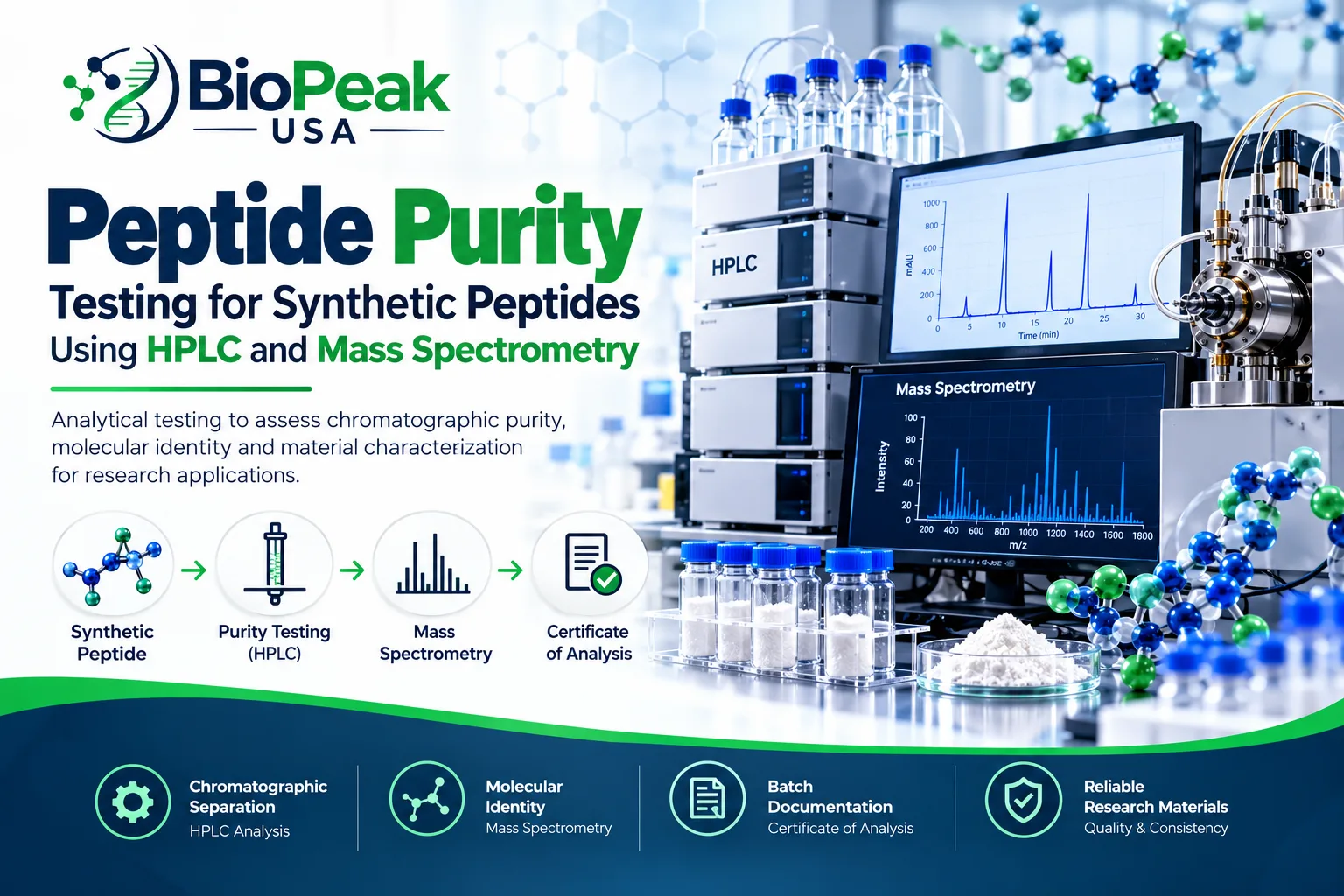
Defining molecular weight and identity of peptides can be achieved by mass spectrometry. Purity of peptides can be assessed by HPLC. Researchers can use these analytical methods to obtain supporting information to justify the use of research peptides in their studies.
Sequence and batch information and analytical results included with the supporting documents, assist researchers to define molecular material to be used in scientific research materials.
Research Grade Peptides and Molecular Research Materials
Research grade peptides form part of a broader category of molecular research materials used in biochemical and cellular investigations. Their scientific value comes from the ability to examine defined molecular structures and their interactions under controlled experimental conditions.
The relationship between sequence and molecular behavior is particularly important. Changes in amino acid composition or sequence can influence characteristics such as molecular structure, charge, polarity, stability, and interactions with other molecules.
For researchers working with molecular materials, analytical documentation provides an additional layer of traceability. Recording material identity, batch information, analytical results, and experimental conditions can make it easier to interpret results and reproduce laboratory studies.
The Sequence Structure Function Relationship
The amino acid chain of research grade peptides determines their molecular behavior. Peptide bonds connect amino acids to form a chain which then fold into complex three-dimensional structures. These amino acid chains play a large role in the functions and activities of cells, and organs.
Peptide behavior is determined by more than just the peptide sequence. The folding of the peptide backbone and the presentation of surfaces can impact the interaction of peptides with other molecules. Interaction observation is dependent on the conditions of the experiment. pH, temperature, and the type and quantity of ions and solvents are all conditions that can impact experiment outcomes.
Sequence Determines Molecular Characteristics
The amino acid sequence of a peptide provides the framework for exploring its molecular properties. Understanding a peptide’s amino acid sequence can help predict molecular characteristics and physical characteristics (e.g. charge, polarity, hydrophobicity, and morphology).
PubChem provides public databases of chemical compounds and may help identify a peptide of interest. Structural information may also be available in the public domain. The U.S. National Library of Medicine’s PubMed provides access to scientific literature and may help researchers identify previously reported molecular interactions.
Structure Influences Molecular Interactions
Molecular structure determines how different regions of a peptide are presented within an experimental environment. When a peptide interacts with a receptor, enzyme, or another molecular target, the spatial arrangement of relevant molecular features can influence that interaction.
This makes sequence and structure important considerations when researchers investigate research grade peptides. Controlled laboratory conditions allow investigators to examine how molecular characteristics correspond with specific experimental observations.
Receptor Binding as a Mechanistic Pathway
Receptor binding is one of the major mechanisms investigated in peptide research. A receptor is a molecular structure capable of interacting with a specific ligand or molecular signal. When a research grade peptide interacts with a receptor, researchers can examine the characteristics of that interaction and any measurable response within the defined experimental model.
Binding Affinity
Binding affinity describes the strength of an interaction between a molecule and its molecular target. One commonly used parameter is the dissociation constant, or Kd. Under the conditions used to determine the value, Kd can help researchers characterize the relative strength of a molecular interaction.
Binding measurements should always be interpreted within the specific assay conditions under which they were generated. Temperature, buffer composition, receptor preparation, assay format, and other variables can influence measured interaction characteristics.
Receptor Selectivity
Receptor selectivity describes the degree to which a peptide interacts with one molecular target relative to other possible targets. Selectivity can be important when researchers investigate related receptors or molecular structures with overlapping characteristics.
Mechanistic studies may therefore examine multiple molecular targets to determine whether an observed interaction is associated with a specific receptor or represents broader activity within the tested experimental system.
Agonism and Antagonism
Agonist and antagonist describe different types of receptor-related activity. An agonist can activate a receptor-mediated response, whereas an antagonist can interfere with receptor-mediated activity within a defined experimental system.
These terms describe experimental molecular relationships and should be interpreted according to the receptor system, assay design, experimental conditions, and scientific literature associated with the study.
Mechanistic interpretation begins with understanding what material is being studied. Mass spectrometry can provide information relevant to molecular identity, while HPLC can provide chromatographic purity information. When analytical results are associated with a defined production batch, researchers have additional information for documenting the material used during a laboratory study.
A batch-specific Certificate of Analysis can connect analytical information with the material supplied for research. This documentation can be particularly useful when researchers compare results between experiments or investigate differences observed between material batches.
Enzyme Interaction Mechanisms
Enzymes represent another important area of mechanistic research. Depending on its molecular characteristics, a research grade peptide may be investigated as a substrate, inhibitor, activator, or other interaction partner within a biochemical assay.
Peptide Enzyme Interactions in Biochemical Research
Peptide-enzyme studies permit the investigation of the interaction of a specific amino acid sequence with a particular enzyme. These studies may shed light on whether a peptide is recognized by an enzyme, influences an enzymatic reaction, or takes part in other enzymatic or biochemical reactions.
Such studies may include variations in the amounts of enzyme and substrate, different buffer systems, various temperatures, and the use of different controls and observation times. It is essential that the conditions of the experiment remain constant in order that the scientist may clearly identify the molecular interactions of the system being studied.
Kinetic Analysis
Enzyme kinetics provides a quantitative framework for examining reaction behavior. Depending on the study design, researchers may measure reaction rates across different concentrations and use those measurements to characterize parameters such as Km, Vmax, or inhibition constants.
Comparing kinetic measurements requires consistent experimental conditions. Changes in enzyme concentration, substrate concentration, temperature, buffer composition, or peptide concentration can influence the resulting measurements and should therefore be documented carefully.
Stability During Enzyme Assays
Peptide degradation is another concern with enzyme assays. Peptides are susceptible to degradation by a number of mechanisms including aggregation, adsorption, and chemical reaction. Degradation can occur even in high quality research peptides. Any degradation of the peptide will alter the assay results.
Analytical testing can help researchers examine material characteristics before or after defined experimental procedures. HPLC may provide chromatographic information, while mass spectrometry can help investigate molecular mass when appropriate analytical methods are available.
Cell Signaling and Migration Mechanisms
Cellular research provides another environment in which peptide mechanisms can be investigated. Researchers may examine how defined molecular interactions relate to measurable cellular responses within controlled in vitro models.
Cellular Models and Controlled Conditions
Cell-based experiments can involve carefully defined cell populations, culture conditions, exposure parameters, measurement methods, and controls. These variables should be documented because cellular observations can change when experimental conditions differ.
Researchers investigating cellular mechanisms can explore BioPeak USA’s Cellular Science materials as part of a broader laboratory research workflow.
Measuring Cellular Responses
Different cellular assays can measure different aspects of a biological response. Depending on the research question, investigators may examine cellular migration, proliferation, differentiation markers, morphology, signaling activity, or interactions with the extracellular environment.
For migration studies, researchers may measure variables such as migration distance, migration rate, cell distribution, or directional movement. The selected measurement method should correspond with the research question and remain consistent across experimental groups.
Batch Consistency and Cellular Research
Batch consistency can become important when cellular experiments are repeated over time. When researchers use different batches of research grade peptides, differences in documented purity, identity, or other material characteristics should be considered when interpreting experimental results.
Batch-specific COA documentation can provide a traceable record of analytical information associated with the material used in a particular experiment. This can support more consistent documentation when researchers compare cellular research results.
Why Mechanistic Documentation Matters for Reproducibility
Reproducibility depends on more than recording a final experimental result. Researchers also need to understand what material was used, how it was characterized, which experimental conditions were applied, and how observations were measured.
Connecting Material Identity With Experimental Results
When a mechanism study uses research grade peptides, material identity and analytical characteristics form part of the experimental record. Recording the material name, sequence information, batch details, analytical results, experimental conditions, and relevant literature creates a clearer connection between the research material and the resulting data.
Connecting Material Identity With Experimental Results
This approach can be useful when researchers repeat an experiment later or when another laboratory attempts to reproduce a similar experimental design.
The Role of a Certificate of Analysis
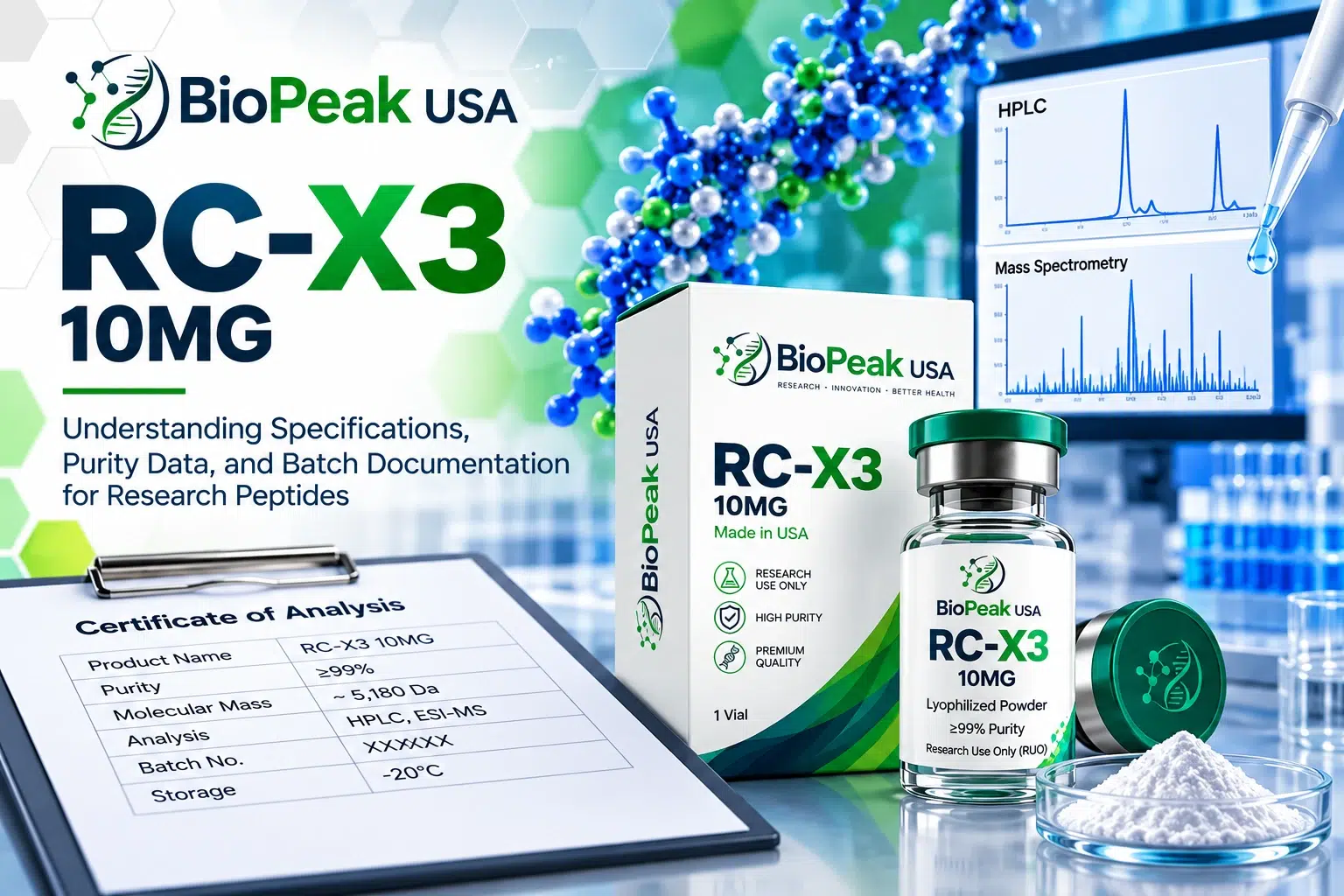
A Certificate of Analysis provides batch-specific information that can help researchers document material characteristics. Depending on the material and analytical methods used, a COA may include information related to identity, purity, batch number, analytical testing, and other quality-related measurements.
Documentation does not replace experimental validation. Instead, it provides researchers with a more complete record of the material and measurement context surrounding a study.
Applying Mechanistic Understanding in the Laboratory
Understanding research grade peptide mechanisms becomes most useful when molecular information is connected with experimental design. Before beginning a mechanism study, researchers can review the molecular target, available literature, analytical documentation, batch information, and suitability of the material for the intended laboratory workflow.
Questions Researchers Should Consider
What molecular interaction is being investigated? Identify whether the study focuses on receptor binding, enzyme interaction, cellular signaling, or another defined molecular process.
What does the scientific literature report? Review relevant peer-reviewed research to understand previously reported molecular interactions and experimental conditions.
What analytical information is available? Determine whether identity, purity, molecular mass, and other relevant characteristics have been documented using appropriate analytical methods.
Can the material be traced to a specific batch? Record the batch number and retain the applicable Certificate of Analysis with the experimental documentation.
Does the material fit the intended laboratory workflow? Confirm that the material’s documented characteristics and research-use classification are appropriate for the planned scientific investigation.
Connecting Material Selection With Research Design
Material selection should be connected to the research question rather than treated as an isolated purchasing decision. Researchers may need different types of molecular materials, reference materials, or laboratory supplies depending on the analytical and experimental methods involved.
Keeping material documentation together with experimental records can make later analysis easier and provide a clearer traceability path from the research material to the reported observation.
Research Grade Peptide Mechanism Checklist
The following checklist provides a practical framework for documenting a research grade peptide mechanism study.
Step
Research Consideration
1
Define the molecular mechanism or interaction being investigated.
2
Review relevant scientific literature and previously reported experimental conditions.
3
Document the peptide sequence and relevant molecular characteristics.
4
Review available mass spectrometry and HPLC analytical information.
5
Record the specific material batch used in the experiment.
6
Retain the corresponding batch-specific Certificate of Analysis.
7
Document assay conditions, controls, concentrations, and measurement methods.
8
Compare experimental observations with appropriate literature and controls.
Frequently Asked Questions
What Determines a Research Grade Peptide’s Mechanism?
A research grade peptide’s mechanism is influenced by its amino acid sequence, molecular structure, binding characteristics, and interactions with receptors, enzymes, or other molecular targets within a defined experimental system.
Is Receptor Binding the Only Mechanism Research Grade Peptides Use?
No. Research grade peptides can be investigated through receptor interactions, enzyme interactions, molecular recognition, cellular signaling, and other biochemical processes depending on the material and experimental model.
How Is a Research Grade Peptide’s Identity Confirmed?
Mass spectrometry can be used to examine molecular mass and support identity assessment. Researchers may also review HPLC data and batch-specific documentation when evaluating a material before a mechanism study.
Why Does Purity Matter When Studying Peptide Mechanisms?
Purity matters because additional detectable components can complicate interpretation of experimental results. Appropriately characterized research materials can help researchers establish a clearer relationship between the intended molecular material and observed findings.
Can Different Batches Show Different Experimental Results?
Researchers should not automatically assume that different batches will produce identical experimental results. Batch characteristics, analytical measurements, experimental conditions, and assay variability should all be considered when comparing findings.
What Is the Difference Between Agonist and Antagonist Mechanisms?
An agonist can activate a receptor-mediated response, while an antagonist can interfere with receptor-mediated activity. These terms describe experimentally observed relationships within specific molecular systems.
Why Is Peptide Stability Relevant to Enzyme Research?
If a peptide changes during an enzyme assay, the resulting measurement may reflect both the original material and changes occurring during the experiment. Stability should therefore be considered when interpreting enzyme interaction data.
How Can Cell Migration Models Help Investigate Peptide Mechanisms?
Cell migration models can provide measurable observations related to cellular movement under defined experimental conditions. Researchers can compare migration-related measurements between controlled groups to investigate molecular mechanisms.
What Documentation Should Accompany Research Grade Peptides?
Useful documentation can include material identity, sequence information, batch number, analytical results, Certificate of Analysis, experimental conditions, relevant literature, and the methods used to measure the research outcome.
Do Research Grade Peptides Interact With Only One Receptor or Pathway?
No. Molecular interactions can vary depending on the peptide, target system, assay conditions, concentration, and other experimental variables. Researchers should investigate selectivity and potential interactions within the specific model being studied.
Conclusion
Research grade peptides are studied through the relationship between molecular sequence, structural characteristics, and interactions within defined experimental systems. Receptor binding, enzyme interaction, and cellular signaling represent important areas through which researchers can investigate peptide mechanisms.
The amino acid sequence provides the molecular foundation, while structural presentation influences how a peptide can interact with other molecules. Analytical characterization helps researchers connect the material being studied with observations generated during laboratory experiments.
For reproducible laboratory research, HPLC-based chromatographic information, mass spectrometry-based identity information, and batch-specific COA documentation can provide useful traceability. Researchers can explore BioPeak USA’s Scientific Research Materials for additional information about molecular research materials.
Table of References
Source
Publisher
Relevance to This Article
Link
PubChem
NCBI / NIH
Provides publicly available chemical, structural, and identity information.
All research grade peptides referenced in this article are discussed strictly in the context of laboratory and scientific research and are classified as Research Use Only (RUO). They are non-medicinal research materials and are not intended for human or veterinary use, clinical administration, or therapeutic application. Handling should be limited to qualified laboratory personnel working according to applicable institutional policies, laboratory procedures, and regulatory requirements.