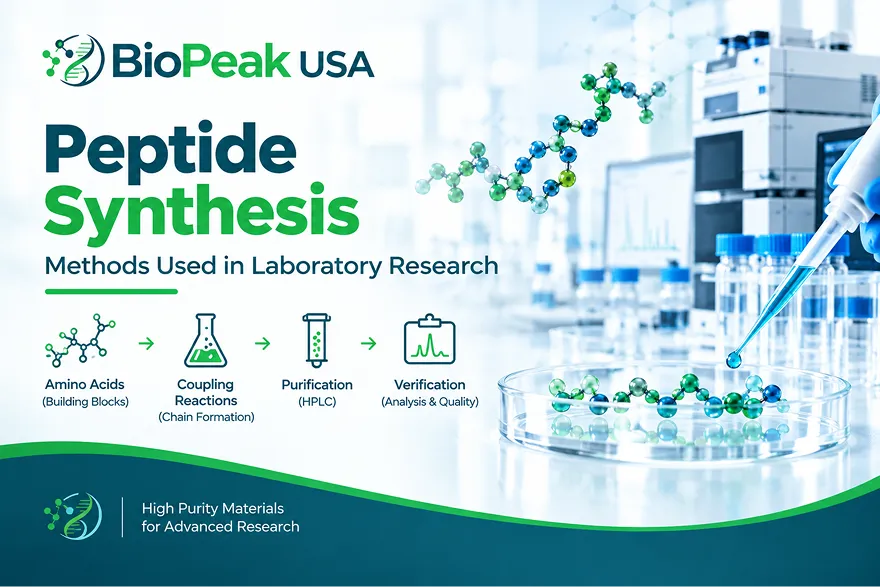
A guide to peptide synthesis, covering solid-phase and solution-phase methods, reagents, purification, characterization, and custom manufacturing for laboratory research.
What Is Peptide Synthesis and Why Does It Matter?
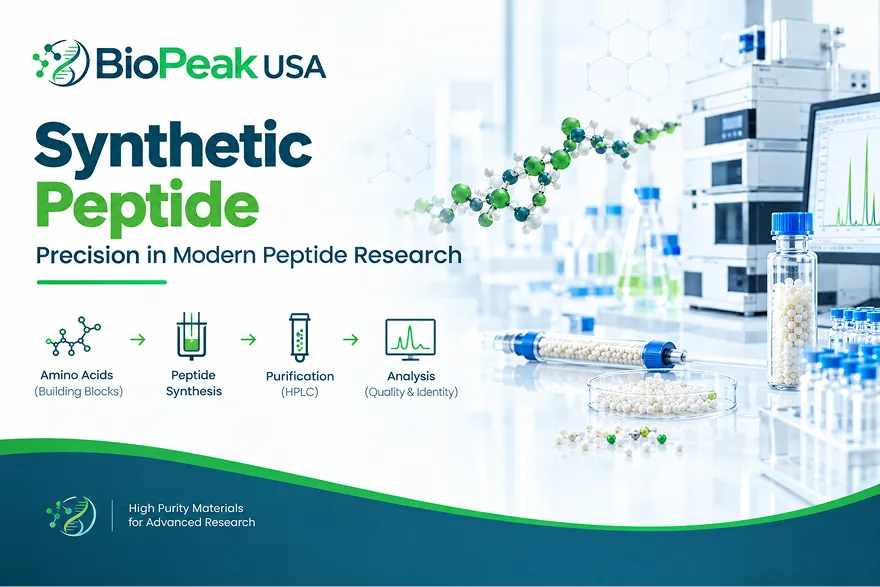
Peptide synthesis is the controlled laboratory process of assembling amino acid residues into a defined sequence to produce a synthetic peptide. Researchers rely on this process across molecular biology, biochemistry, and analytical research, wherever a precisely defined molecular structure is needed. Unlike peptides isolated from biological sources, synthetic peptides can be built to an exact, specified sequence. They can also be verified using analytical methods such as chromatography and mass spectrometry.
Modern synthesis techniques give researchers control over sequence design, chain assembly, purification, and characterization. Depending on the sequence, scale, and research goals, that process may follow a solid-phase or solution-phase approach. This guide walks through the main synthesis methods, the reagents involved, how purified peptides are characterized, what custom manufacturing looks like in practice, and how peptide libraries fit into laboratory research.
The information in this guide is intended for Research Use Only (RUO) in controlled, in-vitro research settings.
Peptide synthesis is the process of joining amino acid residues, one at a time, in a defined sequence to build a peptide. Each amino acid carries reactive functional groups. Controlling those groups at every stage is what allows the intended peptide bond to form at the right point in the chain rather than reacting somewhere it shouldn’t.
Several chemical approaches can carry this out, and solid-phase peptide synthesis remains one of the most widely used. In this method, the growing chain stays anchored to a solid support while amino acids are added one after another. Once the sequence is complete, the finished peptide is cleaved from that support, purified, and characterized — giving researchers a material whose sequence, identity, and analytical profile can all be documented with confidence.
How Peptide Synthesis Works
At its core, peptide synthesis is the repeated formation of peptide bonds between amino acid residues. This is done by extending the chain one residue at a time until the target sequence is complete.
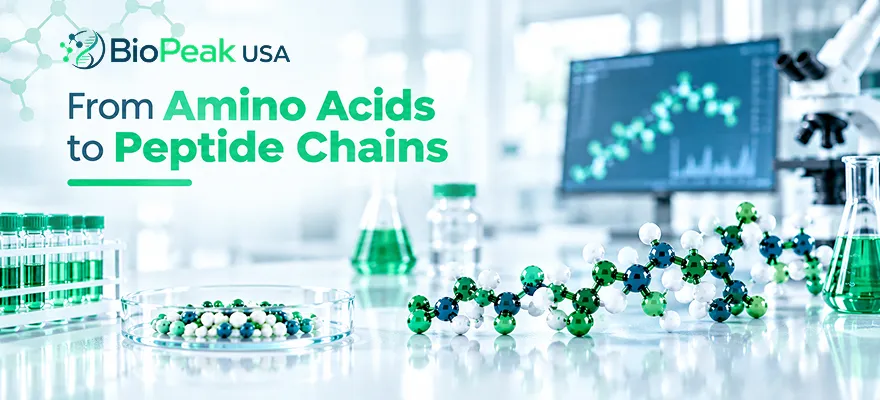
From individual amino acids to a structured peptide chain through peptide synthesis.
The first amino acid is attached to a support or held in solution, depending on the method. Its reactive groups are protected to prevent unwanted side reactions, the next amino acid is introduced and coupled to the chain, and this deprotection-and-coupling cycle repeats until the full sequence has been assembled.
Solid-Phase Peptide Synthesis
Solid-phase peptide synthesis, usually shortened to SPPS, anchors the growing chain to an insoluble resin and builds it up through repeated cycles of deprotection and coupling.
A typical SPPS run starts by attaching the first residue to the resin, then removing a temporary protecting group, coupling the next amino acid, and repeating that cycle until the sequence is finished. The completed peptide is then cleaved from the resin and moved into purification.
Most modern SPPS work uses FMOC-based protection chemistry. This keeps functional groups that shouldn’t react during a given coupling step safely out of the way until it’s their turn. The efficiency of each coupling cycle, how cleanly protecting groups come off, and the conditions used for cleavage all leave a mark on the final analytical profile. That influence only grows as sequences get longer and more structurally complex.
Solution-Phase Peptide Synthesis
Solution-phase synthesis builds peptide bonds without anchoring the chain to a solid support at all — protected amino acids or peptide fragments are coupled together directly in solution.
This approach can work well for certain sequences, peptide fragments, and larger-scale production runs. The trade-off is that isolating and purifying the product between each reaction stage becomes more demanding for long sequences, since there’s no solid support simplifying that separation step.
Which approach makes sense for a given project comes down to sequence length, structural complexity, scale, purification needs, and the analytical specification the final material needs to meet.
Peptide Synthesis Reagents
Amino acids form the basic building blocks of chain extension. However, synthesis also depends on a supporting cast of reagents — chemicals that control reactive functional groups, drive peptide bond formation, strip away protecting groups, and ultimately release the finished peptide from the synthesis system.
Coupling Reagents
Coupling reagents drive peptide bond formation between residues. Which one gets used depends on the synthesis strategy, the specific sequence, reaction conditions, and how much control the researcher needs over the reaction.
Protection and Deprotection Reagents
Protecting groups temporarily mask reactive functional groups so they don’t interfere with the current coupling step. Deprotection reagents selectively strip those groups away so the chain is ready for its next residue.
Cleavage Reagents
Once the chain is fully assembled, cleavage reagents release the finished peptide from its solid support and, depending on the strategy used, remove any protecting groups still left on the molecule.
Capping and Supporting Reagents
Capping reagents help manage incomplete coupling reactions by blocking those partial products from reacting further in later cycles. Solvents and other supporting reagents round out the process, chosen to match both the synthesis chemistry and the analytical standards the final material needs to meet.
Careful reagent selection, paired with tight reaction control, defines a clean synthesis route and keeps unwanted byproducts to a minimum.
Peptide Purification and Characterization
The crude material that comes out of a synthesis run isn’t just the target peptide — it’s usually mixed in with incomplete sequences, reaction byproducts, leftover reagents, and other impurities. Purification is the step that separates one from the other, and it sits squarely between synthesis and analytical characterization.
Peptide Purification
Chromatographic methods separate the target peptide from related compounds in the crude mixture. Reverse-phase chromatography is the go-to method here, since it separates components based on hydrophobicity differences. Depending on how much material needs purifying and how sharp the resolution needs to be, researchers can choose between preparative and analytical HPLC approaches.
HPLC Analysis
High-performance liquid chromatography reveals the chromatographic profile of a synthesized peptide, separating it from related compounds so researchers can assess purity and identify the major components present in a sample. HPLC results typically become part of the analytical documentation tied to a specific research material and its production batch.
Mass Spectrometry
Mass spectrometry adds information about molecular mass, supporting identity confirmation for the synthesized peptide. Paired with chromatographic analysis, it fills in a complementary piece of the material’s overall analytical profile.
Other Analytical Methods
Depending on the peptide and the specific research need, additional methods may come into play. Amino acid analysis, for instance, can offer further insight into the composition — particularly useful when evaluating reference-standard materials.
Taken together, synthesis, purification, and characterization build a documented analytical profile that follows the material through the rest of its use in research.
Peptide Manufacturing and Custom Synthesis
Manufacturing a peptide involves more than just stringing amino acids together. A controlled production workflow spans synthesis planning, raw-material control, chain assembly, cleavage, purification, analytical testing, and documentation — each stage feeding into the next.
Custom synthesis starts with a defined research specification: a required amino acid sequence, a structural feature, or some other requirement the material needs to meet. That specification shapes everything downstream — which synthesis strategy fits, what purification approach makes sense, and what analytical work the final material needs.
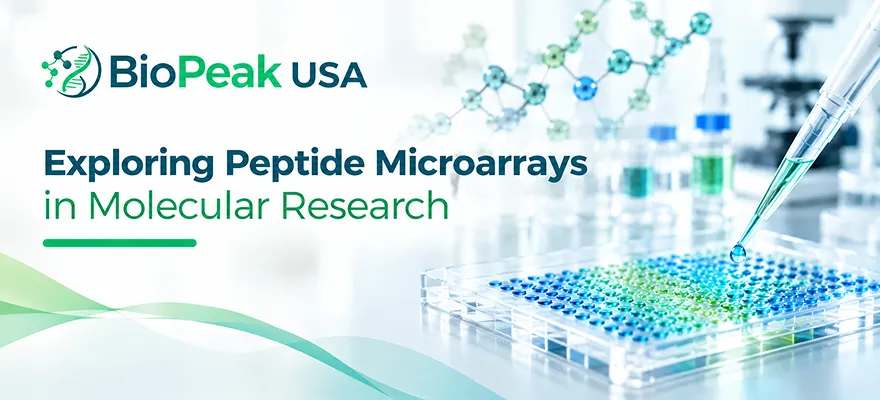
Peptide microarrays provide valuable tools for studying molecular interactions and peptide-based research.
A typical custom workflow moves through sequence definition, synthesis strategy selection, chain assembly, cleavage, purification, characterization, and finally, preparation of analytical documentation that accompanies the finished material.
More complex sequences sometimes call for modified synthesis strategies or extra purification and characterization work. Sequence length, structural features, solubility, and the analytical profile a researcher expects to see can all shift how demanding that process turns out to be.
For research organizations sourcing materials from outside suppliers, batch-specific documentation gives them something concrete to check against the material itself before it enters a workflow.
Peptide Libraries and Special Synthesis
A peptide library is a collection of related sequences built to provide systematic variation within a single research workflow. Instead of studying one sequence in isolation, researchers can work through a whole set of related sequences according to their study design.
These libraries come in handy for screening and molecular recognition research, where differences between sequences are exactly what the experiment is designed to evaluate.
Beyond standard synthesis, other specialized techniques exist too — peptide cyclization, conjugation, labeling, and other structural modifications are among them. Each of these can require adjustments to the underlying synthesis, purification, and characterization strategy.
In other words, the right synthesis method depends on more than just the target sequence — it also depends on the structure and analytical requirements of whatever the finished material needs to be.
Peptide Synthesis in Laboratory Research
Synthetic peptides give researchers something biological sources rarely can: a defined molecular structure that’s been characterized before it enters an experiment. Compared with biological sources’ natural variability, chemically defined materials offer a much more controlled starting point for analytical and experimental work.
Reproducibility, though, comes down to documentation as much as the material itself. A research material should be traceable by its production batch, its analytical results, and records tied to both — so that researchers can always go back and check exactly what was used in a given experiment.
A Certificate of Analysis (CoA) captures batch-specific information: material identity, analytical results, purity data, and storage conditions. These records let laboratories maintain traceability and check a material’s specifications before using it.
BioPeak USA supplies synthetic and biochemical research materials with batch-specific analytical documentation for laboratory and in-vitro research applications.
Frequently Asked Questions
What is peptide synthesis?
Peptide synthesis is the controlled chemical assembly of amino acid residues into a defined peptide sequence. The resulting material is then purified and characterized for laboratory research.
What is solid-phase peptide synthesis?
Solid-phase peptide synthesis anchors the growing peptide chain to an insoluble support and extends it through repeated cycles of amino acid coupling.
What are the main peptide synthesis methods?
The two broad approaches are solid-phase and solution-phase synthesis, with specific variations and hybrid strategies used for particular sequences or research needs.
What reagents are used in peptide synthesis?
Common reagents include protected amino acids, coupling reagents, deprotection reagents, cleavage reagents, capping reagents, solvents, and other supporting chemicals specific to the chosen synthesis strategy.
Why is purification necessary after synthesis?
Crude synthetic material typically contains incomplete sequences, related compounds, and residual reagents alongside the target peptide. Purification separates the intended peptide from these components before characterization.
How is a synthesized peptide characterized?
HPLC evaluates chromatographic purity and separation, while mass spectrometry supports molecular identity and mass confirmation. Other analytical methods may be used depending on the material.
What is custom peptide synthesis?
Custom peptide synthesis is the production of a peptide to a defined research specification, such as a specific amino acid sequence or structural requirement.
Conclusion
Peptide synthesis gives researchers a controlled way to build defined molecular sequences from the ground up. Depending on the sequence and the research at hand, that might mean solid-phase, solution-phase, or a more specialized synthesis strategy, followed by purification and analytical characterization to confirm the result.
The full workflow stretches from synthesis planning and chain assembly through purification, characterization, and batch-specific documentation — with HPLC, mass spectrometry, and other analytical methods anchoring the identity and analytical profile of the final material.
Researchers evaluating synthetic and biochemical research materials can explore BioPeak USA’s Molecular Science category for materials supplied with batch-specific analytical documentation.
Table of References
Resource
Publisher
Use in This Article
Link
PubMed
NLM / NIH
Peer-reviewed literature covering peptide synthesis methods, solid-phase synthesis, purification, and characterization.
All peptide synthesis materials discussed in this article are presented strictly in the context of laboratory and scientific research. The information is intended for Research Use Only (RUO) and controlled in-vitro research settings. These materials are not intended for human or veterinary use, clinical administration, or therapeutic applications. Handling and evaluation should be limited to qualified laboratory personnel following applicable institutional policies, laboratory procedures, and regulatory requirements.